Get Full Government Meeting Transcripts, Videos, & Alerts Forever!
Get email alerts on the Historic Preservation topic
No spam. Unsubscribe anytime.
Planning commission reviews demolition-triggered zoning map amendment for 27 Franklin St., Saint Timothy’s Chapel
Summary
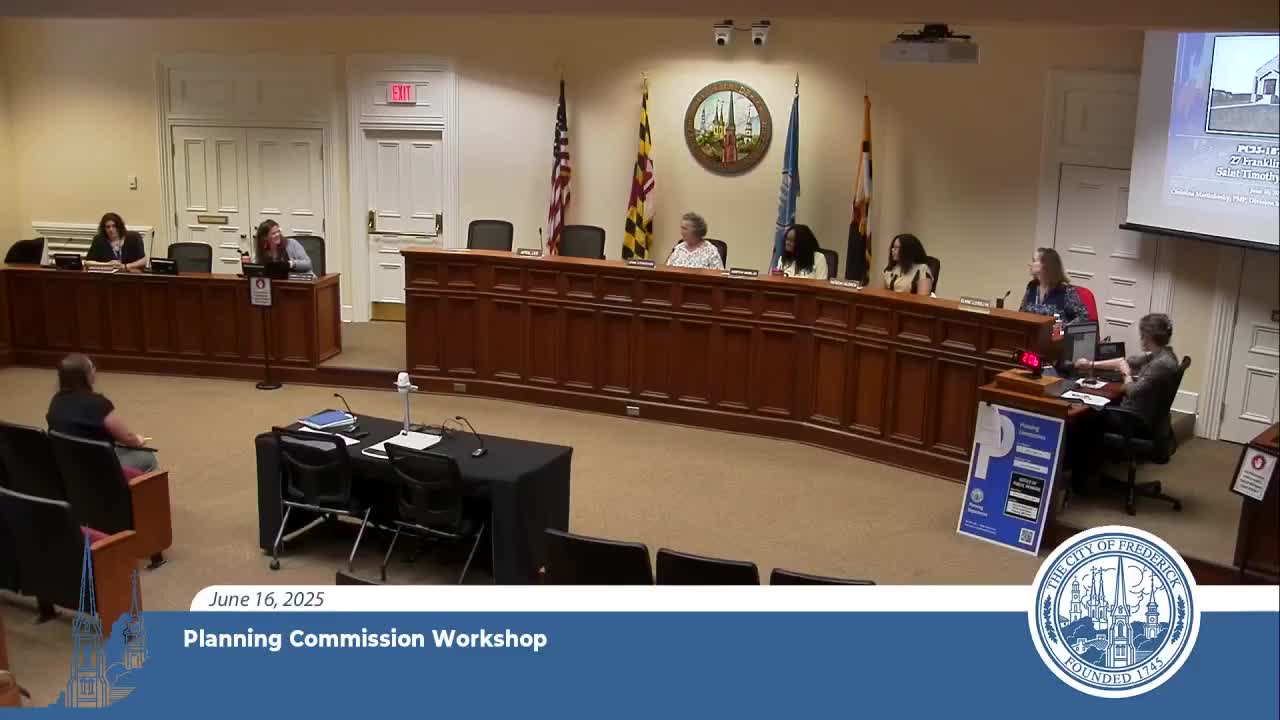
Christina Martin Koski, division manager of historic preservation planning, presented a demolition-driven zoning map amendment for 27 Franklin Street—the 1924 Saint Timothy’s Chapel—at the Planning Commission workshop June 15 and said the Historic Preservation Commission will decide tomorrow whether the site meets the criteria for a historic preservation overlay.
Christina Martin Koski, division manager of historic preservation planning, told the Frederick City Planning Commission at its June 15 workshop that the application before the commission is a zoning map amendment for 27 Franklin Street tied to a demolition review for the former Saint Timothy’s Chapel.
Koski said the stone chapel, constructed in 1924 as Saint Timothy’s Mission to serve workers in the then-developing Schleyesville area, closed in February 2015 and has since become the subject of a demolition-review application that in turn triggered a zoning map amendment application. She told commissioners the Historic Preservation Commission (HPC) will next consider whether the site meets designation criteria for a historic preservation overlay and that the Planning Commission’s role is to review the HPC findings and evaluate consistency with the City of Frederick comprehensive plan.
Koski described the HPO criteria the HPC will use, including age (over 50 years), association with important events or cultural groups, architectural or construction significance, and historic integrity. She said staff believes the building is a “good candidate” for designation because it represents early-20th-century English Gothic ecclesiastical design and served as a mission chapel for working-class residents adjacent to industrial development.
Commissioners pressed staff on procedures and timing. Commissioner Manelas noted the HPC vote on May 22 to create the zoning map amendment application and asked whether tomorrow’s HPC meeting would decide designation eligibility; Koski confirmed the next HPC meeting would vote on whether the property meets the designation criteria and explained that if HPC finds the property eligible the application proceeds regardless of the Planning Commission’s recommendation. Koski and other staff clarified that an HPO applied to the lot would protect future work but would not require undoing work already completed.
Commissioners also asked about the demolition review: Koski said the case involves “partial demolition.” She showed images indicating that a front vestibule had been removed and an addition (described as a deck with structure) added to the front; that work—some of which occurred without full site-plan approval—triggered the demolition review. Koski said a permit for related interior work had been issued about a year earlier but never closed out or inspected, and that staff is now addressing the outstanding demolition-review requirement.
A staff speaker noted that neighborhood advisory committee (NAC 12) minutes — provided to the Historic Preservation Commission but not yet distributed to Planning Commission members — record the NAC’s formal support for the application. Commissioners asked when the matter will return; Koski said the public hearing before the Planning Commission is scheduled for July 14, and the HPC decision deadline on its side is “tomorrow.”
No formal Planning Commission decision was taken at the workshop; Koski and staff framed the item as part of the advisory, multi-step review that culminates with a council decision should the HPC and Planning Commission produce recommendations.
The Planning Commission will consider HPC findings, comprehensive-plan consistency, and other planning issues at the July hearing; the HPC will complete its eligibility vote first. Staff emphasized that the HPO would apply to future work and that the commission will weigh integrity issues and compensating features during subsequent reviews.
Looking ahead, commissioners and staff agreed to circulate the HPC packet material and NAC minutes to commissioners prior to the Planning Commission public hearing.