Get Full Government Meeting Transcripts, Videos, & Alerts Forever!
Get email alerts on the Senior Centers Finance topic
No spam. Unsubscribe anytime.
Berrien County auditors report clean opinions for senior centers; commissioners add reporting and membership limits to millage terms
Summary
A county-hired CPA told commissioners all seven senior centers received unmodified audit opinions; county staff proposed additional terms for millage-funded appropriations including required board minutes, insurance certificates and a prohibition on charging county residents membership fees.
Berrien County commissioners heard an update on audits of the county's seven senior centers and reviewed proposed changes to the millage terms of appropriation, with staff pushing for more consistent reporting and corporate counsel saying membership fees for county residents must be barred.
Linda Eli, the CPA presenting the audit summary, told the board that "the purpose of an audit is to increase the public confidence in the financial statements" and that "all of the centers received a clean audit opinion." Eli described a multi-year effort to standardize accounting across centers: a single CPA firm, a standard chart of accounts, a standardized fiscal year and a 28-item internal control checklist that auditors use annually.
The standardized chart of accounts and other changes, Eli said, have led to fewer audit comments and more consistent policies and procedures. She told commissioners that most centers now use professional outside bookkeeping: "Currently, six of the seven use an outside bookkeeping firm," and noted that Saint Joe remains the only center using an executive director as bookkeeper. Eli said outside bookkeeping generally provides greater independence and reduces accounting errors such as postings outside the current year.
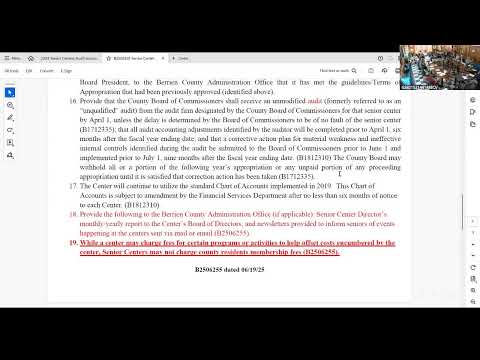
County staff member Annette reviewed proposed additions to the senior-center terms of appropriation tied to the millage. She said the county will ask centers to provide: board meeting minutes, updated bylaws when revised, current certificates of insurance, an updated list of board members with term lengths and election-related figures (number of voters), and regular program/participant reporting. Annette said the county had set the centers' fiscal year to Oct. 1–Sept. 30 in 2015 and that the millage funding covering collections in 2024 (distributed in 2025) totaled $4,433,009.78.
On membership fees, county corporate counsel answered a commissioner question about whether centers could use other labels to impose a door charge: "The intent was to just explicitly disallow a charge for merely being a member of the center," counsel said, while also noting centers may charge fees for individual programs or activities. Commissioners discussed how that rule would apply to part‑time residents who use centers seasonally; counsel said the county could charge a fee for visitors who do not reside in the county and therefore do not pay the millage.
Commissioners and staff also flagged oversight gaps found in audits: several centers were asked to provide written corrective-action plans for items the auditor identified, the auditor recommended routine financial reports at center board meetings, and staff proposed adding a clause to require monthly or annual financial reports be shared with county administration. Finance staff said the terms will return for the board's consideration in December so the county can finalize timelines before the following distribution cycle.
At public comment, Adam Burke, director of the Buchanan Area Senior Center, thanked the county for the millage support and said center boards were taking oversight responsibilities seriously.
Next steps: staff will incorporate recommended language—including a requirement to share board meeting financial reports—and return the terms of appropriation to the full board later in the year for final approval.