Get Full Government Meeting Transcripts, Videos, & Alerts Forever!
Get email alerts on the Land Surveying topic
No spam. Unsubscribe anytime.
Harney County court schedules work session after surveyor raises gaps in corner preservation and records access
Summary
A former county surveyor and licensed land surveyor urged Harney County Court to improve access to survey records and preserve public land survey corners; the court scheduled a work session for June 17 to pursue options including fee changes and coordination with federal agencies.
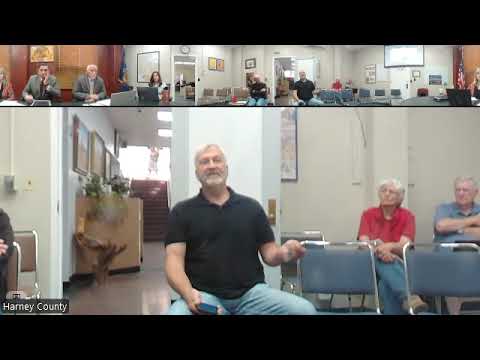
Mark Moore, a professional land surveyor, told Harney County Court on June 4 that the county is not meeting statutory duties for county surveyor functions and for preservation of public land survey corners. Moore urged the court to prioritize public access to survey maps and to use existing corner preservation funds to reestablish and maintain section corners.
Moore told the court that Oregon law (citing ORS 209.07 duties) requires the county surveyor to keep ‘‘a fair and correct record of all surveys’’ and to ‘‘establish or reestablish and maintain all public land survey corners where evidence of the corners can be found.’’ He said the county’s current surveyor arrangement is effectively part time and difficult for the public and other professionals to reach, and that the county’s filing and indexing of surveys is inconsistent.
The court agreed to schedule a work session to consider a response. The court set an initial work session for June 17 at 2 p.m. and discussed inviting the county clerk, county assessor, planning staff, GIS, the Bureau of Land Management, U.S. Forest Service, Oregon Department of State Lands and the Harney Tribe to participate.
Moore also identified a dedicated corner preservation fund and said it contained about $108,000; he recommended prioritizing corners near private property and using the fund to reestablish high‑priority corners. He told the court, “Funding is not an issue. I checked with the county treasurer. There's over a $108,000 in that fund.”
Court members and staff clarified how the fee that feeds that fund is collected. Harney County currently charges $5 per recorded document for corner preservation, with 25 cents retained by the county clerk and $4.75 deposited into the preservation fund. Moore said adjusting that fee toward the statutory maximum (currently $10 per recording) was an option; he also said a state bill may raise the statutory ceiling in January.
Moore urged coordination with federal land managers to determine which public‑lands corners require priority work. He offered to volunteer time to improve records and to participate in the court’s planned work session.
The work session is intended to allow staff and invited agencies to present records, funding details and options for preserving corners and improving public access to survey maps; court staff said the session would help the court shape any ordinance or budget request that might be required.
Questions remain about whether Harney County should fund a local part‑time or shared full‑time county surveyor, how to prioritize thousands of corners across the county’s large area, and whether to raise the recording fee to the current statutory maximum. The scheduled work session is intended to address those issues and to produce specific follow‑up items for a future court agenda.