Get Full Government Meeting Transcripts, Videos, & Alerts Forever!
Get email alerts on the State Budget And Delegation Update topic
No spam. Unsubscribe anytime.
Durham delegation warns budget uncertainty could cut services; urges focus on childcare, Medicaid and schools
Summary
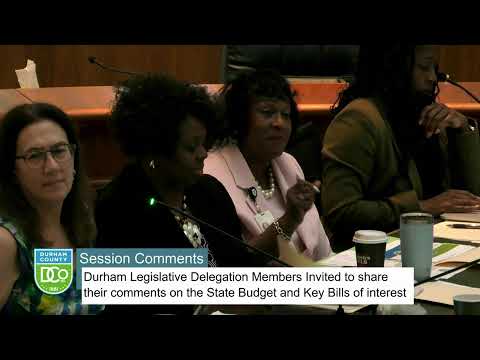
At an in-person briefing with Durham County officials, members of the county’s legislative delegation described sharp differences between the North Carolina House and Senate budget proposals and warned that a combination of proposed tax cuts and reduced federal funding could force cuts to programs the county depends on.
At an in-person briefing with Durham County officials, members of the county’s legislative delegation described sharp differences between the North Carolina House and Senate budget proposals and warned that a combination of proposed tax cuts and reduced federal funding could force cuts to programs the county depends on.
“We would love to have a budget we could vote for,” Representative Zach Coughlin, District 31, said as he described the current stalemate and the prospect that a final budget may not be adopted until late summer or fall. He and other delegation members said the House and Senate bills differ substantially on tax cuts and spending priorities, and that a conference committee will now try to reconcile the two chambers’ proposals.
The delegation highlighted several areas of concern for Durham County officials: expansion and funding for private-school vouchers; an increase in starting teacher pay proposed by the House; proposed Medicaid work and eligibility verification requirements; the potential centralization of Medicaid eligibility processing; childcare supply and financing; and several county-level bills that have not yet advanced.
Why it matters: County officials repeatedly warned that large parts of the health and human services and social services budgets rely on federal funding and that reductions at the federal or state levels would shift costs and service responsibility to the county. Commissioners and department directors said local capacity to absorb cuts is limited and that some programs—SNAP-related nutrition programs, early childhood services, and Medicaid-covered behavioral-health supports—would be difficult or impossible to replicate with county funds.
Budget timing and process Representative Coughlin summarized the calendar: both chambers have passed different budget versions and no conference committee has yet issued a final agreement. Delegation members said they expect negotiations to extend through the summer and possibly into September, noting that if the House and Senate cannot agree, counties could face an extended period without an adopted state budget.
House proposals highlighted by delegation members include an increase in starting teacher pay to $54,000 and continued expansion of opportunity scholarships (private-school vouchers). Delegation members said the House package would make North Carolina competitive on starting-teacher pay, but does not raise pay for returning veteran teachers. They also said the voucher expansion is being used largely by students already in private schools and that the program’s longer-term growth would divert substantial state dollars away from public schools.
Childcare, early education and workforce Senator Sophia Chilwick, District 22, and other delegation members described several childcare initiatives under consideration, including recommendations from a governor-appointed task force on childcare innovation and the possibility of a state-level childcare finance mechanism or agency to help scale local providers. Chilwick said the task force’s top-level recommendations — raising subsidy rates and supporting early childhood educators — have bipartisan support but require significant funding.
County staff noted parallel local work: Durham is revising its Unified Development Ordinance to remove barriers to siting childcare across the county, and Durham Tech applied for a pilot program to expand workforce development tied to students with disabilities.
Medicaid changes and administration Delegation members and Durham Department of Social Services (DSS) leadership flagged language in the House budget bill that references centralizing Medicaid eligibility and application processes. Maggie Clapp, Director of DSS (first referenced at the meeting), said the county is unsure whether the language indicates an immediate state takeover of eligibility administration or an assessment/workforce model. She described concerns that centralization could remove in-person access to caseworkers, impair timely casework for long-term care and discharge planning, and shift administrative costs to counties while removing related operational control.
Separately, the delegation noted a bill (HB546) described as Medicaid modernization that could reduce county costs for health care for people held in county jails; county officials said they spend more than $6 million annually on detainee health care and welcomed language that would mitigate those costs.
Work requirements and verification Delegation members reported several proposals tied to Medicaid that would add work or verification requirements for recipients. They said some versions would require verification of legal presence for anyone receiving state funds and periodic proof of disability for those who qualify. Delegation members and county staff warned that such requirements could create heavy administrative workloads, risk cutting benefits for people with complex needs, and undermine access to treatment for people in recovery.
Education, HBCU and special-needs funding Members of the delegation said the Senate budget included a $100 million insertion for North Carolina Central University for renovation needs that did not appear in the House bill; they said conferees would have to negotiate that funding in conference. Delegation members and county officials also discussed the cap on special-needs and exceptional-child funding, noting the cap limits available resources and that removing the cap would change distributions statewide.
Local bills and county priorities Delegation members described county-level priorities that have not yet advanced: a local bill to add Durham to an existing provision (Senator Chilwick said local bills do not require “crossover” and the delegation will continue to pursue it), a $30 million request to support utility-system upgrades in RTP, and a proposal to allow joint county partnerships to build staff-affordable housing (a teacher housing bill that did not survive crossover). Members said some of those items could be folded into other bills or pursued as local bills.
Land use and HB765/SB587 Delegation members and county officials discussed House Bill 765 (described in the meeting as a bill that would limit local land-use control) and a related Senate bill (SB587). Delegation members said HB765 did not make crossover in its original form but warned that pieces of it could be reintroduced or attached to other legislation; county staff said those provisions, if enacted, could limit local zoning changes and hinder Durham’s planned Unified Development Ordinance updates.
Federal issues and disaster funding County and delegation speakers also raised federal funding risks: potential cuts in FEMA programs, proposed changes to FEMA disaster funding (including shifting toward grant programs and a requirement that participating counties identify mitigation projects), and reductions to programs that currently reimburse local costs for immigrant housing or other local emergency shelter services.
Requests, next steps and staff follow-up County staff said they will request a meeting with the N.C. Department of Health and Human Services to clarify the Medicaid centralization language in the House bill and to coordinate with local LMEs. Delegation members said they will press conferees on school capital needs, childcare financing, Medicaid protections, and local items in conference negotiations. County officials and delegation members urged continued intergovernmental coordination and signaled plans to brief commissioners after a conference outcome.
Quotes in context County Manager Claudia Hager opened the meeting by thanking the delegation: “So grateful you could join us today and give us some highlights,” she said. Senator Sophia Chilwick described the local-bill process and the delegation’s options: “Local bills don't need to make crossover, so we've got time on this bill,” she said.
Ending Delegation members and county staff said they will continue outreach to state leadership and to county counterparts in other jurisdictions while conference negotiations proceed. Staff requested that delegation members and county elected officials keep communication channels open; the county plans to follow up with DHHS and to report back to commissioners after conferees take final positions.