Get Full Government Meeting Transcripts, Videos, & Alerts Forever!
Get email alerts on the Food Truck Inspections topic
No spam. Unsubscribe anytime.
Palm Beach County Fire Rescue outlines food-truck inspection rules after national incidents; gives quarterly response-time data
Summary
Palm Beach County Fire Rescue presented a food-truck safety and inspection program citing past propane/gas explosions and describing required exhaust, suppression, leak detection and spacing rules; the department also presented quarterly response metrics for Wellington.
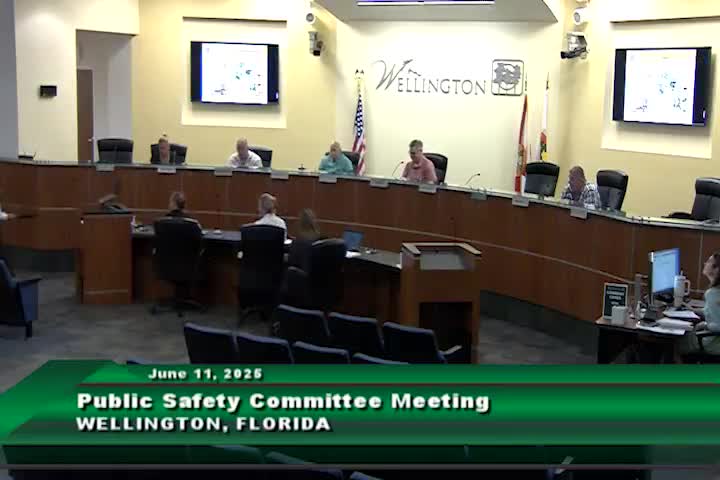
Palm Beach County Fire Rescue staff briefed the Village of Wellington Public Safety Committee on June 11 about a county food-truck inspection program developed after fatal and serious food-truck fires, and provided quarterly emergency-response statistics for the village.
Assistant Fire Marshal Chris Henry described several past incidents nationwide and locally that prompted a formal inspection program, including a Philadelphia explosion tied to a decades-old, uninspected propane tank and recent Florida incidents. Henry said the county requires an exhaust system for any food truck that produces smoke, automatic suppression for grease-laden vapors, leak-detection procedures whenever vehicles are moved during an event, and hydrostatic testing or retest schedules for propane cylinders.
Henry described two inspection types: an on-site event inspection (CAL) and a detailed mobile-food-truck (MFT) annual inspection that typically takes about an hour to 90 minutes and carries a $110 fee. He said on-site inspections are provided at events when requested and that by state law firefighters cannot unilaterally deny a truck's operation at a host event; only the event host can do that. He also detailed generator placement guidance (exhaust 10–12 feet from openings and a preferred 12-foot separation from air intakes) and a recommended 10-foot spacing between vehicles, buildings and fire-access roads at event setups.
Henry reviewed required equipment and documentation including propane and carbon monoxide detectors, emergency shutoffs (quick 90-degree shutoff valves), suppression-system inspection reports (six-month service intervals), and gas-system piping reports consistent with NFPA 58. He said the county provides a six-part fire-rescue folder for inspected trucks containing checklists, gas-detection logs, training logs and operating instructions that hosts should request at events.
Deputy fire leaders also presented quarterly response data for March 10–June 10: 1,707 emergency responses in the village, 73% medical, average dispatch handling time 45 seconds, turnout 43 seconds, travel 5 minutes 9 seconds, and overall response time 6 minutes 36 seconds.
Committee members asked whether inspected trucks display a public score; staff said no externally visible food-truck grade is required, but inspected vendors should have a fire-rescue folder available on request. Staff noted the county will provide free inspections tied to training events on request and that Parks & Rec coordinates event layouts to meet spacing guidance.