Get Full Government Meeting Transcripts, Videos, & Alerts Forever!
Get email alerts on the Municipal Administration topic
No spam. Unsubscribe anytime.
Queen Creek staff describe rising code-enforcement activity and preview potential zoning code changes tied to state bills
Summary
Code compliance staff reported a sharp rise in notices, citations and hearings since 2022 and outlined plans to expand staffing and enforcement procedures. Planning staff previewed potential text amendments to align local code with several state bills on self-certification, middle housing and water use.
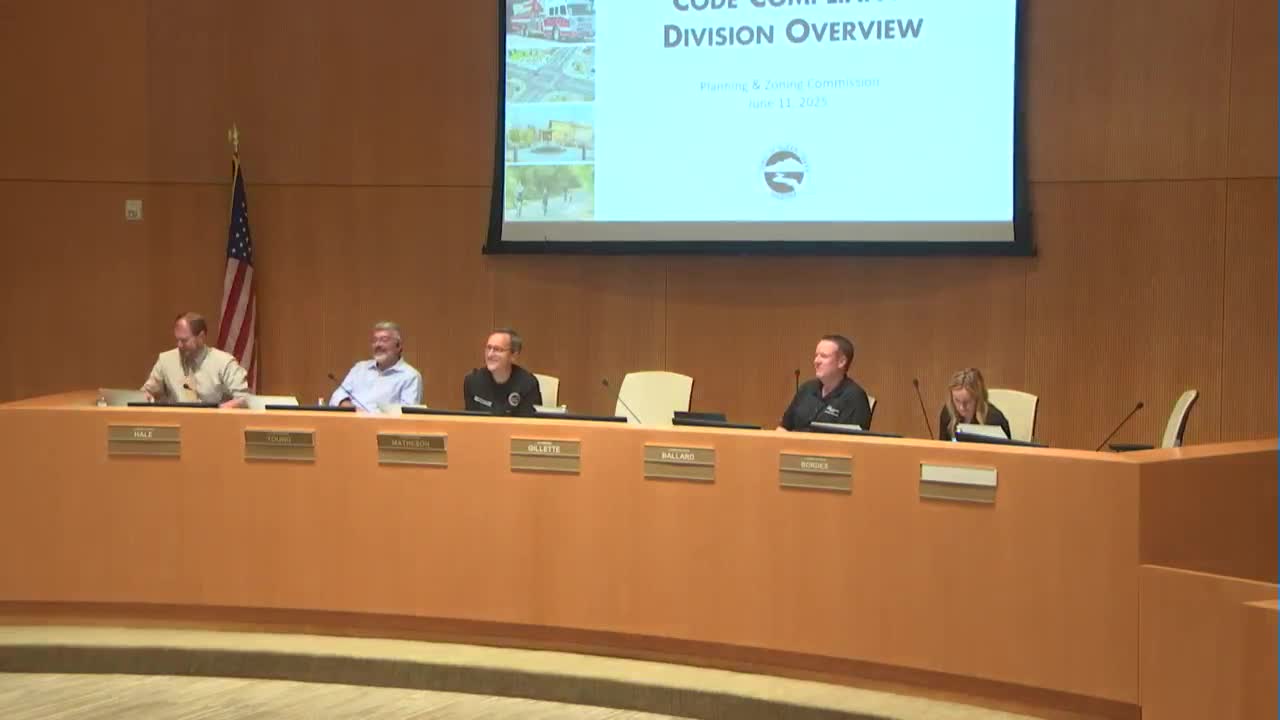
Code compliance and planning staff told the Queen Creek Planning and Zoning Commission that the town's code-enforcement workload has grown substantially in recent years, and they previewed several potential zoning-code updates that would respond to state legislation and local policy needs.
Victor Martinez, the town's code compliance manager, said the division's caseload has risen from 14 notices of violation in 2022 to 182 in 2023 and 250 in 2024. Through the first part of 2025 he reported 144 notices of violation, 41 citations issued and 24 court hearings. Martinez said the increases reflect a growing town and more complaints from residents. To respond, the town is hiring staff, adding contracted hearing officers, updating court procedures and developing a process to recover unpaid fines.
"Voluntary compliance is our main goal," Martinez said, adding that staff emphasize education and outreach before enforcement. He also described proactive work (sign removal and weekend operations) and said the division typically offers 14-day notices with case-by-case extensions while working with residents to resolve issues.
Planning staff member Eric Swanson briefed commissioners on text amendments that could follow action at the state legislature. He summarized bills under consideration and how they might affect local code:
- House Bill 2447: would require municipalities to allow administrative review of certain applications and permits and includes an option for self-certification of code compliance by qualified practitioners; town staff said the town already conducts administrative reviews for many plat and site-plan applications, but self-certification would require further policy decisions.
- HB 2721 ("middle housing"): would require allowance of duplexes, triplexes and quadplexes on lots currently zoned single family in many circumstances. Staff warned the change could expand housing types across areas currently zoned R1 and said they are studying impacts to utilities, streets and community character.
- SB 1162 / HB 2298 (water allocation): both bills address water use for landscaping and open-space requirements; staff said Queen Creek does not mandate ponds or lakes in most developments but noted ponds are sometimes used for aquifer recharge and irrigation cycles, and staff are coordinating with other departments to propose sensible local language.
- SB 1529: would require municipalities to create shelf-ready design plans for single-family, duplex and accessory dwelling unit (ADU) housing types; staff said preparing those plans would speed approvals for some builders but require town resources to develop the templates.
Swanson also discussed local code work the town is pursuing, including evaluating lot-coverage limits for larger lots, clarifying rules for outdoor storage and accessory structures (including reuse of shipping containers and truck bodies), and reconsidering whether certain drive-through uses should always require a public hearing.
Commissioners asked about how the state bills intersect with local authority and how utilities and roadways would be affected by expanded middle-housing allowances. Swanson said the town will provide formal feedback to legislators and return to the commission with draft local text amendments if state law changes.
Martinez told commissioners the code compliance division's goal is to move toward a fully staffed team and to standardize enforcement and hearing procedures. He said staff will continue to prioritize voluntary compliance but will use expedited citation for repeat offenders.