Get Full Government Meeting Transcripts, Videos, & Alerts Forever!
Get email alerts on the Cannabis Regulation topic
No spam. Unsubscribe anytime.
Lake County planning panel forwards cannabis ordinance recommendations; odor mitigation, generators and homeschools highlighted
Summary
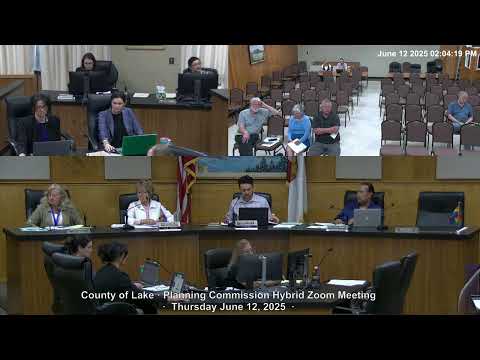
The Lake County Planning Commission concluded its review of recommended changes to the county’s cannabis ordinance and directed staff to incorporate the commission’s suggestions into a draft ordinance that will proceed through environmental review, advisory committees and noticed public hearings before the Board of Supervisors.
The Lake County Planning Commission concluded its review of recommended changes to the county’s cannabis ordinance and directed staff to incorporate the commission’s suggestions into a draft ordinance that will proceed through agency and stakeholder review, environmental analysis, the agricultural advisory committee and noticed public hearings before the planning commission and the Board of Supervisors.
Staff member, Community Development, summarized the next steps and told the commission: “Once the planning commission has completed their recommendations, I will integrate those recommendations into the staff report that then goes to the board.” The draft ordinance will then follow the county’s normal land-use review process, the staff member said.
The commission recorded several areas of consensus and items for further study. Among the recommendations the commission entered or noted: stronger language favoring anchoring systems over concrete slabs for outdoor facilities when anchor points are feasible; seeking additional options to mitigate odor impacts to nearby residences; directing staff to investigate increasing site reclamation bonds to a reasonable level for remediation; preparing a countywide map of approved and pending cannabis applications for staff and future presentations; and considering whether homeschools should be included with public and private schools in exclusion zones.
Public commenters emphasized air-quality and odor concerns and urged stronger setbacks and monitoring. Tom Lasik, a member of the public, argued that “homeschools are recognized by the State of California as a legitimate form of private school,” citing judicial and state code context during his remarks. Bill Wilson urged the county to measure air quality around outdoor grows and warned that “VOCs, volatile organic compounds, are harmful to humans,” and recommended real-time sampling instruments that the commenter said Lake County does not now possess.
Multiple speakers addressed odor control. Margo Kambara said municipalities that fail to manage cannabis odor ‘‘are finding themselves in court’’ and recommended the county prioritize odor mitigation. Andrew Dobbs Kramer noted that odor-causing compounds are not unique to cannabis and defended the discretionary permitting process as a vehicle for site-specific mitigations. The commission also heard technical comments distinguishing terpenes from sulfur-based thiols as sources of different odor effects during public comment.
Generators, wildfire risk and public safety were also discussed. Commenters and commissioners noted recent CAL FIRE wildfire-hazard map updates adopted by the Board of Supervisors and urged caution around permitting temporary generator use for projects awaiting PG&E hookups—particularly for projects in remote, high-grade areas. Staff noted that generator regulations in conditions of approval already require compliance with fire-code safety standards and hazardous-materials rules that cover fuel storage.
Commissioner Rosenthal moved, with Commissioner Field seconding, to request the Board revisit Farmland Protection Zone (FPZ) boundaries; the motion was entered into the record but the transcript notes no formal vote at this meeting. Commissioners expressed that revocation recommendations could go straight to the Board of Supervisors unless the board prefers otherwise; staff recorded that direction.
The commission did not finalize a single rule on homeschools during later discussion; several commissioners and members of the public urged staff to examine setbacks to off-site residences as a possible, less intrusive alternative to adding homeschools to exclusion rules. Commission members also noted an ongoing countywide oak preservation policy being developed separately, and that the commission had not reached consensus on a standalone prohibition on oak removal.
Several speakers suggested further technical work before final regulations. Public commenters urged independent review of hydrology reports, real-time odor/air-quality monitoring where feasible, and clearer mapping of homeschools (noting that specifics of homeschool location may be confidential under state law). Angela Emeril proposed requiring applicants in homeowners associations or property owners associations to include a letter of approval from the HOA/POA with their use-permit application.
No formal ordinance vote was taken at the Planning Commission. Staff said it had received direction and would work with county counsel and other departments to draft the ordinance for the next stages of review and public hearing. The commission closed the item and moved on to a department update before adjourning.
The record includes the commission’s consensus recommendations, the motion to revisit FPZ boundaries (moved by Commissioner Rosenthal, seconded by Commissioner Field), and public comments emphasizing odor mitigation, wildfire safety, hydrology review and HOA/POA coordination.