Get Full Government Meeting Transcripts, Videos, & Alerts Forever!
Get email alerts on the Governance topic
No spam. Unsubscribe anytime.
Training stresses governance: policies, procedures and practices for North Carolina grant recipients
Summary
Deloitte trainers told an NC Pro webinar that clear policies, documented procedures and consistent practices are the foundational controls for administering state and federal grant awards, and urged recipients and subrecipients to adopt written governance frameworks aligned with 2 CFR 200 and North Carolina rules.
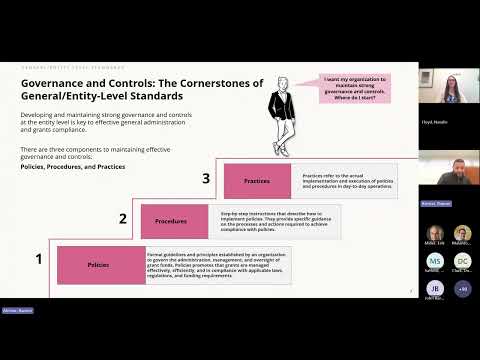
Natalie Floyd, part of the Deloitte team, told a virtual NC Pro training that “everyone joining today, is responsible for the implementation of those general and entity level standards.” The presenters said organizations should front-load written policies, detailed procedures and repeatable practices to govern award administration.
The training explained why a governance framework matters. A Deloitte presenter said such a framework lets organizations “proactively identify and mitigate risk, protect public trust, and achieve organizational objectives.” Trainers tied the guidance to federal and state requirements, naming 2 CFR 200 and the North Carolina Administrative Code as reference points.
Presenters defined the three building blocks: policies (overarching principles), procedures (step‑by‑step instructions, often in SOPs) and practices (how staff actually carry out procedures). They advised that where an organization’s internal rule is stricter than state or federal guidance, the organization must follow its own written policy for consistency with 2 CFR 200.403(c).
The presenters repeatedly emphasized documentation and periodic review. They recommended annual reviews of policies and procedures, centralized access to policy libraries, organizational charts, and standard operating procedures for grant closeouts, procurement and internal controls. Natalie Floyd said these materials support “consistent administrative operation” and make audit response faster.
The session closed with a reminder that the Office of State Budget and Management (OSBM) issues statewide guidance and that NC Pro has developed SOPs aimed at administrating agencies and subrecipients to help align project planning with legislative intent and applicable rules.
Training participants asked questions about responsibility matrices and where templates come from; presenters said agency management typically owns role designations and that the state provides templates and guidance in many cases. The presenters offered to follow up with additional materials and templates via NC Pro.