Get Full Government Meeting Transcripts, Videos, & Alerts Forever!
Get email alerts on the Wildfire Mitigation topic
No spam. Unsubscribe anytime.
SFPUC adopts 2025 wildfire mitigation plan, directs filing with state board
Summary
The San Francisco Public Utilities Commission adopted its 2025 Wildfire Mitigation Plan, which updates the 2024 plan and formalizes situational awareness, vegetation management, and targeted equipment replacement. The commission authorized filing the plan with the California Office of Energy Infrastructure Safety by July 1, 2025.
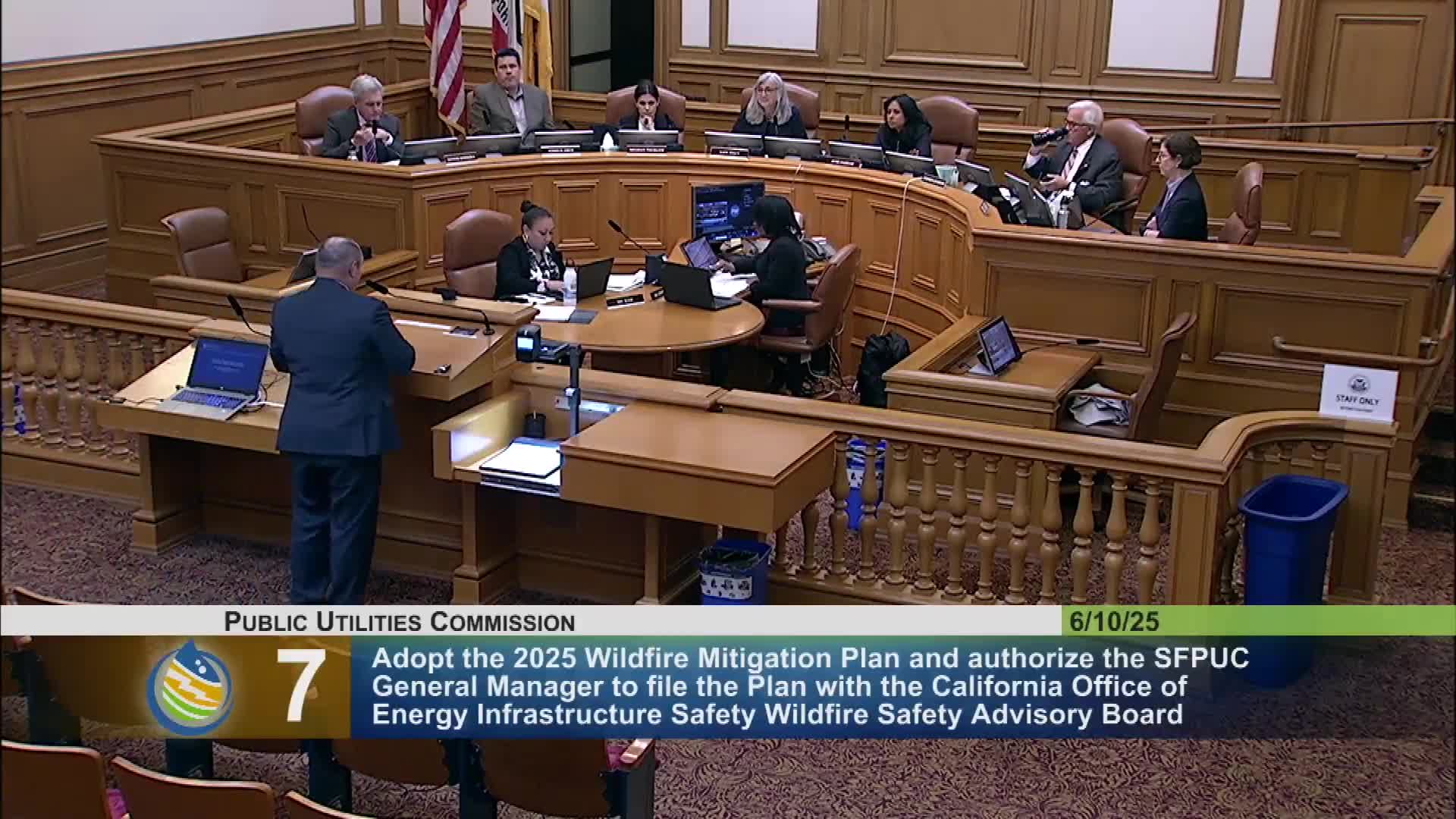
The San Francisco Public Utilities Commission on a unanimous vote adopted its 2025 Wildfire Mitigation Plan and authorized the general manager to file the plan with the California Office of Energy Infrastructure Safety's Wildfire Safety Advisory Board on or before July 1, 2025.
The plan is an update to the commission's 2024 submission and the 2023 comprehensive revision. “The core of our 2025 WMP remains the same, minimizing the source of ignition, grid resiliency, and then striving towards continual improvement,” said Ethan Billigmeyer, utility specialist with Hetch Hetchy Water and Power, during the presentation.
The nut graf: the plan formalizes daily situational awareness tools, targets vegetation management using satellite and aerial data, and identifies equipment replacement priorities for assets in California’s high fire threat districts. Commissioners said the plan’s operational details and interagency coordination make it a practical step for managing wildfire risk to both water and power assets.
In the presentation, staff described three primary tools that feed daily operations: an automated morning wildfire-weather alert delivered to field crews via a contracted Technosilva-based application; live feeds from wildfire cameras covering roughly 80% of the system; and satellite analysis from LiveEO that monitors vegetation encroachment near overhead lines. Billigmeyer said the Technosilva feed includes a three-day forecast, live wind and humidity data, and a three-hour update cadence for situational changes.
Staff also described asset-specific actions. The plan includes replacing identified non‑exempt equipment under Public Resources Code section 4292 with exempt equipment where feasible and continuing pole‑wrapping at vulnerable distribution poles. The Hetch Hetchy Water and Power team reported 117 distribution poles were wrapped with a product staff said forms a heat-resistant shield and preserves climber access.
Commissioners pressed staff on inspection timing and the degree to which satellite data can substitute for field inspections. Commissioner Thurlow asked whether satellite imagery reduces the need for ground inspections; Billigmeyer said it does not replace inspections but helps prioritize and validate field work. “It’s another set of eyes to tell us if the inspector may have missed something while he was out in the field,” he said.
Staff discussed the relationship between water- and power-related assets in remote “upcountry” watersheds, noting that Hetch Hetchy Water and Power assets are managed inside the water enterprise but also carry power-operational considerations. Assistant General Manager Steve Ritchie said National Weather Service forecasts are an important input for de‑energization decisions and that the utility does de‑energize transmission lines when forecast wind and humidity conditions warrant it.
The plan also documents collaboration with other agencies. Staff said they work regularly with Cal Fire, the U.S. Forest Service, the Bureau of Land Management and local emergency services through regional partnerships including the Southwest Interface Team (SWIFT), and that Cal Fire leads larger prescribed-burn work in parts of the Peninsula watershed. The commission asked staff to continue pursuing interagency coordination and to provide follow-up details on when inspections are completed relative to declared fire seasons.
The commission voted 5–0 to adopt the plan. President Stacy cast the first aye, followed by Vice President Arce, Commissioner Jamdar, Commissioner Laverone and Commissioner Thurlow.
Ending: Commissioners thanked staff for the plan and for increased use of data-driven tools; no public commenters spoke on the item at the meeting.