Get Full Government Meeting Transcripts, Videos, & Alerts Forever!
Get email alerts on the City Budget topic
No spam. Unsubscribe anytime.
Philadelphia council members field community feedback on FY26 proposed budget, including tax changes and housing borrowing
Summary
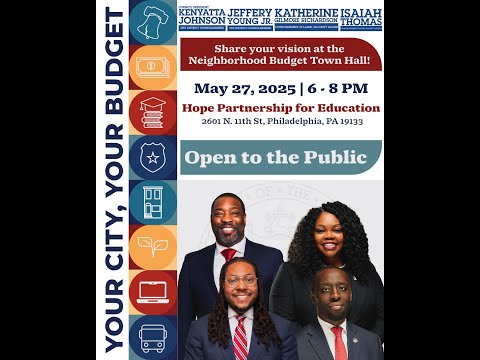
Council leaders and the city council CFO outlined the administration's FY26 proposed budget and heard neighborhood feedback on taxes, housing, public safety and neighborhood services at a "Your City, Your Budget" town hall hosted in Fair Hill.
Philadelphia City Council members and staff presented the administration's FY26 proposed budget and invited local residents to comment on priorities, tradeoffs and implementation at a "Your City, Your Budget" town hall hosted in the Fair Hill / Hartranft neighborhood.
Council President Kenyatta Johnson opened the meeting and emphasized that "it's only a proposed budget from the administration, so the importance of this evening is to listen to your ideas," and that council will negotiate changes with the administration.
Helen Lawhead, chief financial officer for city council, provided the summary of the plan. She described the budget as the city’s annual plan that shows "how much money will be spent on different programs and services," and walked through operating and capital budgets, revenue categories and the five‑year projections the administration submitted.
Lawhead said the proposal includes $2.3 billion in new operating spending and nearly $1.5 billion in new capital investments over the five‑year plan. For FY26 specifically, she said the administration projects $6.7 billion in operating spending, including $356 million in new spending, and $7.2 billion in capital spending with nearly $340 million in new capital investment for the coming fiscal year.
The CFO identified major priorities that the administration tied to the proposal: substantial public safety investments (including a new forensic center, anti‑violence grants, body camera funding and Vision Zero street safety work), clean‑and‑green initiatives, economic opportunity programs and education expansions. The plan also proposes tax changes and new borrowing to support the mayor’s housing effort.
On taxes and housing, Lawhead said the proposal would provide $210 million to reduce the wage tax and business tax and remove the construction impact tax while increasing the realty transfer tax and document recording fees to fund the mayor’s “Housing Opportunities Made Easy” initiative. The administration proposes $800 million in borrowing for that housing initiative and expects $263 million in debt service over the five‑year plan.
Council members who attended the meeting reiterated that the council’s role is to review and negotiate the proposal. Council President Johnson and Fifth District Councilmember Jeffrey J. Young said council will consider residents’ feedback as they begin negotiations with the administration.
Residents at the town hall raised questions about how the proposal would affect housing affordability, neighborhood services, parks and recreation, and neighborhood infrastructure; speakers also asked about specific line items—such as the proposed increase to the realty transfer tax—and asked for more detail on implementation and timelines.
Council members encouraged attendees to provide 311 case numbers and follow up with district offices so staff can monitor and press departments for action on local repairs and projects.
The council president closed by reminding attendees that the proposal is the administration’s starting point and that council will work to finalize a budget through negotiation and amendment.