Get Full Government Meeting Transcripts, Videos, & Alerts Forever!
Get email alerts on the Stormwater topic
No spam. Unsubscribe anytime.
Middleton told federal rule keeps city in MS4 stormwater program; council hears cost estimate of up to $600,000 a year
Summary
City staff and the city attorney briefed council on why Middleton remains regulated under the federal MS4 stormwater program despite being excluded from the Nampa urbanized area after the 2020 census, and described funding and program options including potential fee increases.
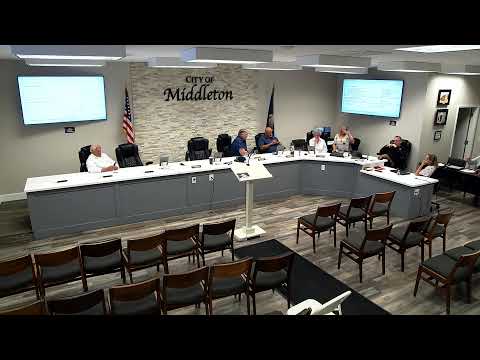
City officials told the Middleton City Council on June 4 that federal and state interpretations of the Clean Water Act mean the city will remain regulated under the municipal separate storm sewer system (MS4) program even after the 2020 census excluded Middleton from the Nampa urbanized area — and that complying with the permit could cost far more than the city’s current stormwater budget.
Jason Van Gilder, Middleton’s public works director, and the city’s legal counsel explained the background and the city’s options during an informational presentation that the council did not vote on. Van Gilder said Middleton currently operates a minimal stormwater utility funded mostly by a small fee and staff support from the streets department. "Right now our stormwater fee is about a dollar fifty or so per house, per month," he told the council.
Attorney Mark Hilty summarized the regulatory problem: Middleton was designated as a regulated small MS4 when the city was included in the Nampa–Caldwell urbanized area in earlier census calculations. Federal regulations and the state agency that implements them, the Idaho Department of Environmental Quality (IDEQ), say a small MS4 that was once automatically designated by an urbanized-area calculation remains regulated even if a later census excludes it. "Once you’re hooked in, you don’t get to get out," Hilty said, reading language in the federal rule that IDEQ applies.
Hilty and Van Gilder described three basic paths: (1) remain on an individual NPDES permit and negotiate terms specific to Middleton, (2) seek coverage under a statewide general MS4 permit (if and when IDEQ issues one), or (3) pursue a waiver in narrow circumstances. Hilty said IDEQ has not created the general permit yet; if Middleton were placed under a future general permit, the city might face fewer individualized requirements, but the state’s current position is that Middleton must maintain permit coverage. He added that qualifying for a waiver — for example under criteria for very small jurisdictions or technical waste-load arguments — appears unlikely based on current population data.
Van Gilder outlined what a fully compliant program would require: a dedicated staff member for inspections and code compliance, replacement and inspection of stormwater infrastructure, increased street sweeping, catch-basin cleaning and a capital-improvement plan for pipes and facilities. His back-of-the-envelope estimate: a program now costing roughly $75,000 a year could grow to roughly $600,000 a year, and the monthly household fee could go from about $2 to the neighborhood of $10–$12. "That's not something I'm championing," he said, adding the estimate came from comparing Middleton to other cities and required staffing and capital needs.
Hilty emphasized a legal consequence of having a permit: it provides a regulatory defense to citizen suits. Van Gilder said the city has received at least one letter from IDEQ noting that Middleton was out of compliance because the city missed a renewal deadline; the city has since resubmitted. Council members asked whether the city is currently in compliance; Van Gilder said the city remains in compliance with the permit’s basic reporting and operations but is not "the exemplary student of compliance" and is on the threshold of more expensive compliance requirements.
Council discussion focused on whether to invest more legal effort now to seek alternative coverage or waivers, or accept that the city will need to expand the stormwater program. Several council members asked for a follow-up to quantify likely funding approaches. Van Gilder said staff will return with more information, cost estimates, and options for the council to consider.
Why it matters: the MS4 permit requires ongoing operational and capital work to reduce polluted runoff; because federal rules do not fund local compliance, cities must develop their own revenue sources. Middleton’s leaders now face a decision that could affect household fees and the city’s budget for utilities and streets.
Ending: Council did not take formal action on the issue on June 4. Staff said it will return with additional analysis and options for the council to consider.