Get Full Government Meeting Transcripts, Videos, & Alerts Forever!
Get email alerts on the Budget Capital Improvements topic
No spam. Unsubscribe anytime.
Hernando County reviews $millions in FY26 capital projects; fleet facility, water projects draw heaviest debate
Summary
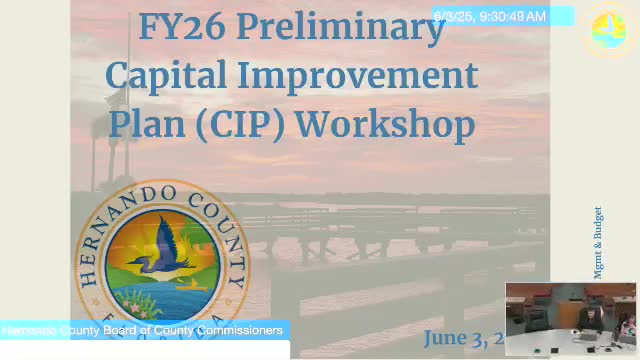
Hernando County staff and commissioners spent a June 3 workshop reviewing the draft fiscal‑year 2026 capital improvement program, with the fleet maintenance facility and several large water and wastewater upgrades drawing the most scrutiny.
Hernando County staff, department directors and commissioners spent the morning of June 3 reviewing the proposed fiscal‑year 2026 capital improvement program (CIP), sorting projects by funding source and priority and debating which items should move forward into the FY26 budget.
Office of Management and Budget director Albert Bertram opened the workshop by explaining the CIP ranking, multi‑year projections and color‑coding by major funding source. “The construction projects for just as a brief overview, building construction projects incorporate the cost of both design and construction. Oftentimes, the design is in 1 year and the construction's in the following year,” Bertram told the board.
Utilities projects dominated the early portion of the spreadsheet: Gordon Otterdonk, utilities director, outlined ongoing and planned work including the Killian water plant upgrades (a new well and high‑service pump station), force‑main improvements for several corridors, the Hermosa pump station upgrade near Hernando Beach and a Centralia wells and 20‑inch transmission line to increase Spring Hill area potable supply. On permitting he said, “They currently, they are not permitted. We're going through water use permit modification right now, to permit those wells.”
Fleet maintenance building became the meeting’s most discussed single item. Staff presented a space‑needs estimate and preliminary capital numbers; one early conceptual cost cited to staff was about $20 million for a 20‑bay shop, which prompted skepticism from several commissioners. Fleet manager Doug Livermore described immediate operational costs the county pays now when vendor technicians travel: “The closest shop that maintains … is in Fort Myers. They have their hourly rate, which is significantly higher than what ours is, plus they charge just to come out.”
Commissioners pressed for a rigorous cost‑benefit analysis before committing to a large fixed facility. Commissioner Loco asked for data on what the county would save by performing more maintenance in‑house; Commissioner Champion asked whether light‑duty vehicles under warranty should be excluded from in‑house work. Staff proposed a $175,000 study in FY26 for a space‑needs/financial analysis and offered lower‑cost phased alternatives, including a smaller 10‑bay shop and a potential Station 2 satellite bay to reduce travel for fire apparatus.
Electric vehicle transitions became part of the discussion; several commissioners and staff flagged the potential for light‑duty vehicles to migrate to EVs and suggested an EV infrastructure/analysis be commissioned alongside fleet planning. Commissioner Champion summarized the technology question this way: “I think the consumer has. Right? And that's overwhelming what that future looks like… The only thing that I've done with my car over the last 3 years … is put water in the wiper fluid.”
Board and staff also reviewed major water/wastewater projects with high price tags (not exhaustive): a 6‑MGD Glen plant expansion (planning/design only in the CIP) estimated in preliminary work as a multi‑hundred‑million‑dollar future project; Lehi wastewater treatment upgrades to meet advanced treatment and BMAP requirements; Bridal Manor reclamation facility expansion; and a planned new 16‑inch force main under I‑75 to serve growth west of the interstate. Otterdonk said the Hermosa pump station design was about 90% complete and likely to bid late in the year; some well projects were still undergoing water‑use permitting.
No formal votes were taken; the workshop is advisory. Commissioners directed staff to run targeted financial analyses: a fleet demand, cost‑comparison and procurement plan; alternatives to the large centralized maintenance facility (including phased construction and private‑sector contracting); and updated project phasing for utilities tied to growth and grant availability. Staff said they would return with revised cost estimates and proposals for which projects should be included in the FY26 adopted budget.
Why it matters: CIP decisions set the county’s capital commitments and borrowing needs for years. The workshop highlighted competing priorities — immediate maintenance and resilience versus large new facilities — and underscored the need to justify multi‑million‑dollar projects with clear operating‑cost savings, grant leverage or developer contributions.
Ending: Staff will bring revised estimates and a proposed list of FY26 funded projects to the board for budget decisions; commissioners asked specifically for a fleet study and clearer grant/permit roadmaps for major utilities work.