Get Full Government Meeting Transcripts, Videos, & Alerts Forever!
Get email alerts on the Parks Levy Renewal 2025 topic
No spam. Unsubscribe anytime.
Portland council begins planning for November parks levy as options, trade-offs surface
Summary
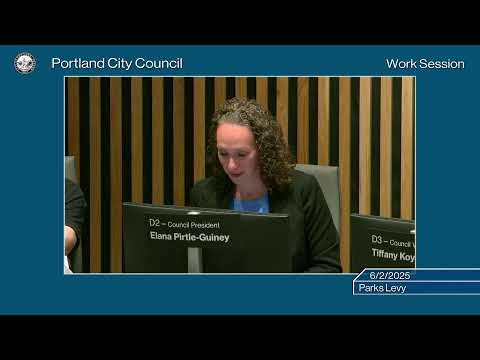
Portland council held a work session June 2 to begin framing a potential renewal of the Portland Parks Levy, discussing rate scenarios, trade-offs between operations and capital needs, and next steps for city staff and council ahead of a July referral deadline.
Portland City Council met June 2 for a work session to begin drafting options for a renewal of the Portland parks levy and to hear bureau staff explain how different rate scenarios would affect operations, preventive maintenance and limited capital work.
Council members were asked to consider whether to refer a measure to the November 2025 ballot and, if so, how large it should be and what it should fund. ‘‘The current parks levy is set to expire, and we need to have a conversation about what comes next for parks,’’ the Council President said at the start of the session.
Deputy City Administrator Sonia Szymanski, who leads the city’s Vibrant Communities service area that includes Portland Parks and Recreation, walked council through the bureau’s funding picture and high‑level policy tradeoffs. She summarized the effect of different rates on service levels and noted that ‘‘essentially every 10¢ of a local option levy rate raises about $6,000,000 in revenue each year.’’ That rule of thumb was used repeatedly during the discussion as a starting point for comparing options.
Why it matters
Councilors and staff emphasized that the current levy, passed in 2020, now provides roughly half of Portland Parks and Recreation’s operating budget and that the bureau faces a large deferred‑maintenance backlog. Council members said they wanted the referral to be specific enough to give voters a clear sense of what levy revenue would buy while also weighing political feasibility.
What staff presented
Szymanski and bureau leaders presented three illustrative rate scenarios that have been discussed internally: an $0.80 per $1,000 assessed value renewal, a roughly $1.30 rate that assumes restoring some proposed cuts, and a $1.60 rate that would more fully preserve current services and could allow a limited amount of capital maintenance. Szymanski said, ‘‘For example, the dollar 60 rate that you've heard about could restore all of the reductions that are on the table for this year if you chose to allocate it in that way.’’ She and finance staff cautioned that a higher rate would be needed to meaningfully fund capital maintenance in addition to operations.
City finance staff explained the mechanics and accounting choices behind the current levy. Claudio Camposano, finance, property and technology manager for Vibrant Community Support Services, described the bureau’s ‘‘blended’’ funding approach, where general fund and levy dollars are used together and the levy acts as the incremental resource to fill gaps. He said the blended model was reviewed by the city budget office and an independent audit as part of levy oversight.
Discussion highlights and numbers cited
- Maintenance threshold: Bureau staff said the city distinguishes ‘‘routine’’ operating maintenance and ‘‘major’’ capital maintenance by an internal threshold of roughly $10,000 per effort; items above that are typically treated as capital. That internal practice, Szymanski said, is largely an accounting distinction rather than a legal prohibition.
- Scale of fund-raising: Councilors and staff repeatedly used the guideline that each 10¢ in levy rate yields about $6 million annually.
- Service and staffing impacts: Staff and councilors discussed that letting the levy expire or passing a smaller renewal would require significant cuts. Councilors were told layoffs in the hundreds are possible under some downside scenarios; staff estimated roughly ‘‘about 250 people’’ could be affected in a severe lapse scenario. (No formal layoffs or staffing decisions were recorded at the meeting.)
- Levy-era program changes and amounts: Bureau staff said proactive tree maintenance was effectively zero before the 2020 levy and that roughly $5 million of levy resources were spent on proactive tree maintenance last year. The bureau reported it now provides about $1.4 million per year in community partnership grants. The access/discount program for recreation grew from about $600,000 in scholarships pre‑levy to about $4 million of discounts utilized last year. Assets and development spending rose from about $10 million pre‑levy to just over $20 million last year; land stewardship spending rose from about $23 million to just over $40 million.
- Small general fund capital pot: Szymanski said the bureau generally receives about $5 million per year from discretionary general fund for capital maintenance, ‘‘and it typically goes to emergency uses.’’
Policy tension: operations versus capital and specificity
Councilors debated how prescriptive the next levy should be. Several members urged more specificity so voters know exactly what a levy would fund; others warned that too much detail could complicate communications and legal accounting. Councilor Ryan and others pressed for clearer accounts of what was added, subtracted or shifted under the current levy so the public can judge whether a renewal is meeting intended goals.
Equity, campaign strategy and partners
Multiple councilors said success will depend on advocacy partners and community groups. Several councilors and staff acknowledged strained relationships between some ‘‘friends of’’ park groups and bureau leadership and urged repairing those relationships to build a successful campaign if councilors decide to refer a measure. Some members recommended additional polling or outreach now that more voters are aware of the parks budget shortfall.
Next steps and deadlines
Staff reminded council that July 16 is the fixed date by which council must act to refer a measure for the November ballot. Szymanski and her team said staff will provide a calculator tool to let councilors model which services each 10¢ increment can buy and will return follow‑up data. The council asked for additional financial detail, including historic spending comparisons, the deferred‑maintenance list, more granular staffing and program‑level headcount and the distribution of revenue sources (fees, philanthropic revenue, property management, SDCs). Szymanski said staff would respond promptly to those requests and aim to supply an initial package of data within about a week.
No formal vote or final referral language was taken at the work session. Councilors left the discussion with a range of priorities — operating maintenance, extended community‑center hours, park rangers and recreation access programs were frequently mentioned — and asked staff to prepare more-detailed options for further council consideration before the July deadline.
"This is a decision about the kind of city we want Portland to be," the Council President said in closing, urging a coordinated, specific proposal that councilors can collectively support.
Ending
The council closed the work session after directing staff to produce the requested financial comparisons, a deferred‑maintenance list and the calculator output for councilors to test rate and program combinations. Staff and several councilors said they intend to continue targeted conversations with partner organizations and return to the dais with draft referral language and costed options in the coming weeks.