Get Full Government Meeting Transcripts, Videos, & Alerts Forever!
Get email alerts on the Land Use Solar topic
No spam. Unsubscribe anytime.
Northampton County hears public concerns as planning board submits draft solar ordinance
Summary
Citizens and planning staff discussed a draft solar farm ordinance that would set a 5% density cap on agricultural/wooded land and add inspection, setback and decommissioning requirements; no final vote was taken.
Residents and county planning staff discussed a draft Northampton County solar energy ordinance at the Board of Commissioners meeting, where the planning board submitted a final draft for the board’s consideration ahead of a June 30 expiration of the current ordinance.
The draft presented by Jason McAllister of the zoning department proposes a 5% maximum density cap on agricultural and wooded land, which the planning board says would allow about 8,608 acres for solar installations. McAllister said the county already has roughly 8,627 acres of solar across 25 locations and 68 parcels, and a roughly 3,000-acre installation is currently under construction.
Jason McAllister, Zoning Department: “The planning board did submit a 5% density maximum of the agricultural and wooded land, which would bring total to allow 8,608 acres of solar.”
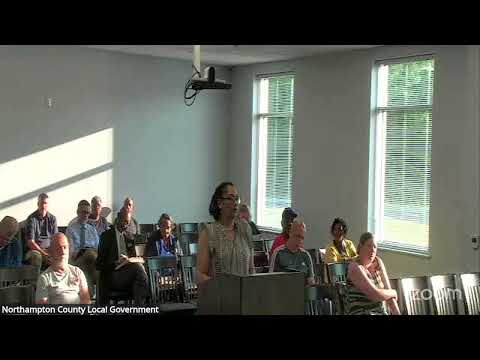
During the citizen-comment period, Alfred Koschepi of Jackson and Gaston area residents urged the board to limit the number and scale of solar farms, pressed for stronger inspection and enforcement language, and asked that local community benefits agreements include citizen representation.
Alfred Koschepi, citizen: “On page 5, there's appears to be a significant need for, solar energy system inspections by the county and monitoring. We certainly can't expect them to self report. We need inspections. Our inspection department is small. And my question is, will these owners of the developers, the solar, system owners be required to pay to the county a fee such that the county can hire additional inspectors?”
Koschepi also raised questions about permits and fees, lease lengths, maximum countywide density calculations, construction-waste fines, decommissioning performance guarantees and whether community benefits agreements would be signed by developers and enforceable. He asked that two lay citizens be added to a proposed community benefits committee otherwise composed of five county officials.
McAllister and planning staff told commissioners that some issues raised — notably environmental permitting and recycling requirements — depend on rules or oversight from the North Carolina Department of Environmental Quality (DEQ). McAllister said the draft contains a provision requiring that 50% of cleared land be recycled and that the planning board recommended increasing frontage setbacks and vegetation-maintenance obligations for finished sites.
Jason McAllister, Zoning Department: “A lot of [the public’s] questions are actually things that we don't have control over. They're in reference from DEQ. So all those dependencies are through DEQ.”
The draft also addresses construction-waste management, setbacks (the planning board recommended increasing frontage setbacks to 300 feet), and decommissioning performance bonds. Planning staff noted the county’s inspection capacity is limited and that enforcement language and fees may be needed if the county is to fund additional inspections.
No formal vote on the ordinance was taken at the meeting. Staff and the planning board presented the draft for the commissioners’ review; commissioners were told the existing ordinance will expire on June 30 if a replacement is not adopted.
If adopted, the draft’s 5% density cap would function as a countywide limit on acreage allowed for solar energy systems on agricultural and wooded land; planning staff said the county is near or above that threshold with existing permitted projects. The planning department recommended the board review the draft and consider public comment and any needed alignment with DEQ rules before final action.
The board did not adopt the draft at this meeting; planning staff and citizens will return with further details and clarifications at future meetings.