Get Full Government Meeting Transcripts, Videos, & Alerts Forever!
Get email alerts on the Property Tax Fleet Funding topic
No spam. Unsubscribe anytime.
Brigham City staff outline options — including a 5.15% property-tax scenario — to cover $405,000 fleet-cost increase
Summary
City staff told the council the mayor’s budget includes a roughly $405,000 gap driven by an inflation adjustment for fleet assets and presented options to cover that gap, including property-tax increases, higher sales-tax revenue forecasts, ambulance revenue changes, or a modest utility-fund transfer.
Brigham City staff told the Brigham City Council a $405,000 change in the general fund tied to fleet-asset cost increases is driving the current budget discussion and presented several ways to cover that amount.
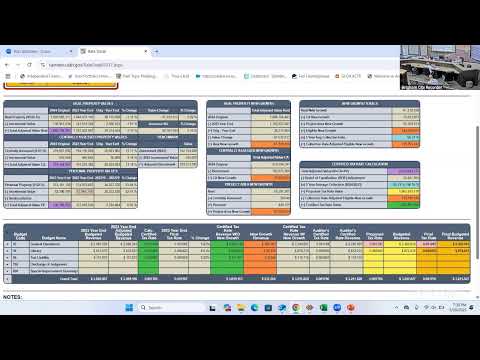
Tom Carter (staff member) presented scenarios during the council’s work session. Using a conservative assumption of $75,000 in county-certified new-growth revenue, Carter said the city would still need about $330,000 to cover the $405,000 fleet-related amount. One across-the-board scenario would produce a 10.3% property-tax increase; splitting the difference yields a roughly 5.15% property-tax increase that would raise about $165,000, Carter said.
To cover the remaining $165,000 under the half-property-tax scenario, Carter presented three alternatives the council could use in combination: (1) increase the sales-tax revenue forecast (not the sales-tax rate) — staff modeled raising the expected sales-tax receipts from $5.4 million to $5.505 million; (2) assume higher ambulance-transport revenue based on a recent change in state law affecting allowable transport fees; or (3) increase the transfer from the utility fund modestly (Carter modeled moving the transfer from 12% to 12.5%, producing about $158,000).
Council members questioned the fairness and sustainability of each option. Council member Jeffries and others said they were uncomfortable relying solely on sales-tax forecasting because residents often interpret press reports to mean the sales-tax rate increased; Carter repeatedly clarified that staff were only increasing the revenue forecast in the budget, not proposing a sales-tax rate change. Council member Jensen noted the sales-tax forecast increase would represent roughly a 2% change in expected sales-tax receipts, which staff called a modest and justifiable assumption given recent revenue history.
Staff also summarized fleet priorities and replacement logic. The police department described a four-year rotation for patrol vehicles and proposed replacing eight vehicles this year as part of a standard rotation; staff explained the city purchases on state contract to preserve resale value and offset future fleet costs. Carter said property taxes represent roughly 12% of general-fund revenue and are the most certain revenue stream; sales tax and ambulance collections are less certain but have funded recent capital purchases when revenue exceeded forecasts.
Staff recommended the council consider placing a 5.15% property-tax increase in the tentative budget and funding the remainder through a combination of sales-tax forecast increases and ambulance-revenue assumptions. Carter said the council can advertise a tentative rate for the truth-in-taxation process and still lower it later but cannot increase the advertised maximum after public notice.
Ending: Council members expressed general comfort with the 5.15% starting point for the tentative budget but asked staff to bring final numbers before the council adopts the tentative budget and before the public hearings required by truth-in-taxation.