Get Full Government Meeting Transcripts, Videos, & Alerts Forever!
Get email alerts on the Capital Infrastructure Cip topic
No spam. Unsubscribe anytime.
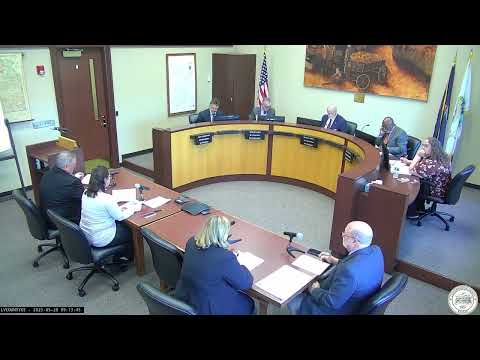
Leavenworth County commissioners table 2024–29 CIP, direct staff to report on three bridges and road funding
Summary
After a lengthy discussion about geographic disparities in road and bridge spending, the Leavenworth County Board of Commissioners unanimously tabled the 2024–29 capital improvement plan and asked staff to prepare detailed reports on three bridges and options for setting aside local pilot funds for a Tonganoxie road project.
Leavenworth County commissioners on May 28 tabled the county's 2024–29 capital improvement plan (CIP) and directed staff to prepare detailed reports on three local bridges, while asking staff to return with options to earmark pilot funds for a Tonganoxie road project.
The action came after a two-hour presentation from county public works staff and extended discussion among commissioners about geographic distribution of past sales-tax-funded projects, bridge replacement timing and prioritization, and smaller-scale “dust abatement” or county-crew road repairs for lower-traffic roads.
Public Works staff summarized the CIP and the county's approach to programming projects by need, safety and past sales-tax measures. Staff said carryover projects from 2024 were listed in the CIP under the year they expect to bid them, and noted that some federally funded projects have narrow contracting windows that will require accepting bids even if prices are tight. “We will not put forward a proposal that we can't afford,” Public Works staff member Bill said when commissioners raised concerns about funding and exposure.
Commissioner Jeff moved to table the CIP, saying the board needed more time to blend in projects that would increase investments in the northern portion of the county and to evaluate whether certain low-use bridges should remain open. The motion passed on a unanimous roll call.
Why it matters: Commissioners debated whether sales-tax and grant-funded projects have disproportionately benefited southern districts and whether some low-use bridges should be closed rather than replaced so limited funds can be shifted to paving and other road work that benefits more residents. The board asked staff to present visual materials and cost estimates so members can make informed decisions.
Key directions and follow-ups from the meeting: - Staff was directed to prepare a bridge report for three structures identified during the discussion: the bridge on Jamieson Road often referenced as HP-51 (a concrete arch culvert cited by commissioners), a low‑traffic bridge identified as A07 in Alexandria Township, and a bridge referred to as K03 on Knapp Road. The board asked the report to include traffic counts, inspection ratings, expected remaining service life, the costs to design and replace the structure, the costs and processes for permanent closure or removal, and potential detour impacts. - Commissioners asked staff to present photos or other visuals of the three bridges when the report is returned so the board can better evaluate condition and community impact. - The board discussed setting aside the annual PILOT (payment in lieu of taxes) from Hills Pet Nutrition—about $41,000 per year—to help fund a resurfacing/overlay effort on 220 Second Street in Tonganoxie. Staff said the pilot currently goes into county funds and that commissioners can direct the county to reserve the money in a capital fund and amend the budget to transfer it. - Staff recommended creating a prioritized list of candidate roads for dust-abatement or limited county-crew reconstruction projects (a “secondary CIP”) that would be eligible for lower-cost county work and could be distributed geographically rather than by traffic count alone.
What staff said about bridge funding and timing: Public Works staff described the KDOT low‑cost bridge standard (used on some planned projects) as a lower‑engineering, lower‑cost option that can reduce project cost but may increase change‑order risk if field conditions differ from geotechnical assumptions. Staff also said the county currently has several projects funded and under construction and that KDOT bridge‑replacement grant eligibility requires bridges to meet certain deck/substructure-rating thresholds before closure/replacement is mandated.
Board comments: Commissioners emphasized fairness across districts, the limits of county crew capacity for reconstructing roads (staff estimated roughly 1–1.5 miles per year of county-crew reconstruction under current resources), and the need to balance bridge replacement with resurfacing/paving projects.
Next steps: Staff will return with the requested bridge reports, visuals, and a proposed mechanism for reserving the Hills PILOT funds and for a prioritized “dust-abatement” candidate list. The CIP will remain tabled until the board reviews those materials and decides how to blend additional projects into the 2026–27 programming.
Ending: The board voted unanimously to table the CIP and to direct staff to prepare the requested materials, with staff noting any programming changes would be brought forward in the formal CIP and budget cycle so projects would only be included if funding is available.