Get Full Government Meeting Transcripts, Videos, & Alerts Forever!
Get email alerts on the Land Use topic
No spam. Unsubscribe anytime.
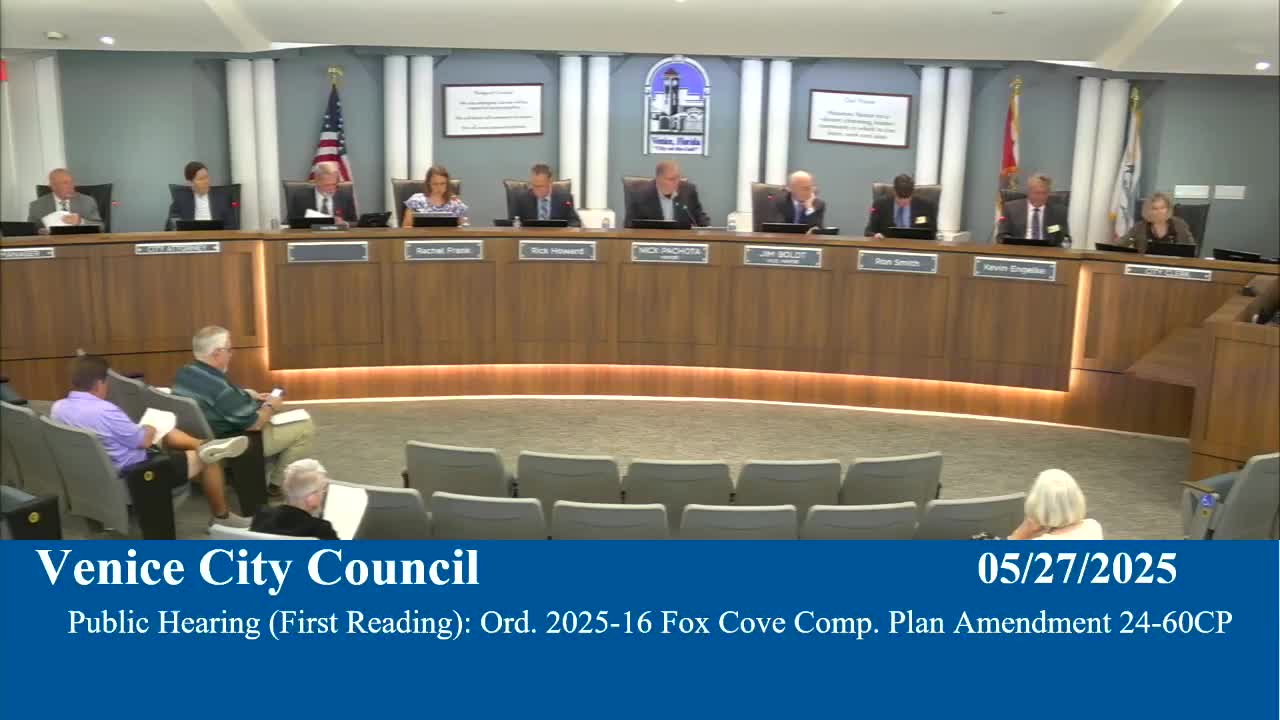
Venice council unanimously denies Fox Cove future land-use change amid density, compatibility concerns
Summary
The Venice City Council voted unanimously to deny a first-reading ordinance that would have changed the future land use designation for a 10.73-acre parcel at the northeast corner of Auburn and Border Road, a move that would have allowed a 70-unit attached housing development.
The Venice City Council voted unanimously to deny a first-reading ordinance that would have amended the city’s future land use map to allow moderate-density residential development on a 10.73-acre parcel at the northeast corner of Auburn and Border Road. The vote followed staff presentations, an applicant briefing, technical testimony on stormwater, and public opposition from neighborhood representatives.
Britney Smith, a planner for the City of Venice, told council staff recommended consideration of future land use map amendment petition 2460CP (Fox Cove). The petition, filed by agent Morris Engineering on behalf of owner KB Home Tampa LLC, sought to change the site’s designation from low-density residential (1–5 units per acre) to moderate-density residential (5.1–9 units per acre) to allow a 70-unit single-family attached (townhome) project.
That recommendation came with context: the parcel sits adjacent to I‑75 on the north and east, abuts the Waterford planned development to the west and the Casada Oaks development to the south, and was the subject of a unanimous 7–0 denial by the Venice Planning Commission on April 15. Smith said the application materials and staff analysis addressed Comprehensive Plan policies, the city’s land development code, and applicable sections of chapter 163, Florida Statutes.
Josh Law, a planner with Morris Engineering representing the applicant, said the concept is for 70 build‑to‑own townhomes and that the applicant proffered a unit cap of 70 (about 6.52 units per acre). Law said the applicant proposed enhanced Type 3 buffering along the west and south property lines, a sound wall along I‑75, preservation of an approximately 1‑acre wetland in the site’s southeast corner, and a Border Road access location preliminarily agreed with FDOT. Law also cited market analysis that the units would serve workforce/attainable ownership between roughly 120–140% area median income.
Brett Rockland, a civil engineer with Morris Engineering, addressed stormwater concerns raised at a neighbor workshop held after recent hurricanes. Rockland said detailed stormwater calculations and modeling would be required as the project advances, and that the design would be subject to review by the City of Venice Technical Review Committee, the Southwest Florida Water Management District (environmental resource permit), and FDOT because of the site’s proximity to I‑75. He said the site’s stormwater system would be designed not to create additional adverse impacts downstream.
Opposition during public comment focused on compatibility and an asserted jump in density. Steve Carr, speaking for the Central Venice Coalition, said the requested density represented a substantial increase over the existing low‑density designation and questioned the applicant’s repeated characterization of the site as "infill" given its 10.73‑acre size. Nancy DeForge, a neighborhood resident, told council she supported the Planning Commission denial and asked council to preserve the area’s low‑density character.
Council discussion emphasized intensity and neighborhood compatibility. Multiple council members cited the Planning Commission’s unanimous denial and compared the proposal’s density to surrounding development patterns, including Casada Oaks and Waterford. Council members also noted the applicant’s proffered limitations and the proposed buffering and sound wall but said those measures did not overcome concerns about overall intensity on the parcel.
A motion to deny ordinance 2025‑16 (the comprehensive plan amendment) was made by Mayor Pichota and seconded by Councilmember Howard. The motion passed unanimously; the council instructed staff that the companion rezoning petition (ordinance 2025‑17) would be withdrawn by the applicant and was removed from further consideration at this meeting.
The denial ends the current proposal to convert the parcel’s future land use to moderate density; any future development requiring a change in the comp plan or zoning would require new applications, additional technical review, and further public hearings. Staff and the applicant noted multiple subsequent review steps (traffic, stormwater, environmental permits) would have been required had the council approved the change.