Get email alerts on the Ai Policy topic
No spam. Unsubscribe anytime.
Wake County Schools previews generative AI policy after multi‑day workgroup
Summary
District staff told the policy committee they convened a 50‑person workgroup and will bring a draft generative AI policy to the committee on June 25 addressing definitions, guiding principles, literacy and operational guardrails.
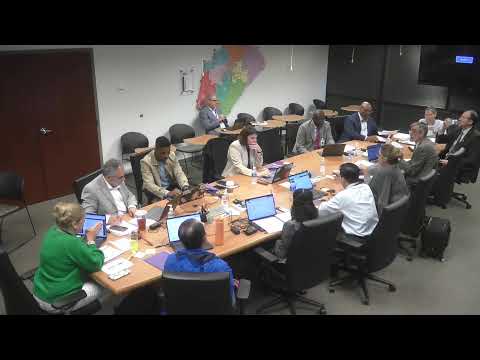
Dr. Robinson, a district administrator, told the Wake County Board of Education policy committee that the district has convened a multi‑stakeholder workgroup to draft a generative artificial intelligence policy for classroom and operational use. He said the group will present a draft to the policy committee on June 25.
The district convened about 50 participants—school leaders, teachers, teacher leaders, PTA and other community members—and ran four full working days, 8:30 a.m. to 3:30 p.m., to develop foundational knowledge, guiding principles and stakeholder resources that will inform the draft policy. Allison Reed, senior director for digital learning and libraries, said the group ranged from participants who had never used AI to others with paid subscriptions to multiple platforms.
District staff said the draft policy will include a board statement, definitions for “generative AI” and “AI literacy,” commitments and guiding principles, and resources for instructional and operational staff. The committee heard that students have not been excluded from the process: staff reported multiple briefings with the superintendent’s student leadership council and planned follow‑up engagement with teacher advisory groups and community partners.
Staff signaled several policy and implementation priorities. They said the policy will address academic integrity, data privacy, intellectual property and equity of access, and will be paired with professional learning for staff and AI/digital literacy work for students. Staff also described a technical approach under consideration—moving district use to an enterprise model from an existing vendor suite—which they said would create a “walled garden” so district data would not be used to train external models and would allow archival and audit capability. Dr. Robinson described those moves as part of the district’s effort to manage data risk while enabling access.
Board members asked about scope and timing. Mr. Hershey asked whether the policy would govern only students or include staff and operations; staff replied it is intended for students, educators and operational staff. Several trustees raised concerns about classroom practice and staffing impacts; Mr. Hershey and others pressed staff to identify specific central‑services use cases where AI could ease administrative burdens. Chair Harrity suggested staff consider bifurcating instructional and operational sections so expectations for students and for staff are distinct. Dr. Eanes asked about security and data flow; staff said adopting an enterprise product would reduce the risk that district data train commercial models and would give technical controls such as archiving and access logs.
Staff emphasized that certain policy components remain under development: the draft policy is intended as a starting position that will evolve “rapidly” as the technology and legal environment change. They also noted some implementation limits: preliminary access for students would be restricted to those whose terms and conditions permit (staff said, for example, that the district intends provisions limiting student access to older students in some circumstances), and training for staff will be required before broader classroom deployment. Staff told the committee they will return June 25 with a policy draft and examples tied to proposed guardrails.
The committee did not take formal action on the AI work today; staff asked for questions and offered to incorporate board feedback into the June 25 draft. The committee directed staff to continue developing detailed implementation materials and to coordinate with the superintendent on timing for any rollout.
Ending: Staff asked trustees to submit comments and said administrators will return June 25 with a draft policy and illustrative examples for classroom and operations use.
AI generated
The text on this page is AI generated. Summaries, highlights, analysis, and video transcripts are all produced from the original source material.
AI can make mistakes, so if you spot one, and we will fix it for everyone.
Note: the source content is unaltered by us. Any content source we link to, be it a video, an audio recording, or a document, is presented exactly as its publisher released it. That publisher is usually a government body, sometimes an individual official or another organisation.