Get Full Government Meeting Transcripts, Videos, & Alerts Forever!
Get email alerts on the Sanitation Fines topic
No spam. Unsubscribe anytime.
Committee advances bill to raise sanitation fines, Health Department urges clear fee schedule and posting of inspection grades
Summary
The committee voted to forward bill 36‑0043 to Rules and Judiciary after testimony from the Department of Health calling for modernization of fines, mandatory posting of inspection grades and clarified suspension/revocation and appeals procedures; the Department cited a 2019 NEHA study showing USVI fines far below comparable jurisdictions.
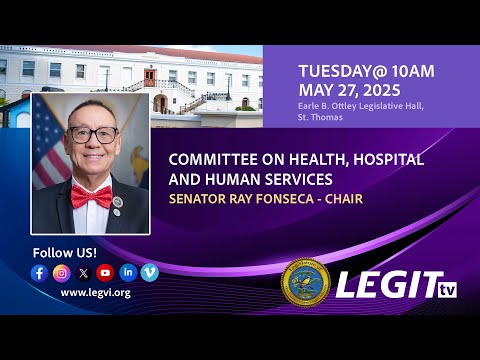
The Committee on Health, Hospitals and Human Services voted to advance bill 36‑0043, an act to increase penalties for sanitation law violations, after extensive testimony from the Department of Health and other witnesses who urged a broader update to Title 19, Chapter 53 and a clear, objective fee schedule.
Justa Encarnacion, Commissioner of the Virgin Islands Department of Health, told the committee that the territory's citation and fine schedule dates back to 1949 and is now "severely outdated." Encarnacion said a 2019 National Environmental Health Association (NEHA) study found USVI first‑citation fines were roughly 30 times lower than comparable jurisdictions. "The U.S. Virgin Islands' division of environmental health fines and citation assessments are the lowest among all benchmark agencies by significant margin," Encarnacion said.
The Department recommended updating fines to align with NEHA findings—examples in testimony included increasing a first citation from $30 to about $900, a second from $50 to roughly $1,500, and a third to about $1,700—coupled with graduated enforcement emphasizing education and compliance assistance prior to penalties. Encarnacion also proposed mandatory posting of health permits and inspection grades in a conspicuous place within an establishment and clearer statutory procedures for summary suspension, reinspection timelines and revocation with due‑process hearing rights.
"Updating these penalties would create meaningful deterrents," Encarnacion said. Department witnesses emphasized that the intent is not to target compliant businesses but to deter repeat or serious violations that put public health and the territory's tourism economy at risk.
Committee members raised concerns about discretionary enforcement and urged a codified fee schedule so penalties are consistent and transparent. Director Watson Harris, Division of Environmental Health, described risk‑based inspections that focus on hazards likely to cause severe illness (for example, failing refrigeration temperatures and cross contamination) and said the department will coordinate a risk‑based fee scale to avoid arbitrary fines.
After debate and an amendment in the nature of a substitute that added posting of inspection grades and clarified suspension/revocation language, the committee voted to forward the bill to Rules and Judiciary for further drafting. The clerk recorded the committee vote as favorable (committee tally recorded as six yes, one not voting on the amended measure). Members asked the Department of Health to return with a specific, codified penalty schedule (by category and risk level) to be incorporated into the bill and to work with DLCA and the Legislature on implementation guidance.
Ending: The committee advanced the measure while asking agencies to produce an objective fee schedule, clearer timelines for suspension/reinstatement, and language to protect due process for permit holders.