Get Full Government Meeting Transcripts, Videos, & Alerts Forever!
Get email alerts on the Sound Money Gold And Silver topic
No spam. Unsubscribe anytime.
Attorney Larry Hilton urges residents to adopt ‘sound money’ options using gold, silver and negotiable gold-backed notes
Summary
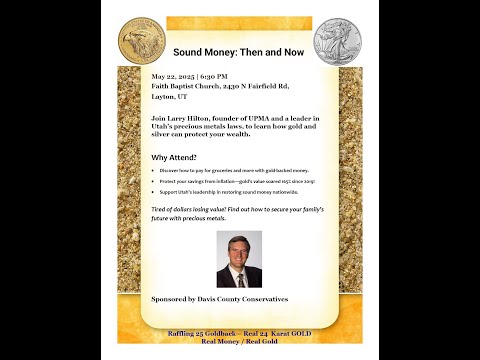
Larry Hilton, an attorney who serves as general counsel for the United Precious Metals Association (UPMA) and several private firms, told a Memorial Day–weekend meeting hosted by Davis County Citizen Journalism that individuals can “embrace” a personal gold or silver standard today using existing law and private arrangements.
Larry Hilton, an attorney who serves as general counsel for the United Precious Metals Association (UPMA) and several private firms, told a Memorial Day–weekend meeting hosted by Davis County Citizen Journalism that individuals can “embrace” a personal gold or silver standard today using existing law and private arrangements.
Hilton framed his remarks as a mix of history, statute citations and practical steps for people who want to hold and spend precious metals. He urged attendees to consider U.S.-minted silver and gold coinage, and negotiable instruments built around gold (Goldbacks), to avoid what he called “bullion booby traps” including criminal liability and capital-gains tax exposure.
Why it matters: Hilton argued that moving some value out of fiat dollars and into physical gold or silver or into negotiable gold-backed instruments can protect purchasing power and reduce what he called the hidden inflation tax on holders of paper currency. He described both statutory provisions and private-sector mechanisms he said allow individuals and small groups to transact in precious metals without running afoul of federal law.
Hilton summarized the historical background that, in his view, explains Americans’ present monetary choices — the colonial era bills of credit and Continental currency, 19th-century bimetallism, President Franklin D. Roosevelt’s gold restrictions in the 1930s, and the U.S. decision in 1971 to end convertibility of dollars into gold. “There is a gold standard that each and every one of you can embrace, today,” Hilton said.
He told the audience the federal government has some applicable laws and obligations — citing a provision he called “Ronald Reagan’s golden rule,” which he identified as 31 U.S.C. 5116 and summarized as requiring that amounts received from the sale of government-held gold be deposited in the Treasury and used to reduce the national debt. Hilton said the statute’s existence shows federal law recognizes metal-based receipts and that some legal pathways exist for citizens to use precious metals as a medium of exchange.
Practical legal and tax points Hilton described: - Criminal-liability risk: He warned that federal law makes it an offense to “make or utter” coins intended for use as current money if not authorized by law, and said some private rounds or tokens can expose users to prosecution. He advised favoring U.S.-minted coins and negotiable instruments that fit within the Uniform Commercial Code (his example: Goldbacks) to stay within a “safe harbor.” - Capital-gains exposure and exceptions: Hilton explained that using precious metals other than U.S.-minted coin in barter can create a taxable capital-gains event because the Internal Revenue Service treats barter as a disposition of property. He said U.S.-minted coin is an important statutory exception and recommended structuring arrangements so routine spending does not trigger taxable sales. - Qualified Business Units (QBU) and functional currency: Hilton described the UPMA approach of placing holdings into revocable trusts and treating an account or business activity as a QBU with a functional currency of gold or silver. He said a QBU can keep books in that functional currency and translate annual profit or loss to U.S. dollars using an average exchange rate for tax reporting. - Vaulting, insurance and liquidity: Hilton said organizations such as Alpine Gold provide vault storage and that holdings can be insured for loss, theft and damage; he also described options to borrow against bullion (a form of liquidity) instead of selling, which can avoid a taxable disposition.
On instruments and circulation: Hilton highlighted Goldbacks as negotiable instruments designed to be used as small-denomination gold currency. He said Goldbacks were created to solve interchangeability and denomination problems that make U.S. Mint gold coins impractical for small everyday purchases. “Goldbacks, that’s an option,” he said, noting they are issued in state series and that the UPMA and similar exchanges provide account and transfer services for members.
State and private developments: Hilton noted Utah’s 2011 legal-tender law recognizing gold and silver coin and said several other states have adopted measures “on some level” since then; he specifically cited a recent Florida measure that he said allows state acceptance of gold and silver coin for tax payments and authorizes licensed money transmitters to facilitate transactions. He said the movement has both state-law and private-sector components.
Audience discussion and questions: Audience members asked about day-to-day convenience, fees and how to avoid being taxed for spending bullion. Hilton said the UPMA debit card is available to members and carries a $10 monthly fee unless account thresholds or growth conditions waive it; he said members can also be offered a discount on Goldbacks and that some merchants already accept them. On fraud and custody, he said holdings at some vaults are insured through markets such as Lloyd’s of London and that UPMA accounts typically hold metal in trust so depositors remain the owners.
Constitutional and civic context: Longtime local attendee Jeff Foster spoke during Q&A about broader constitutional purposes, arguing public officials should recognize state constitutional language that limits state tender to gold and silver; Foster said the auditor’s role includes informing citizens when state practice differs from that language. Foster’s comments were presented as his opinion and part of audience discussion, not as governmental action.
Ending: Hilton closed by urging attendees to try small, local transactions using gold or Goldbacks — for example, paying a hairdresser or hardware store that accepts Goldbacks — as a practical, bottom-up way to expand use. “We’re gonna start from the grassroots,” he said, and encouraged people interested in the UPMA approach to review documents the association provides for tax advisers and to consider vaulting and insurance options.
Speakers quoted in this article are identified in the speaker list below. This article reports claims and interpretations made by speakers at a community event; it does not independently verify statutory or tax positions described by presenters.