Get Full Government Meeting Transcripts, Videos, & Alerts Forever!
Get email alerts on the Billboard Variance Appeal topic
No spam. Unsubscribe anytime.
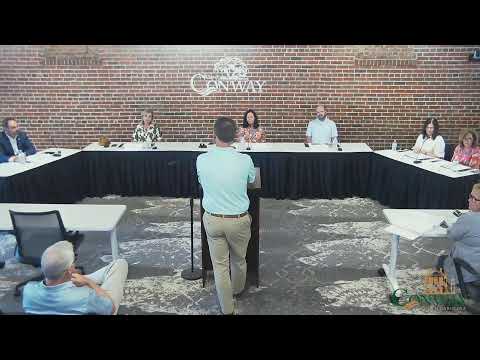
Conway zoning appeals board denies Lamar request to repair storm-damaged billboard
Summary
The City of Conway Board of Zoning Appeals on May 22 denied an appeal by Lamar Advertising to repair a storm-damaged billboard located at the corner of Highway 378 and Roos Street after city staff advised the sign’s required relocation put the structure under different rules in the Unified Development Ordinance.
The City of Conway Board of Zoning Appeals on May 22 denied an appeal by Lamar Advertising to repair a storm-damaged billboard located at the corner of Highway 378 and Roos Street after city staff advised the sign’s required relocation put the structure under different rules in the Unified Development Ordinance.
The board’s decision came after staff said the billboard, which had one pole in the South Carolina Department of Transportation (SCDOT) right of way, is no longer approved in that right of way under an updated SCDOT encroachment permit and that moving the structure off the right of way would make the device a new submittal. Miss Wilkerson, a city zoning staff member, summarized the staff interpretation, saying city rules require application of UDO section 12.10.6 for nonconforming signs and that section 11.4.0.14 prohibits traditional and off-premise billboards unless they qualify under the city’s billboard replacement program.
“The billboard is no longer approved in the SCDOT right of way,” Miss Wilkerson told the board, noting the updated permit contains a directive to “notify the owner of 1 pole in the right of way. They will need to move the sign back on the property.” The staff memo and the SCDOT permit history were offered into the record; an earlier SCDOT encroachment permit from 1973 was also provided by the applicant.
Brooks Marlow, who identified himself as the applicant’s agent, told the board the structure was damaged in a recent storm and that Lamar sought to repair the existing sign. Marlow argued the UDO’s general nonconformity provision allows repair when damage is less than 50 percent of appraised value. “Section 12.10.2(f) . . . nonconforming structure shall be permitted to be rebuilt or repaired after sustaining damage less than 50% of its appraised value. I feel like that’s pretty cut and dry,” Marlow said.
Ty Singleton, Lamar Advertising’s sales manager, said the sign had been effectively grandfathered and that SCDOT had historically allowed the structure to remain when Highway 378 was widened. “When 378 was widened, that board was still there. . . . It’s grandfathered in,” Singleton said, adding that SCDOT had asked only that the sign be shifted roughly “3 to 5 feet” so all poles would sit on adjacent private property owned by Kenneth Bellamy.
Board members pressed the applicant on whether moving the structure even a few feet would constitute a relocation that triggers the UDO’s prohibition on new off-premise signs. Several members said allowing the repair under those circumstances would undercut the ordinance’s clear goal of eliminating billboards over time and could create an unwanted precedent.
One board member cited the board’s variance criteria and said they could not find the “extraordinary and exceptional conditions” required to grant a variance because the nonconforming condition at issue was common to similarly situated properties. Another member said the 50 percent appraisal test would matter only when the sign could be reinstalled in the exact same location; because SCDOT’s updated permitting and its requirement to move at least one pole made this a new submittal, the board could not treat the application as a simple repair.
After discussion, a board member moved to deny the appeal on the basis that the required movement placed the sign under a separate set of rules and that the four variance criteria were not met; another board member seconded the motion. The board approved the motion; the transcript does not record individual roll-call votes or a numerical tally.
The board noted that Lamar may pursue the city’s billboard replacement program, which staff said requires removal of three legal nonconforming billboards within the city limits to permit one replacement digital billboard in a qualifying location. Staff told the board that the billboard at Highway 378 and Roos Street would count as one of the three if removed for that program.
The board did not set further conditions or remand the matter; the record indicates no written public comments were received. The applicant and Lamar representatives said they had provided an inventory of signs in the city to staff; the applicant described the inventory as listing “in the ballpark” roughly three dozen to a few hundred structures but did not provide a precise number during the hearing.
The board adjourned after approving the motion to deny the appeal. The applicant’s next steps were not stated on the record.