Get Full Government Meeting Transcripts, Videos, & Alerts Forever!
Get email alerts on the Land Use Lot Diminishment topic
No spam. Unsubscribe anytime.
Miami planning board defers Coconut Grove lot-diminishment appeal after heated public comment
Summary
The Miami Planning, Zoning and Appeals Board deferred a warrant appeal that would have allowed an existing 21,000-square-foot Coconut Grove parcel to be subdivided into three 7,000-square-foot lots. Staff had recommended upholding a denial; neighbors urged protection of the Neighborhood Conservation District.
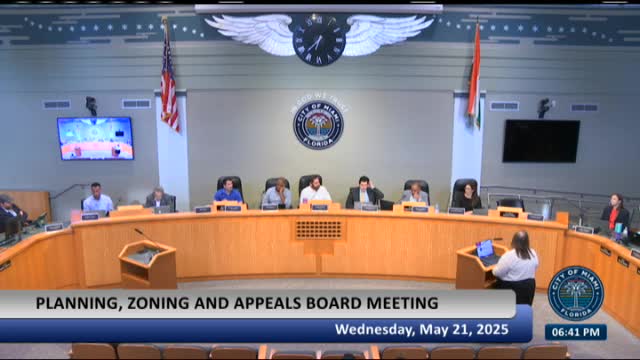
The Miami Planning, Zoning and Appeals Board voted on May 20 to defer a warrant appeal for 4055 Poinciana Avenue to its June 4 meeting after lengthy presentations and public comment.
The appeal was filed by Mark Grafton on behalf of Ponce Cana Avenue LLC, asking the board to overturn a Planning Department denial of a lot-diminishment warrant that would divide a 21,000‑square‑foot single-family building site into three 7,000‑square‑foot lots to allow construction of three single-family homes. “The planning department did deny the warrant,” Savanne Steiner, assistant director of planning, told the board, and staff recommended the board uphold that denial.
The issue matters, neighbors and staff said, because Coconut Grove’s Neighborhood Conservation District (NCD 3) and Miami 21 policies aim to preserve the neighborhood’s historic lot patterns, scale and tree canopy. Steiner told the board the average lot on the immediate block is about 9,300 square feet and the neighborhood average within the study circle is roughly 11,000 square feet; the Planning Department concluded three 7,000‑square‑foot lots would be inconsistent with Article 4, Table 12 and Miami 21 guiding principles.
The applicant’s team said the parcel was originally three platted lots and argued the proposed subdivision would better reflect other lots in the area. Mark Grafton, attorney for the applicant, noted the lots were platted and the applicant had secured demolition and building-permit work before staff’s denial. Co-presenter Francisco Garcia, a former city planning director and co-author of Miami 21, urged the board to consider historical zoning studies that originally excluded the subject parcel from protected overlays and argued the 7,000‑square‑foot lots would be “contextually appropriate.”
Residents who live near the site urged denial. “Higher density, increased traffic, and less green space — none of those are the goals of Miami 21 or the NCD,” said Debbie Dolson, 4205 Lenox Drive, who said her family has walked and cycled past the property for 55 years. Multiple neighbors, several speaking for themselves and neighborhood associations, warned the split would set a precedent for further subdivisions and increase vehicular activity.
Board discussion focused on the interpretation of Miami 21’s context‑sensitive criteria and on potential compromises such as a two‑lot subdivision instead of three. Several board members asked staff to provide additional analysis of the Coconut Grove NCD3 area (by lot‑size bands rather than averages), and to meet with the applicant about potential conditions — landscaping, open space, lot coverage, building massing and other safeguards — that might mitigate neighborhood impacts.
The board voted to defer the item to the PZAB meeting on June 4, 2025. Roll call recorded eight votes in favor of the deferral and one opposed (Paul Maine). The board asked staff to return with additional analysis of NCD3 lot-size distributions, options for a two‑lot division, and possible conditions to address design, landscaping, open space and parking impacts.
Staff repeatedly cautioned the board that the warrant review focuses on Miami 21 criteria and that design details are generally addressed later in the permitting or design-review process. The applicant said it would work with staff during the deferral period and was open to designing conditions and safeguards.
The deferral leaves the underlying planning questions unresolved; the board directed staff and the applicant to continue working toward a return presentation on June 4 that includes empirical lot-size breakdowns, potential conditions, and any alternative lot configurations discussed during the hearing.