Get Full Government Meeting Transcripts, Videos, & Alerts Forever!
Get email alerts on the Urban Forest And Climate Adaptation topic
No spam. Unsubscribe anytime.
City sustainability office details "Cool the City" tree‑canopy effort and new authority to set canopy requirements
Summary
Sustainability staff described a USDA‑funded Cool the City program to plant thousands of trees in heat‑vulnerable neighborhoods, previewed a draft urban-heat mitigation "Richmond Cool Book," and said state law passed in March 2025 enables local tree‑canopy requirements and a developer tree fund.
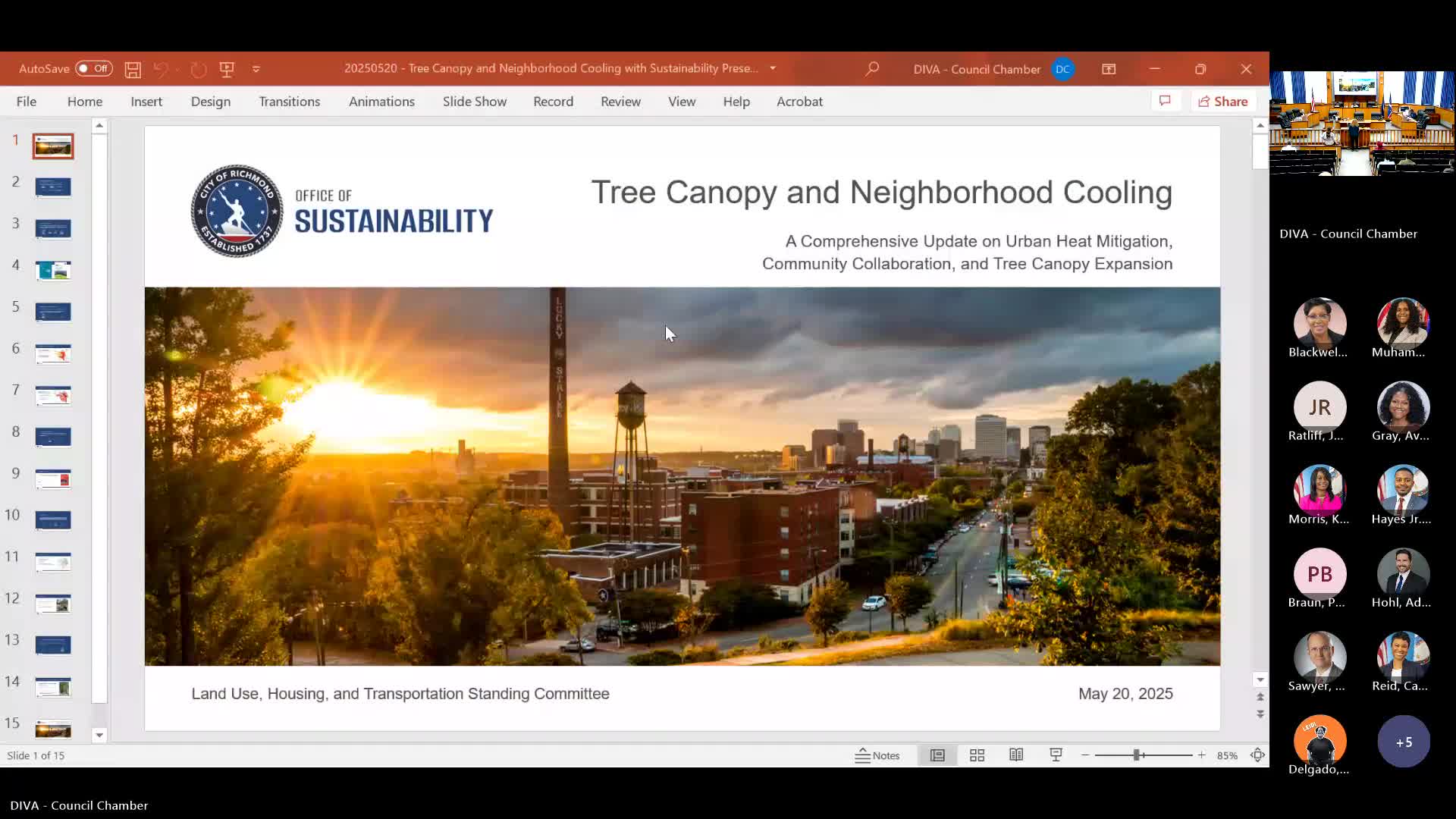
Laura Thomas, Director of Sustainability, and Tara Wharton, Sustainability Manager, briefed the Land Use Committee on Richmond’s urban tree‑canopy initiative aimed at reducing extreme‑heat risk and improving stormwater outcomes.
Wharton summarized a data‑driven approach that combines the newly completed Richmond Resilience Assessment and a draft Richmond Cool Book, the city’s first urban‑heat mitigation strategy. She said the assessment maps where climate vulnerabilities and social vulnerabilities converge and that "a majority of census tracts in the city are categorized as highly vulnerable to extreme heat," driven by limited canopy and extensive impervious surfaces.
The city has secured a five‑year USDA urban and community forestry grant for the Cool the City partnership that staff said will fund planting by multiple partners: Parks will plant 750 trees, community‑based organizations will plant more than 1,000 trees across priority neighborhoods, and the program will distribute over 1,500 trees to residents. Wharton said the initiative also includes plans for a food forest, neighborhood orchards and several Miyawaki (tiny) forests.
Wharton also told the committee that grant administrators have instructed staff to avoid certain terminology in written materials (for example, "climate change," "climate justice," "equity" and "race") but that reimbursements and program work continue. She said the city has been reimbursed for dollars spent to date.
Thomas and Wharton noted the passage of HB 2630 in March 2025, which expands authority across Virginia for localities to adopt tree‑canopy requirements and to establish a tree‑canopy fund for developers unable to meet on‑site canopy requirements. Wharton said staff will draft an ordinance for the zoning code setting minimum canopy requirements for new development consistent with the state caps and will present the draft for committee feedback before any formal code changes.
Committee members welcomed the work and asked for additional details as the draft ordinance and the Richmond tree plan are developed.