
Senate passes judiciary and public-safety omnibus after heated debate over training, victim services and Stillwater Prison
Get AI-powered insights, summaries, and transcripts
Subscribe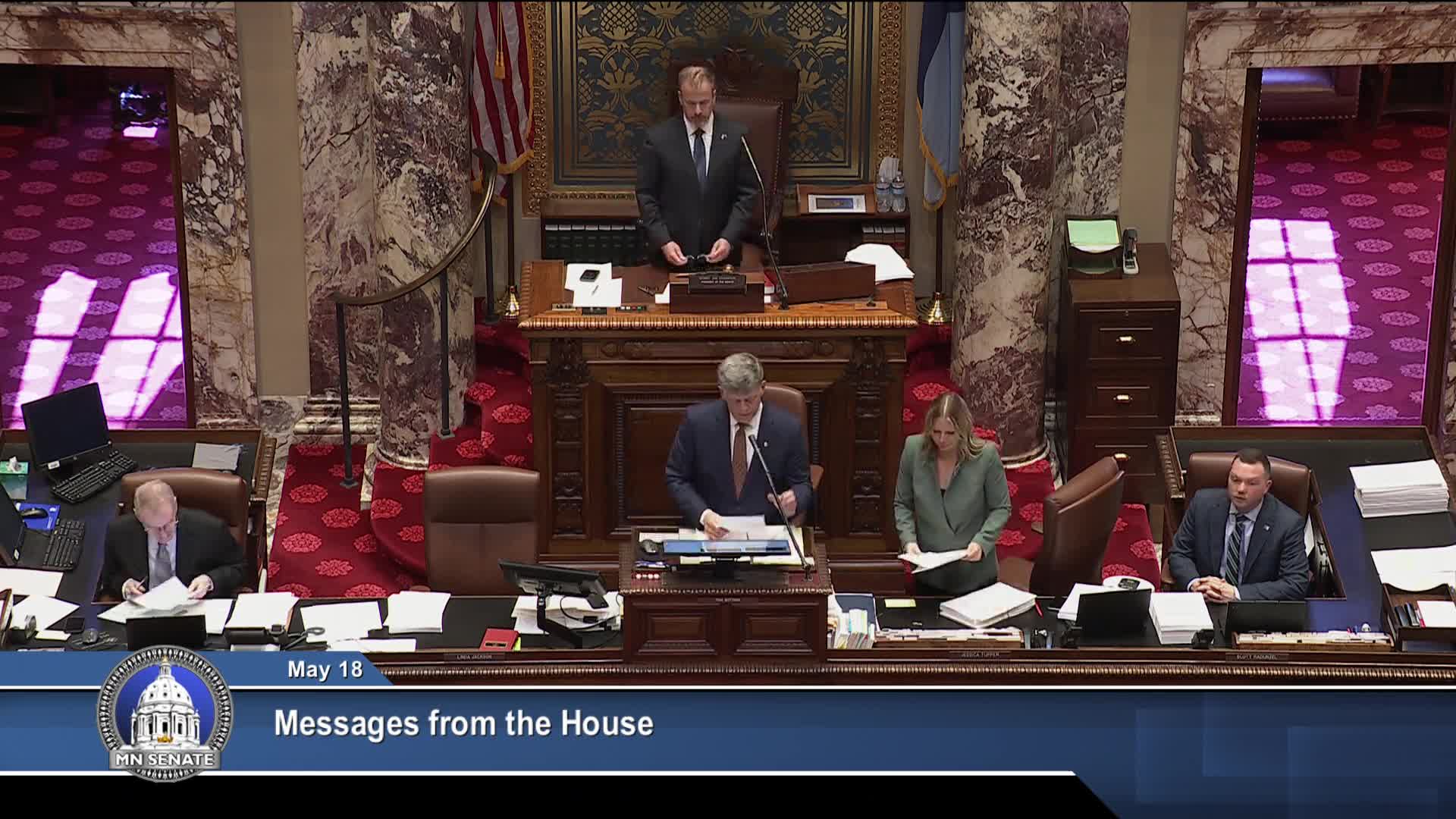
Summary
The Senate adopted the conference committee report on House File 2432, the judiciary and public-safety omnibus, after a close 34–33 vote. Debate focused on funding choices for police training and victim services, and an eleventh‑hour provision to phase out Stillwater Prison that drew sustained criticism for process and oversight.
The Minnesota Senate narrowly adopted the conference committee report on House File 2432, an omnibus judiciary and public‑safety policy and appropriations bill, in a recorded vote the secretary announced as 34 ayes and 33 nays.
Senator Scott Latz (conference committee author) presented the bill package as a targeted, if constrained, set of investments for courts, corrections and public safety that sought to protect crime victims, support law enforcement and fund technical changes to state law. "This is a slim but effective and carefully targeted judiciary and public safety bill," Latz said on the floor.
The conference report set specific funding targets and appropriations that drew disagreement about tradeoffs. Latz said the judiciary target was $19,163,000 with tails of $54,882,000, and a separate public safety target of $88,260,000 with tails of $57,257,000. The bill includes appropriations for victim services, the Philando Castile training fund, prosecutor training grants, use‑of‑force training and critical radio infrastructure, among other items. Latz cited a $9,884,000 appropriation for the Philando Castile training fund and $7,232,000 for crime victim services in the first biennium, plus other funding streams.
Opponents said the bill left important law-enforcement training priorities underfunded and that the conference committee shifted money to agency operating adjustments at the request of the executive branch. Senator Jim Limmer argued the conference report reduced funding reserved for police training and removed funds requested for multi‑jurisdiction violent crime enforcement teams (VSET). "We also had the request from law enforcement for adequate funds beyond training, which are no longer in the bill," Limmer said.
A central flashpoint in debate was a late provision authorizing a phased closure of Stillwater Prison, a facility that senators said houses about 1,200 inmates and employs roughly 500 staff. Multiple senators criticized that the closure language was added without committee hearings or clear legislative deliberation. Senator Limmer and others said the provision amounted to a "backroom deal" and warned of risks to corrections staff, inmates and public safety if capacity is reduced without a replacement plan.
Supporters of the closure argued the facility is antiquated and unsafe. Senator Murphy, who said she had toured Stillwater, called the prison "unsafe for the people who work there" and for those incarcerated, and described the planned phase‑in as designed to protect workers and inmates while the Department of Corrections implements the change. Conference committee members and other senators said they will pursue oversight hearings later in the year; the author also pledged phased implementation and promised legislative oversight.
Other policy items in the conference report drew support from across the aisle: an expansion of peace officer death benefits, creation of a task force on mandatory minimum sentences, funding for forensic examiners and adjustments to mobile tracking-device use for fleeing vehicles. Some members praised inclusion of mandatory minimums for first‑degree trafficking and the change to the statute of limitations for arson.
The roll-call result on the conference report was 34–33 in favor; senators later recorded final passage of the bill and its title agreed to as amended by the conference committee.
Votes at a glance House File 2432 (judiciary, public safety, corrections, and government data practices policy) — Motion to adopt conference committee report: Moved by Senator Scott Latz; outcome: adopted; roll-call vote: 34 yes, 33 no.
What changed and why it matters The conference report funds some targeted training and victim‑service priorities but also shifts a large share of the budget to agency operating adjustments, according to multiple floor speakers. Sponsors said they included funding for the Philando Castile training fund and additional victim‑services funding; critics said dedicated training dollars were reduced from prior expectations, potentially shifting costs to local property taxpayers or counties.
Concerns and clarifications Opponents repeatedly criticized the addition of the Stillwater closure directive to the conference report without separate committee hearings, arguing it short‑circuited public and legislative review. Supporters said the facility is outdated and unsafe and that a phased approach with oversight will protect staff and incarcerated people.
Next steps The bill passed the Senate after the close vote; conferees and some authors indicated they will schedule oversight hearings this summer and follow the phased implementation of corrections changes closely.