Get Full Government Meeting Transcripts, Videos, & Alerts Forever!
Get email alerts on the Flood Control Budget topic
No spam. Unsubscribe anytime.
Cochise County supervisors debate redirecting flood-control funds toward recharge and road drainage
Summary
Supervisors discussed the Flood Control District budget, questions about contingency balances, planned recharge projects near Palominas and Sierra Vista, and directed staff to prepare a June work session with mapping and project details for potential fund shifts.
The Cochise County Board of Supervisors discussed the Flood Control District budget and a slate of planned projects during an agenda item presented by county staff, with supervisors asking whether contingency balances could be used to reduce the district tax and where remaining funds should be spent.
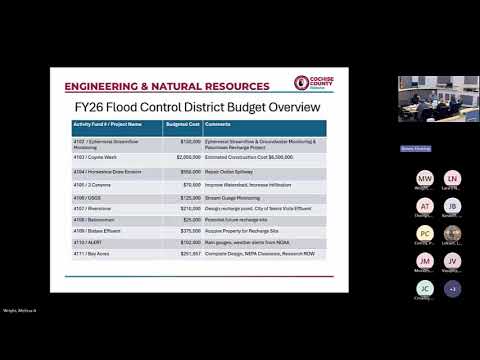
Ms. Gilman told the board the presentation was intended “to bring you more information to address some of those questions and get direction from the board regarding that budget specifically.” Deputy County Administrator Joe summarized pending projects and said, “This is just kind of a list of the projects that we have on the docket for the next year that, you know, either construction or planning is scheduled to happen, and where that money would be expended.”
Why it matters: Supervisors pressed whether the Flood Control District’s contingency reserves could allow the district tax rate to be reduced or eliminated, and whether planned studies and designs are the best use of funds. The discussion identified trade-offs between engineering-heavy solutions (lined channels, concrete structures and formal design work) and lower-cost, nature-based measures (rock gabion walls, slowing flows to increase infiltration). Several supervisors said they want more projects and spending moved to the county’s rural side where groundwater levels are deeper and recharge may have greater local benefit.
Key details: Board members questioned specific line items and project costs. One supervisor asked why a recharge-pond design was listed at roughly $210,100 and asked staff to explain what the design scope included. Staff characterized a major no-activity line in the Flood Control budget as general wages and benefits and noted a $1 million contingency for potential road drainage and road upgrades. A supervisor also pointed out a $3,000,000 number shown on the materials as an overall funds line and separately questioned a $251,000 item listed for “Vegas” (detail not specified in the meeting).
Project scope and geography: Discussion referenced the Palominas recharge pilot (described in the packet as testing multiple methods at 13 stations to determine effective recharge techniques), Riverstone-related efforts to collect urban runoff north of the Sierra Vista treatment plant EOP/EOC for recharge, and streamflow monitoring locations across basins including the San Pedro, Wilcox and Douglas basins. Board members suggested shifting some attention and funds away from San Pedro-focused projects and toward recharge and retention on the county’s eastern/rural side (Gabion-style rock retention in creeks and draws was raised repeatedly as a lower-cost, locally supported option).
Actions and next steps: Supervisors agreed to a follow-up: staff will prepare mapping, project-level details and budget options and return for a focused work session in June. County staff said they will compile flooding-location mapping (five consistent road-flood sites were cited as examples) and additional project information ahead of that session. No formal vote was taken on changing tax rates or reallocating funds during the meeting.
Dissent and constraints: Several supervisors cautioned that some projects are constrained by existing contracts or grant agreements and that litigation and federal stakeholders (Fort Huachuca was discussed in the context of past litigation and national-security concerns) have shaped past spending decisions. Board members also noted that recharge benefits differ across basins and that local geology and watershed differences make a one-size-fits-all approach impractical.
What’s next: The board scheduled an in-depth June work session on Flood Control District projects and asked staff to provide clearer cost breakdowns, mapping of flood-prone roads, and proposals for how contingency or project funds could be shifted without violating existing grant or contract obligations. The meeting then moved on to a scheduled jail-district presentation and was adjourned.