Get Full Government Meeting Transcripts, Videos, & Alerts Forever!
Get email alerts on the Human Services Policy topic
No spam. Unsubscribe anytime.
Senate adopts human services policy bill after debate over placement timelines and assisted‑living protections
Summary
The Minnesota Senate on Feb. 16 adopted the conference committee report on House File 2115, a human services policy bill that modifies provisions relating to aging and disability services, the Department of Health, Direct Care and Treatment, behavioral health and the Department of Human Services Office of Inspector General.
The Minnesota Senate on Feb. 16 adopted the conference committee report on House File 2115, a human services policy bill that modifies provisions relating to aging and disability services, the Department of Health, Direct Care and Treatment, behavioral health and the Department of Human Services Office of Inspector General.
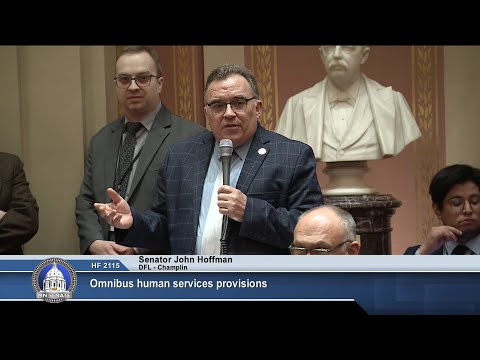
Senator Hoffman moved adoption of the conference committee report and urged colleagues to support the measure. “House file 21 15 is a bipartisan conference committee report, which all conferees voted for, and we focused on a number of key provisions, program integrity, efficiency and modernization,” Senator Hoffman said on the floor. The motion to adopt prevailed and the bill was advanced for third reading and final passage.
Why it matters: The bill changes policies that affect Minnesotans who rely on state human services, including adjustments intended to strengthen program integrity and streamline administrative requirements for behavioral health and substance use disorder providers. It also includes provisions that revise oversight of long‑term care and assisted‑living settings.
Key provisions and debate - Program integrity and billing: Senators said the bill targets illegal kickbacks in the child care assistance program, aligns enforcement with state theft laws and seeks to prohibit duplicative billing practices across Department of Human Services programs. Senator Rasmussen noted these steps as measures to “protect taxpayer dollars.”
- Assisted living and resident protections: Supporters, including Senator Dibble, described amendments that aim to provide parity in certain protections for residents of assisted living similar to those in nursing homes. Dibble said the conference process preserved provisions that strengthen residents’ rights, including limits on binding arbitration as a condition of admission for assisted living and clarifying the role of registered nurses in medication monitoring.
- 48‑hour placement rule and capacity concerns: Senator Rasmussen pressed for clarity about a provision that extends the state’s 48‑hour placement rule for individuals needing state facility placement. “One concern ... is that the 48 hour rule was put in place years ago ... we have people ... waiting a hundred days to get into a direct care and treatment facility,” Rasmussen said, asking how the extension would be addressed pending finance bill action. Senator Hoffman replied that funding and capacity increases — including bonding to add 51 beds at the Miller Building — were included in the finance discussions and that the Miller Building bonding is contingent on related work in the finance bill.
- Regulatory balance and paperwork reduction: Supporters described efforts to balance resident safety and operational realities for providers, while cutting paperwork and administrative requirements for mental health and substance use disorder providers.
Votes and next steps Senator Hoffman moved final adoption of the conference committee report and the bill was advanced; the Senate proceeded to give the bill its third reading and moved toward final passage. (Roll‑call detail for final passage was read on the record.)
Ending note Senators who spoke in support described the conference report as a set of compromises that preserve core protections for vulnerable populations while removing some administrative burdens. Several senators said follow‑up work would continue in the finance negotiations to secure capacity funding tied to placement timelines and facility expansions.