Get Full Government Meeting Transcripts, Videos, & Alerts Forever!
Get email alerts on the Corrections Jail Conditions topic
No spam. Unsubscribe anytime.
Residents and jail staff describe unsafe conditions at 201 Poplar; commissioners discuss hazard pay, new jail funding and oversight
Summary
Advocates and corrections employees described unsanitary, unsafe conditions at the Shelby County jail and urged commissioners to secure funding for a new facility and to add hazard pay for jail staff.
Multiple speakers at the Shelby County Commission meeting described hazardous and unsanitary conditions at the Shelby County jail facility at 201 Poplar and called on the commission to accelerate construction of a new jail and to add hazard pay for corrections and related staff.
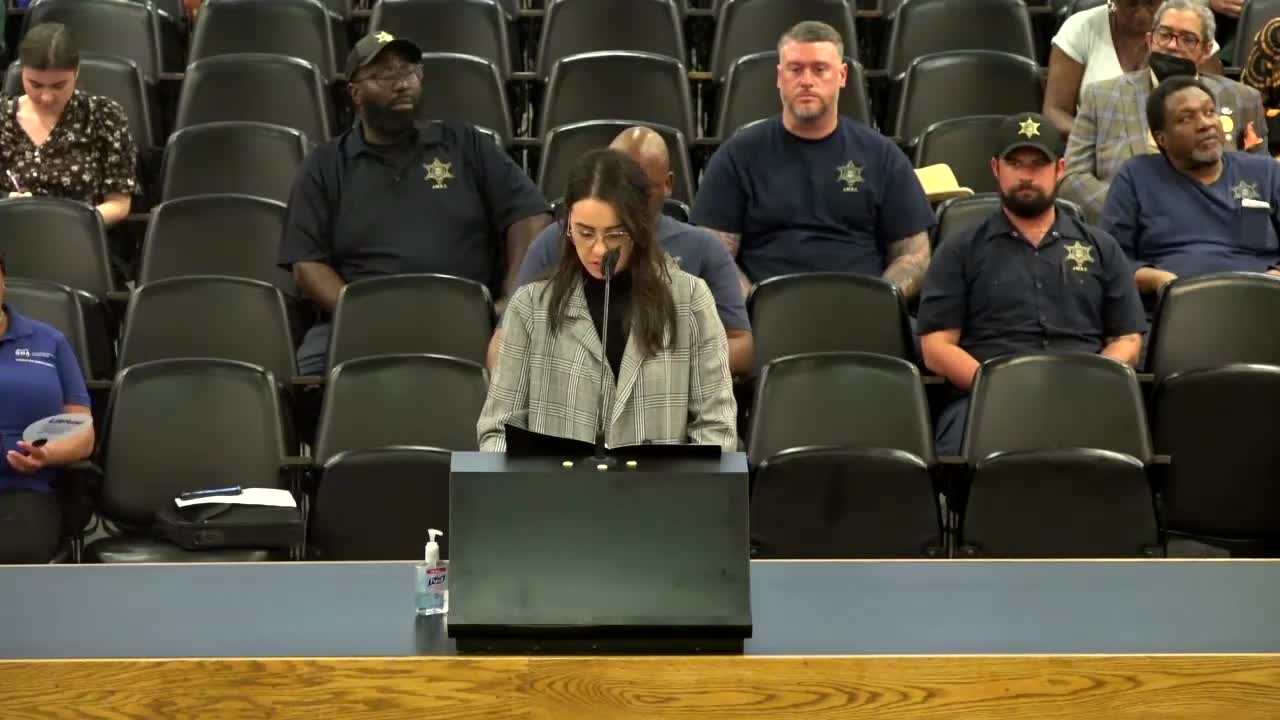
Laramie Wheeler, advocacy coordinator at Just City, read a letter from an incarcerated person describing broken sinks and toilets, mold in showers, nonfunctioning smoke detectors, infestations of roaches and mice, limited access to the law library, delayed grievance responses and a lack of proper cleaning supplies. Wheeler cited Tennessee Code Annotated sections 41-4-108 through 41-4-116 and 41-4-111, which set standards for cleanliness, bathing facilities, water and bedding, and said those statutory requirements were not being met.
Shelby County Sheriff's Office employees also spoke. Jeremiah Trundle, who said he works for the Sheriff's Office, described repeated on-the-job exposure to hazardous conditions including exposure to fentanyl, COVID, scabies, bed bugs and a reported monkeypox case; he and other staff detailed physical assaults, threats and the need for personal protective responses. Trundle said other county corrections personnel receive hazard pay through other agencies and asked the commission to extend similar pay to his unit.
Sheriff's Office Chief Administrative Officer Alicia Lindsey told commissioners the office considers the jail hazardous and said job postings already disclose that. Lindsey said the department had not included additional hazard pay in its budget submission but said she would calculate costs if the commission requested figures. She later provided a department estimate for a possible hazard-pay amount for a 19-person unit: $19,608 annually (based on $43.33 per person per pay period in the example provided to commissioners).
Commissioners described prior efforts to address jail conditions. Several said they had sought state approval for a temporary sales-tax question to fund a new jail but that the bill was blocked in the House after passing the Senate; they said the county would continue to pursue options. Commissioner Ed Ford and others urged public advocates to pressure state representatives who opposed the measure.
Commissioners and public commenters also discussed oversight and accountability. Commissioner Sugarman asked for confirmation that three previously approved positions for a citizen law-enforcement review committee (to investigate jail conditions among other duties) appear in the commission's budget; she said the committee needs staff to investigate complaints. Advocate Laramie Wheeler and others urged the commission to follow through on both short-term repairs and long-term capital funding for a new facility.
Why it matters: Speakers characterized conditions at the county jail as a public-safety, legal and humanitarian problem; commissioners said the county must act on short-term remedial steps and on longer-term capital solutions while protecting staff and inmates.
Ending: The commission asked the Sheriff's Office to provide cost estimates for hazard pay and said commissioners would continue to press for state and local funding and follow-up reports in committee and budget subcommittees.