Get Full Government Meeting Transcripts, Videos, & Alerts Forever!
Get email alerts on the Unemployment Insurance topic
No spam. Unsubscribe anytime.
Virginia employment commission: trust fund stronger than 2019 peak; solvency metric still affected by pandemic years
Summary
Virginia Employment Commission officials told a legislative subcommittee the UI trust fund balance has recovered beyond its 2019 peak and claims volumes have normalized, though statutory solvency measures remain depressed by pandemic-era payouts.
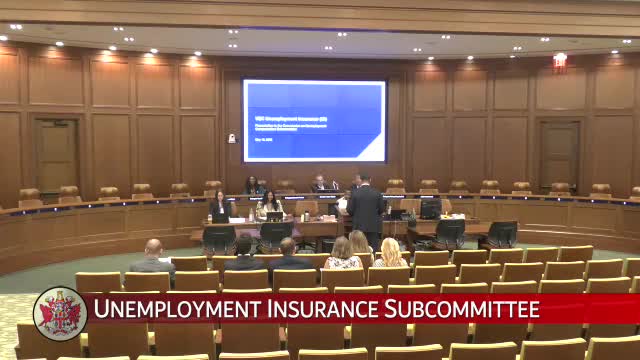
The Virginia Employment Commission's Unemployment Insurance trust fund has a current raw balance of about $1.56 billion, higher than its pre-pandemic 2019 peak, Commissioner Mitch Mellis told the Unemployment Insurance Subcommittee on public testimony day.
Mellis, the commissioner of the Virginia Employment Commission, said the fund's balance and related metrics show long-term strengthening even as the statutory solvency percentage remains low because the calculation still includes the very large COVID-era payouts. "The trust fund's raw balance of $1,600,000,000 is really a very much indicator of the strength of the trust fund's health. It's a very positive indicator," Mellis said.
Why it matters: the trust fund balance affects employer tax rates and the state's fiscal readiness for a rise in unemployment; the statutory solvency percentage guides policy but currently reflects pandemic-era anomalies.
Mellis presented several data points to the subcommittee chaired by Senator Adam Evan. He said initial claim volumes have returned to pre-pandemic levels — roughly 130,000 to 140,000 initial claims annually after a peak of more than 1,000,000 claims in 2020 — and that continuing claims remain far below historical peaks. "We're keeping a close eye on 2025 data, but current trends do not yet indicate a systemic concern," Mellis said.
On solvency, Mellis said the calculated solvency percentage stands at about 57 percent. He explained that the statutory formulation uses the highest three years of payout, which still includes pandemic years with unusually high benefit payments: "The solvency rate is likely gonna continue being low because the COVID year, which was extremely high is of an anomaly... So the solvency will be impacted until perhaps consideration is given to a different variation of determination of solvency," Mellis said.
Employer tax changes and administrative fee: Mellis said employer UI tax rates returned to standard methodology after a pandemic-era freeze expired Dec. 31, 2024. The average state UI tax per employee was $71.24 in 2024, which included a $2.40 pool tax; for 2025 the average tax per employee was projected to decrease to $53.60 (applied to the first $8,000 of wages). He also said the General Assembly approved a revenue-neutral administrative fee to support VEC operations and that the VEC had collected just over $10.6 million from that fee so far this calendar year.
Claims, benefits and duration: Mellis reported an average weekly benefit amount near $348 for recent years and that average benefit duration has risen gradually to just over 12 weeks in 2024. He noted Virginia's unemployment rate has been low and stable, averaging 2.5 to 2.9 percent over the prior two years and measured at 3.2 percent in March 2025 compared with a national rate of 4.2 percent.
Federal layoffs and contractor claims: In response to questions from committee members, Mellis said VEC had received roughly 1,000 initial claims from federal employees and about 1,800 total claims when including contractors tied to large federal contracts. He said continuing claims from federal employees were approximately 145 and that, to date, those filings had not materially affected the trust fund.
Backlog, appeals and processing improvements: Mellis said the VEC has eliminated pandemic-era backlogs for most claims and has an appeals working inventory of about 1,000 cases, with average appeal processing time down to about 10 days (he noted a statutory 10-day notice that constrains further reductions). "We have no backlogs," Mellis told the subcommittee. He also described administrative savings of roughly $17 million over several years and said the administrative fee gives the agency steady funding for IT and operations rather than the previous boom-or-bust federal funding model.
Outstanding items: Mellis acknowledged a small number of manually processed paper checks remain for reversed appeals; he said those cases require multi-signature accounting steps and that the agency would provide a count on request.
Public comment and praise: Advocates who addressed the subcommittee, including Flannery O'Rourke of the National Employment Law Project, thanked the VEC for improvements to its website and outreach to laid-off federal employees. Pat Levy Lavelle of the Legal Aid Justice Center urged the commission to keep monitoring metrics and to maintain investments in systems and staffing as the group's statutory work moves to the full commission.
The subcommittee did not take formal votes because there was not a quorum. The meeting adjourned and members planned to reconvene as the full Commission on Unemployment Compensation at 11 a.m.