Get Full Government Meeting Transcripts, Videos, & Alerts Forever!
Get email alerts on the Research And Observations topic
No spam. Unsubscribe anytime.
LSU outlines coastal research, new programs and observation tools at CPRA meeting
Summary
LSU researchers updated the Coastal Protection and Restoration Authority Board on research and education work at the new Center for River Studies, including deployment of high-frequency radars, new bachelor’s program in coastal meteorology and partnerships on navigation and offshore sediment studies.
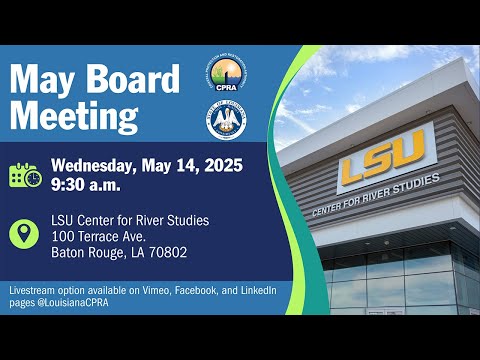
Dr. Wilson, representing Louisiana State University, gave a presentation to the Coastal Protection and Restoration Authority Board on LSU’s Center for River Studies and related coastal research, education and outreach activities.
The presentation emphasized LSU’s work to link research, education and workforce development with coastal planning and coastal programs. Dr. Wilson described a cluster of projects spanning river science, offshore continental-shelf studies, remote sensing and new observation tools, and highlighted LSU’s effort to consolidate points of contact so state and local partners can more easily find campus expertise.
Dr. Wilson said LSU is expanding observational capacity in the Gulf and inland waterways. He said a federal contract has been awarded and the university has support to acquire and install five high-frequency radars on the Louisiana coast to deliver real‑time surface current data for research and emergency response. He described how those radars can support oil‑spill response, search and rescue and marine operations.
The presentation also covered several ongoing research grants and facilities: a multi‑million‑dollar project led by faculty in geology and geophysics to characterize the lower Mississippi River; a Bureau of Ocean Energy Management–funded study of continental‑shelf stability; WaveSys stations and remote‑sensing work in the EarthScan Lab; and a Center for Geoinformatics that provides high‑precision surveying. Dr. Wilson noted partnerships with NOAA and the U.S. Army Corps of Engineers on projects that use LSU data for planning and operations.
Dr. Wilson announced a new bachelor of science degree in coastal meteorology recently approved by the Board of Regents and discussed plans to increase student field experiences and internships. He described a Coastal Ecosystem Design Studio that co‑produces research and design with stakeholders and cited engagement with port and parish officials during recent field visits.
Board members asked how local governments and industries can find the right LSU contacts for technical questions. Dr. Wilson said the Institute for Energy Innovation and other campus units serve as entry points and that the university is working to centralize outreach so partners can be directed to the appropriate faculty or unit.
Board members and parish officials raised insurance and flood‑modeling concerns during Q&A, asking whether LSU can help review or ground‑truth FEMA and other federal models. Dr. Wilson noted ongoing work with academic units (e.g., a real estate research institute, flood modelers and building‑code efforts) and encouraged local partners to engage the Coastal Ecosystem Design Studio or relevant LSU institutes for short‑term analyses or student projects.
Dr. Wilson closed by thanking the board for its partnership with CPRA and noting the long history of LSU coastal research dating to the Coastal Studies Institute.