Get Full Government Meeting Transcripts, Videos, & Alerts Forever!
Get email alerts on the Climate Element topic
No spam. Unsubscribe anytime.
Clark County planning commission reviews draft climate element, commissioners press for clearer definitions and baseline data
Summary
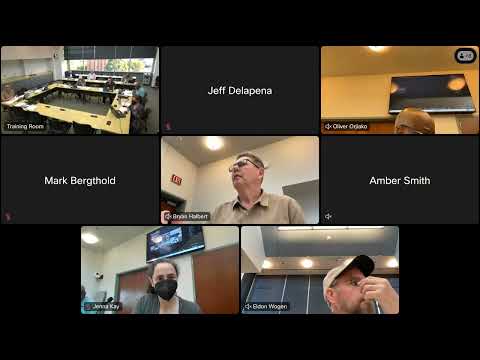
Acting Chair Brian Halbert convened the Clark County Planning Commission on June 5, 2025, for a work session focused on the proposed climate element (Chapter 14) of the county comprehensive plan, staff briefings and cross-references to the rural and parks chapters.
Acting Chair Brian Halbert convened the Clark County Planning Commission on June 5, 2025, for a work session focused on the proposed climate element (Chapter 14) of the county comprehensive plan, staff briefings and cross‑references to the rural and parks chapters. Jenna Kaye, a community planner with Clark County Community Planning, walked the commission through goals and policies the county drafted with input from a Climate Advisory Group (CAG) and the Environmental Justice Coalition.
Why it matters: The climate element consolidates resilience and greenhouse‑gas reduction policies required under recently enacted state guidance and House Bill 1181. Commissioners said they supported the overall aims but pressed staff for clearer definitions, baseline data and implementation detail before the element advances to public hearing and a county council recommendation.
Kaye told commissioners the draft chapter flags which policies are intended for greenhouse‑gas reduction (GHG), resilience (RES) or both and includes cross‑references to the rural and parks chapters. "We have a legislative due date of the end of this year to implement this new piece of legislation," Kaye said, summarizing the statutory timeline staff is using for the comprehensive‑plan update.
The CAG and an Environmental Justice Coalition helped draft the material, Kaye said; staff incorporated the advisory recommendations and added cross‑references so related policies appear in the land‑use and parks chapters. Kaye also said four goals in the draft did not receive unanimous support from the CAG and that staff included a memo documenting members' votes and reasons.
Commissioner concerns focused on several recurring themes:
- Vagueness and implementation: Multiple commissioners described many policies as high‑level and "wishy‑washy." Commissioner Eldon said, "it just sounds kinda wishy washy," and asked how staff would turn broad goals into measurable action. Commissioners pressed staff to bring clearer implementation language and metrics as the element moves forward.
- Definitions and wording: Commissioners asked for explicit definitions for terms such as "holistic," which appears in goals on local food economies and regenerative agriculture. Kaye said the team would consider adding the term to the glossary and pointed commissioners to written explanations the CAG provided when they voted.
- Data and baselines for tree canopy: Commissioners repeatedly requested a baseline tree‑canopy inventory before setting targets. Kaye said Clean Water is finishing a tree‑canopy assessment for the urban unincorporated area but that the county lacks comparable rural data. She said a tree plan and implementing ordinance (policy 14.9.0.2 in the draft) should include baseline measurements so future progress can be measured.
- Food distribution and agriculture: Commissioners asked whether the county has identified food distribution nodes in hazard‑prone areas and whether relocation or mitigation would be necessary. Kaye said staff would need to research warehouse locations, routes and hazards in partnership with cities and community groups and that the policy is intended as a high‑level guide to inform future work.
- Forestry and clear‑cutting: The draft includes an advocacy policy urging the county to press the state to curb clear‑cutting and protect legacy trees. Commissioners noted the county has limited authority over state forest practices; Kaye described the policy as an advocacy position to be directed to the legislature and the Washington State Department of Natural Resources. Commissioners debated the phrasing; one said "prohibit clear cutting" may be too broad and suggested softer language such as reducing clear‑cutting or protecting specific legacy stands.
- Building and energy rules amid litigation: The draft includes multiple policies encouraging energy‑efficient buildings and incentives for electrification. Kaye and commissioners noted Initiative 2066 (a voter initiative protecting access to natural gas) is currently in litigation. Kaye said a King County Superior Court judge found the initiative unconstitutional and the decision is under appeal; she said staff may amend local policies if the state courts alter the initiative’s status.
Staff directions and next steps: Commissioners and staff repeatedly said the next stage is refinement rather than final adoption. Halbert and Kaye asked commissioners to submit written comments and noted staff will:
- Provide additional research and clarifications on questions raised (for example, whether food distribution nodes sit in mapped hazard areas and more detail about barriers to agriculture cited by stakeholders). - Develop baseline data where missing — notably for tree canopy across rural and urban unincorporated areas — as part of any future tree plan or ordinance. - Continue cross‑referencing climate policies into related chapters (land use, transportation, housing, environment, parks) and coordinate with city staff and county divisions (Clean Water, Public Works) where programs overlap.
No formal vote was taken during the work session. Kaye said the draft and supporting materials — including a memo documenting the CAG vote, analysis tables and a working glossary — will remain available to commissioners and the public and that staff expect to bring additional chapters (environment, transportation, land use/housing) to future work sessions.
Acting Chair Halbert closed the session by encouraging commissioners to review the materials and return questions to staff. "Well done," Halbert said to Kaye after the presentation.
The planning commission will continue its review in upcoming work sessions; Kaye said the environment chapter will likely be next and that staff plan to post drafts and solicit public comments prior to hearings.