Get Full Government Meeting Transcripts, Videos, & Alerts Forever!
Get email alerts on the Housing Affordability topic
No spam. Unsubscribe anytime.
Riley County Commission finds 'adverse effects' for Manhattan RHID and adopts resolution
Summary
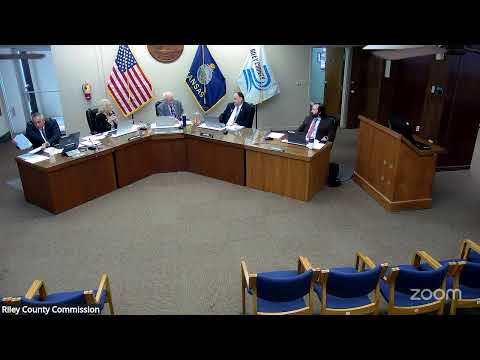
The Riley County Commission on June 12 voted to find that the City of Manhattan's proposed RHID for the LK Townhomes project would create adverse effects on Riley County and adopted a resolution reflecting that finding.
The Riley County Commission on June 12 voted to find that the City of Manhattan's proposed reinvestment housing incentive district (RHID) for the LK Townhomes project would create adverse effects on Riley County and adopted a formal resolution reflecting that finding.
County staff and officials told the commission their analysis raised fiscal and policy concerns about the proposal, which would enable a developer to capture future property-tax increment from newly developed homes on existing lots in Manhattan for a defined period. Britney Phillips, Riley County budget and finance officer, told commissioners the county's review found the county's share of captured revenue that would be paid to the developer could total roughly $557,173.73 through 2040 and that the RHID would shift tax burden onto other taxpayers during the capture period. Phillips said the applicant's own March presentation had described the development as “an all or nothing development,” and county staff flagged replacement of public infrastructure, special assessments and the length of the capture period as concerns.
Why this matters: Manhattan and Riley County face a recognized shortage of workforce housing, but the RHID tool diverts future property-tax increments for a period (15 years in this case) to finance development incentives. The Riley County Commission concluded that, for this project, the near-term fiscal and policy tradeoffs outweighed potential long-term benefits and adopted a resolution finding adverse effects. The City of Manhattan and other taxing entities previously reviewed or supported the project and state housing officials had awarded related grants; the county's action is a separate legal finding by the commission.
What county staff presented
Jacob Hansen, interim Riley County counselor, outlined the board's procedural options: take no action, approve/participate, or make findings of adverse effect and adopt a resolution. Anna Berson, Riley County appraiser, provided valuation context used by staff: Riley County's certified assessed valuation for budget work was $853,082 (a 3.05% increase in the certified value), and about 40% of the county's full value is already exempt from taxation, a figure Berson cited when staff discussed fiscal capacity.
Phillips summarized the county's fiscal review and legal background. She cited state guidance and KHRC (Kansas Housing Resources Corporation) moderate-income definitions used by the project's grant application, and she summarized a draft analysis produced by the county's financial adviser showing the county portion of captured revenue (the amount paid to the developer rather than retained by the county) totaled about $557,173.73 through 2040 under the assumptions modeled. Phillips also noted Riley County GIS records list the lots proposed for purchase at $18,000 each while the Frontier Development presentation had described a purchase price of $40,000 per lot.
Public comment: proponents and opponents
More than a dozen people spoke during the public-comment period. Gabriela Vega, a Manhattan resident and taxpayer, urged the commission to support the project (or at least not block it), saying it would create workforce housing and new taxpayers, and noting other governing bodies had already supported the project: “We need housing,” Vega said. Several local employers, the Manhattan Area Chamber of Commerce and nonprofit housing advocates also urged the county not to block the development and warned that denying participation could push projects to neighboring jurisdictions.
Opponents raised concerns about neighborhood scale, historic homes, and the project's financial structure. Mel Borst, a Manhattan resident, highlighted two older homes on one of the proposed lots and argued the city's rezoning and proposed redevelopment would destabilize the neighborhood and were under legal challenge in court.
A number of commenters who had helped develop local housing studies stressed the supply shortage and argued that public–private incentives have been necessary in other Kansas communities to produce workforce housing that the private market will not deliver on its own. Scott Seal, a member of the city's housing steering committee, said the developer's contract was contingent on RHID approval and warned that “If you vote no today, that contract is dead,” meaning the parcels could remain undeveloped for years.
The commission's action and what it does (and does not) do
After discussion, a commissioner moved findings that the RHID would cause adverse effects on Riley County, listing six points from the county policy (including potential loss of tax revenue, increased burden on delivery of public services, and that the term requested exceeded the county's 10-year guideline). The board voted in favor and then executed the attached resolution making the findings. The motion passed by voice vote; commissioners voiced their assent.
County staff and others noted the City of Manhattan and Kansas Housing Resources Corporation have separate authority to proceed with their grant and RHID processes; county counsel and staff told the board the KHRC grant would not automatically be lost if Riley County adopted adverse findings. The county's resolution is a formal, local finding and does not by itself cancel city actions or state grant awards.
Numbers and clarifications from the meeting
- Certified assessed valuation used for county budget work: $853,082 (3.05% increase). (Rich Vargo, county clerk; Anna Berson, county appraiser.) - Size of proposed project discussed by presenters: 26 dwelling units (developer materials and KHRC application). (Applicant materials summarized in county staff packet.) - County-modeled county-share of captured revenue paid to developer through 2040: approximately $557,173.73 (county financial adviser draft). (Britney Phillips.) - Appraised lot values per Riley County GIS: $18,000 each; purchase price discussed in developer presentation: $40,000 per lot. (County GIS and Frontier Development presentation cited by staff.)
What happens next
The commission's resolution documents the county's formal finding of adverse effects on June 12. Staff noted that the City of Manhattan, the school district and KHRC have their own processes; KHRC staff told county staff earlier in the week that the project's state grant award would not automatically be lost if the county adopted adverse findings. Whether the developer will proceed, modify terms or seek other approvals is up to the applicant and the City of Manhattan. The county expects no immediate fiscal change from the resolution, but county officials said the decision clarifies the county's policy interpretation and will affect future RHID applications.
Ending
Commissioners and staff emphasized the complexity of balancing housing supply needs with fiscal duty to existing taxpayers. The county's vote creates an official local record of those fiscal concerns while leaving the city's and state's separate review processes intact. The City of Manhattan and other stakeholders may respond through their existing administrative or legal channels.