Lifetime Citizen Portal Access — AI Briefings, Alerts & Unlimited Follows
Council committee advances PCDC Omnibus bill to extend pretrial presumption, expand MPD credit options and address fare evasion
Loading...
Summary
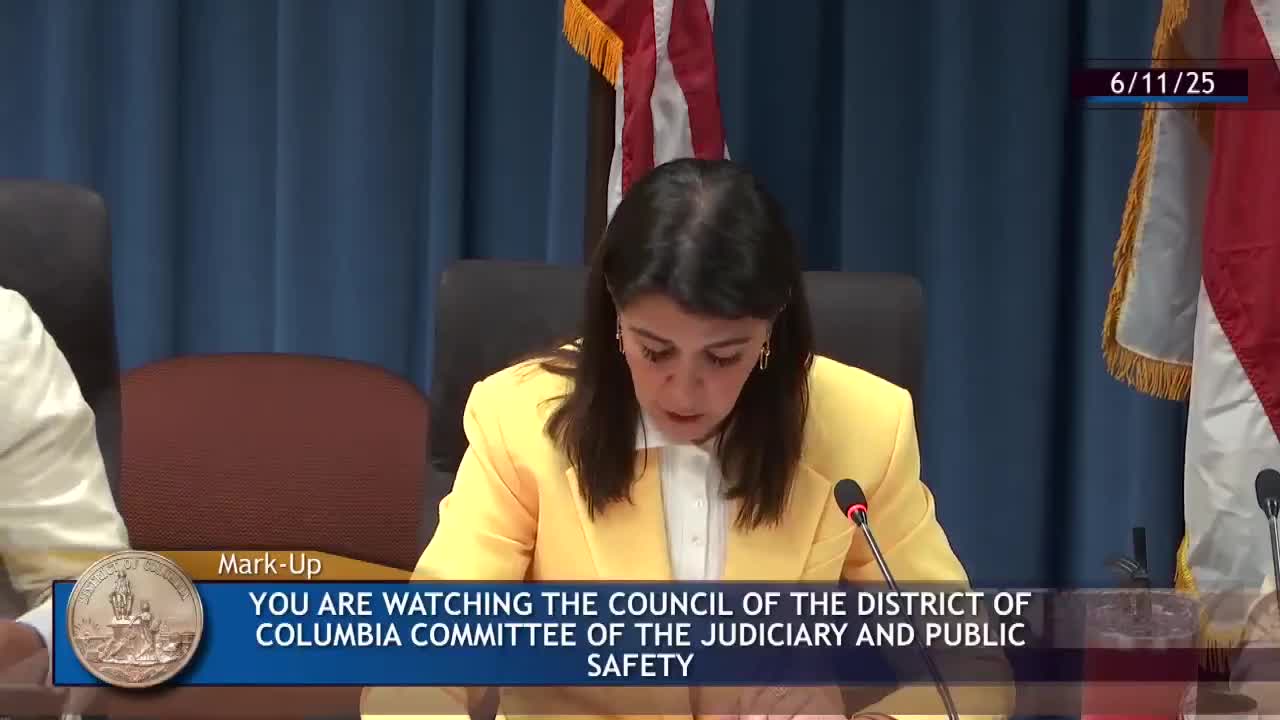
Councilmember Brooke Pinto, chairwoman of the Committee on Judiciary and Public Safety, moved June 11 to print and report Bill 26‑187, the PCDC Omnibus Amendment Act of 2025, and the committee approved the measure by voice vote with Councilmember Charles Allen recorded as voting “present.”
Councilmember Brooke Pinto, chairwoman of the Committee on Judiciary and Public Safety, moved June 11 to print and report Bill 26‑187, the PCDC Omnibus Amendment Act of 2025, and the committee approved the measure by voice vote with Councilmember Charles Allen recorded as voting “present.”
The omnibus package, described by Pinto as part of a broader Public Safety and Community Development Compact (PCC), contains multiple provisions: expanding tools to address fare evasion on the Washington Metropolitan Area Transit Authority (WMATA) system, extending a rebuttable presumption for pretrial detention in certain violent‑crime cases that would otherwise expire July 15, changes to the Metropolitan Police Department (MPD) academy and college‑credit pathways for recruits, survivor‑benefit clarifications for fire and EMS personnel, and technical fixes to the Second Chance Amendment Act of 2022 regarding record sealing.
Why it matters: Pinto said the omnibus “builds on the significant progress in crime reduction” and combines legislative, funding and policy proposals intended to prevent violence, support the public‑safety workforce, empower young people and reduce recidivism. The committee advanced the bill to the full council for further consideration.
Key provisions and debate
Fare evasion and WMATA: The bill authorizes special police officers (SPOs) to issue civil citations for fare evasion to increase enforcement capacity, a change Pinto said would expand staff capacity to address fare evasion by about 25 percent and cited a committee estimate that unpaid fares contributed to approximately $50,000,000 in lost revenue. Pinto framed the change as a tool to protect fare revenue that supports WMATA operations, maintenance and service.
Pretrial detention presumption: The omnibus extends a rebuttable presumption for pretrial detention in certain violent‑crime cases that Secure DC Omnibus Amendment Act of 2024 had expanded but which is scheduled to lapse July 15. Pinto said the extension applies to specified violent crimes and to some offenses committed while armed; she said two categories were removed from the presumption in committee: robbery that did not produce significant bodily harm and second‑degree burglary.
MPD recruiting and college credits: The measure authorizes MPD to enter into an agreement with an accredited college or university to allow recruits to earn up to 60 college credits during academy training and any supplementary instruction. Pinto told the committee, “Every sworn officer will still be required to have 60 college credit hours.” She said the committee expects a partnership with the University of the District of Columbia (UDC) could credential those hours.
Record sealing fixes: The bill includes changes to address timing and eligibility gaps created by the Second Chance Amendment Act of 2022 so that the sealing regime aligns with the original intent for non‑convictions and motion‑based sealing of more serious offenses.
Dissent and concerns: Councilmember Charles Allen (Ward 6) thanked Pinto for the effort but raised two principal objections. First, he opposed authorizing SPOs to issue citations in public space and on the Metro system, saying SPOs receive far less training than Metro Transit Police and lack existing oversight measures such as body‑worn camera rules and civilian complaint processes. He said, “Don’t do it,” and later told the committee, “I’m gonna vote present on the legislation today,” citing his concern about expanding SPO authority. Second, Allen said he was concerned the proposal could dilute the spirit of the 60‑credit standard by accrediting most academy training as the equivalent of two years of college; he argued that the academy plus a brief supplementary period could shortchange the broader educational experience the credit requirement was meant to ensure.
Committee action and vote: Councilmember Pinto moved to print and report the bill with leave for staff to make technical, editorial and conforming changes. The committee approved the motion by voice vote; the transcript records the ayes and notes Councilmember Allen voting present.
Next steps: The committee record shows the measure will be transmitted to the full Council for first reading and further consideration.