Get Full Government Meeting Transcripts, Videos, & Alerts Forever!
Get email alerts on the Budget Mill Rate topic
No spam. Unsubscribe anytime.
Board of Finance sets mill rate at 38.45, uses $5 million from fund balance; city, school budgets adopted
Summary
The Torrington Board of Finance voted on June 4 to adopt the 2025–26 city budget at $71,865,471 and the Board of Education operating budget at $78,722,698, set the general mill rate at 38.45 while authorizing use of $5,000,000 from fund balance, and fixed the motor vehicle mill rate at the state-mandated cap of 32.46.
The Torrington Board of Finance voted on June 4 to adopt the 2025–26 city budget at $71,865,471 and the Board of Education operating budget at $78,722,698, set the general mill rate at 38.45 while authorizing use of $5,000,000 from fund balance to offset taxpayer impact, and fixed the motor vehicle mill rate at the state-mandated cap of 32.46.
Why it matters: The board’s actions follow a grand list revaluation that drove large, uneven assessment increases — particularly on residential properties — and left municipal officials weighing a range of fund-balance scenarios to blunt steep tax hikes for households. Board members debated the tradeoff between immediate taxpayer relief and preserving reserves for future uncertainties, including potential state or federal funding changes and emergency needs.
Board actions and votes - The Board of Education operating budget for 2025–26 was adopted at $78,722,698. Motion moved by Mr. Anderson and seconded by Mr. Bayes; roll-call vote recorded six yes, zero no (Miss Inocido: yes; Miss Pesky: yes; Mr. Anderson: yes; Mr. Bayes: yes; Mr. Wright: yes; Miss Trapp: yes). - The Board of Education capital budget was adopted at $0. Motion moved by Mr. Anderson and seconded by Mr. Bayes; roll-call vote unanimous (six yes). - The city operating budget for 2025–26 was adopted at $71,865,471. Motion moved by Mr. Anderson and seconded by Miss Pesky; roll-call vote passed 5–1 (Miss Inocido: yes; Miss Pesky: yes; Mr. Anderson: yes; Mr. Bayes: no; Mr. Wright: yes; Miss Trapp: yes). - The board set the general mill rate at 38.45 and authorized the mayor to execute the tax warrant, contingent on using $5,000,000 from fund balance to reach that rate. Motion moved by Mr. Bayes and seconded by Mr. Wright; roll-call vote passed 5–1 (Miss Inocido: yes; Miss Pesky: yes; Mr. Anderson: no; Mr. Bayes: yes; Mr. Wright: yes; Miss Straub: yes). - The motor vehicle mill rate was set at 32.46 (state cap) and the mayor was authorized to execute the tax warrant. Motion moved by Mr. Anderson and seconded by Mr. Bayes; roll-call vote unanimous.
What officials said and key figures City staff and the mayor summarized fiscal options and multiple scenarios showing how different uses of fund balance affect the city’s reserve ratio and the mill rate. The town’s audited fund balance at the end of FY24 was presented as approximately $20.18 million, which included an assigned $3.9 million set aside during last year’s budget adoption. Using the full $3.9 million for FY26 would reduce available fund balance to roughly 10.8% of operating expenses; using $3.6 million would reduce it to about 8.4%; and using $5.0 million (the option the board approved) would move the fund balance closer to 7.5%.
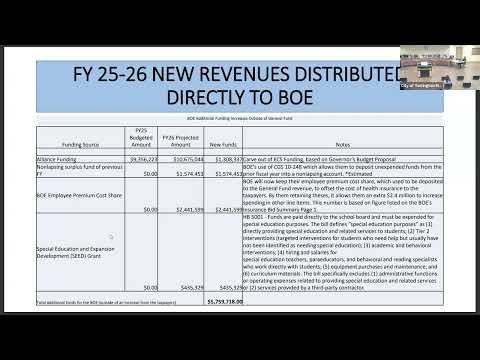
Finance staff described revenue changes that affected the calculations: a shift in how the Board of Education accounts for employee premium cost shares (the BOE retains an estimated $2,441,599 in FY26) and a newly announced special education expansion grant (referred to as a SEED grant) of $435,329 that will be paid directly to the Board of Education. Staff noted an updated Alliance District / ECS allocation and that the state-mandated motor vehicle mill-rate cap remains 32.46.
Board members were split on the use of reserves. Board of Finance member Wendy Traub said, “I’m not really quite sure it rises to the level of an emergency,” and urged caution about drawing reserves that could create a fiscal cliff in future years. Finance staff Erica said, “I would anticipate a large portion of that will be used — 3,000,000,” describing an expectation that most of the $3.9 million assigned sum will be needed this year because of the BOE’s departure from the joint insurance program. Board members including Mr. Bayes argued that the revaluation’s impact on many taxpayers — especially those on fixed incomes or in multifamily housing — justifies more use of fund balance now to blunt immediate increases.
Context and technical points - Revaluation effects: Staff reiterated that residential assessments rose far more than commercial assessments in the latest grand list, shifting a larger share of the tax burden to homeowners; this explains why a doubling of assessed values does not translate to a proportional mill-rate cut. - Phase-in: The council previously voted to apply a two-year phase-in of full revaluation impacts in order to reduce the year-one shock to taxpayers. - Fund balance policy: Board members referenced the city’s long-standing fund-balance policy (a floor around 7%–10% of operating expenses). Some members argued preserving that floor is essential for bond ratings and emergency response; others urged using reserves now to mitigate historic tax increases. - State and federal context: Staff referenced the state budget actions and the potential for federal/state-level changes to Medicaid funding, which could have downstream effects on municipal revenues and grants.
What this means for taxpayers Staff provided example calculations showing the tax effects on sample properties under the three fund-balance scenarios. For a property with assessed value that doubled from $100,000 to $200,000, the additional tax increase (over last year’s bill) would be roughly $940 at a 38.25 mill rate, $970 at 38.45, and about $1,047 at 38.96 — illustrating that each choice of fund-balance use produces measurable differences for individual taxpayers.
Next steps and forward-looking notes Board members and the mayor urged careful monitoring of revenue performance through the fiscal year and recommended increased fiscal discipline in budgeting next year. The mayor suggested considering a two-year budget approach so the city can better manage multi-year changes and reduce the temptation to repeatedly use one-time reserves.
Ending: The mill rates and budgets adopted at the June 4 special meeting will be transmitted as required, and staff will continue to report year-to-date revenue and expenditure performance to the board as the fiscal year closes.