Get Full Government Meeting Transcripts, Videos, & Alerts Forever!
Get email alerts on the Education Curriculum topic
No spam. Unsubscribe anytime.
Niskayuna staff outline K–12 social studies needs, flag textbooks, multilingual supports and scheduling
Summary
District educators presented a K–12 social studies program review that recommends clearer pacing, shared resources, updated materials and more time for teacher collaboration; staff also asked for guidance on the role of Regents exams and steps to implement the Seal of Civic Readiness.
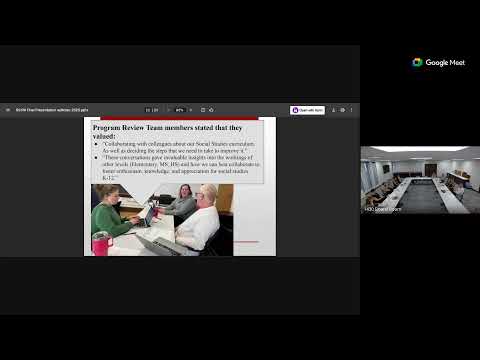
At a recent Niskayuna Central School District meeting, district social studies teachers and staff presented the district’s K–12 social studies program review, summarizing curriculum alignment to New York State standards, gaps revealed by teacher and parent surveys, and recommendations for pacing, resources and supports.
The review team said the program is aligned with New York State social studies standards and the state’s Portrait of a Graduate, and framed its findings around four areas: curriculum, assessment, instructional supports and recommendations. “We’re continuously building on that. And that’s really kinda coming down and focusing on learning standards, our findings, and that’s really what it is. So this presentation is really just a general summary of that,” said Michael (staff member), one of the presenters.
Why it matters: presenters said the district faces near-term choices about instructional time and materials as state requirements evolve — notably uncertainty about the future of Regents exams at the high school level — and ongoing operational needs to support multilanguage learners and to preserve strong classroom practices as staff retire or roles change.
Key findings and recommendations
- Alignment and vision: Presenters said the department already attempts to prepare students consistent with the Portrait of a Graduate (critical thinking, global citizenship, problem solving) and recommended intentionally linking units and lessons to those portrait attributes.
- Elementary schools: Survey results and teacher reports signaled a need for a clear, developmentally appropriate scope and sequence, a parent-facing report card that explains what students have studied and been assessed on, hands-on units and time for teachers to develop and plan. The review recommends using existing district-created resources and PNW BOCES materials to build a pacing calendar and curriculum map. Teachers also asked for an easier-to-navigate digital repository for materials.
- Middle schools: Reviewers said middle-level teachers have rigorous individual practices but lack mechanisms to share and archive those lessons, raising the risk that effective work could be lost when long-serving teachers retire. The report recommends creating a shared repository of lessons and common assessments, aligning writing and document-based-question expectations across sixth through eighth grades, and adjusting the schedule so social studies teachers can access high-need students who currently receive intervention time during a period when social studies staff are not available.
- High school: Staff reported strong elective interest from students, parents and teachers, and recommended exploring shorter-term electives and earlier access for underclassmen. The group flagged the district’s global history textbook (noted in the presentation as published in 1998) as out of date and recommended pursuing updated textbooks, maps and digital resources, especially materials that can be translated for multilanguage learners. Presenters also asked for district clarity on whether Regents exams will remain the district’s final exams and what role the exams should play if the state changes requirements.
- Multilanguage learners and translation: Presenters described two related challenges: translation of materials for families and students, and classroom composition. One teacher described the difficulty of supporting several students who speak different home languages in a single class and urged both better translation tools and consideration of class assignments. The district is exploring a one-time device purchase to provide on-demand translation in dozens of languages for front-line staff and teachers, a technology Mike Granigan (staff member) is reported to be evaluating.
- Seal of Civic Readiness: Teachers expressed interest in pursuing the state Seal of Civic Readiness at the high school level and exploring ways middle schools might contribute evidence toward that seal. They recommended coordinating data collection with counseling and administration so responsibility does not fall disproportionately on senior-level teachers.
Quantitative details cited in the presentation
- Eight National Board Certified Teachers across the district and one teacher pursuing certification (source: presenter). - Roughly 50% of teachers reported feeling knowledgeable about the current standards in a teacher survey (presenter-cited figure). - The global history textbook used in many classes was described as published in 1998 (presenter-cited). - At the high school, presenters said 12 full-time social studies teachers advise more than 15 clubs and that AP scores and Regents passing rates were reported as strong, though specific percentages were not given in the presentation.
Discussion and next steps
Presenters and meeting participants emphasized time and collaboration as recurring constraints. Recommended next steps included the creation of a K–12 curriculum map and pacing guide, a shared digital repository for lessons and assessments, targeted professional development (including content-specific strategies for working with English learners), and an implementation plan for the Seal of Civic Readiness that leverages other districts’ models. The presentation team said a full program review report is posted on the district’s K–12 website and that representatives will share slide decks and summaries during end-of-year faculty meetings.
Board-member comments and administration response
A meeting participant who identified themselves during the discussion praised the teachers’ work and the program-review process, saying, “What you do affects the entire nation and the whole planet,” and thanking staff for their dedication. District leaders present said they will review the recommendations, examine scheduling and staffing implications and consider vendor or device purchases for translation and digital resources as part of fiscal planning.
No formal votes or policy decisions were recorded during the presentation; presenters characterized most items as recommendations requiring further administrative review and potential negotiation with staff associations for schedule or contract changes.
Taper: The district’s program review highlighted areas where staff said modest changes (time for collaboration, clearer pacing, updated digital and physical resources) could preserve effective classroom practices and improve continuity for students as schedules and state expectations evolve. District staff said they will continue work over the summer and into the next school year, with follow-up actions to be coordinated by curriculum leaders and district administration.