Get Full Government Meeting Transcripts, Videos, & Alerts Forever!
Get email alerts on the Transit Safety topic
No spam. Unsubscribe anytime.
Transit drivers describe escalating assaults, sanitation problems and fentanyl exposure; council seeks better data and security options
Summary
City transit drivers testified about verbal and physical assaults, drug use and sanitation problems on buses. Councilors asked transit officials for clearer data and discussed security models including transit ambassadors and violence-interrupter programs.
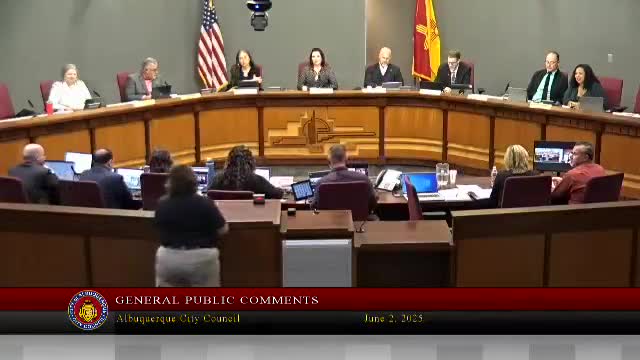
Several Albuquerque transit drivers and trade representatives described persistent safety and sanitation problems on city buses during the June 2 public-comment period and asked the City Council for stronger enforcement and security support.
Denise Mooney Archibec, a motor-coach operator with City Transit, testified that drivers routinely face verbal abuse, threats and physical assaults; that buses are often used for drug activity and left with human waste and discarded paraphernalia; and that fentanyl smoke and other hazardous exposures are a recurring problem. "Buses are routinely misused for personal spaces resulting in extensive messes, discarded drugs, paraphernalia including fentanyl," she said, and asked for "immediate attention to implement greater security for law enforcement presence on all our transit routes."
Why it matters: Drivers said safety problems reduce service reliability and put staff and riders at risk. Councilor Rogers, who had earlier pulled a quarterly transit security report (EC 400) from the consent agenda for discussion, told the chamber she will seek more reliable, route-level data. Deputy Director Mike Davis told the council the transit system now uses infrared automatic passenger counters on its buses and that the agency provides quarterly reports; he acknowledged gaps in route-level reporting for APD and ACS service calls during the study period and said the agency has recently transitioned to a single counter technology.
Data and possible responses: Davis said the transit division receives and reports calls for APD service, ACS calls and metro security incidents by route, but that the available spreadsheets for the study period had many 'not applicable' entries for APD/ACS by route. Davis said the agency has migrated to infrared counters on all buses and that historical ridership-count methods were a mix of fare-box and infrared equipment. Councilors and staff discussed nonlaw enforcement safety models — including violence-interrupter programs and transit ambassadors — as options to reduce the strain on police and protect drivers while allowing officers to focus on higher-priority calls.
Request to administration: Drivers asked for a stronger uniform security presence and clearer enforcement of conduct rules, and asked the council to consider policy changes around free fares, enforcement mechanisms and dedicated transit security staff. Councilor Rogers moved and the council voted unanimously on a consent-item motion to note receipt of the quarterly transit security report (EC 400) and asked administration to provide the missing route-level data and improved reporting on APD/ACS/Metro security incidents for priority corridors such as Route 66.
Ending: Councilors thanked the drivers for speaking and asked transit staff to follow up with better route-level data and to explore security models that do not rely solely on sworn officers.