Get Full Government Meeting Transcripts, Videos, & Alerts Forever!
Get email alerts on the Energy Wildfire Preparedness topic
No spam. Unsubscribe anytime.
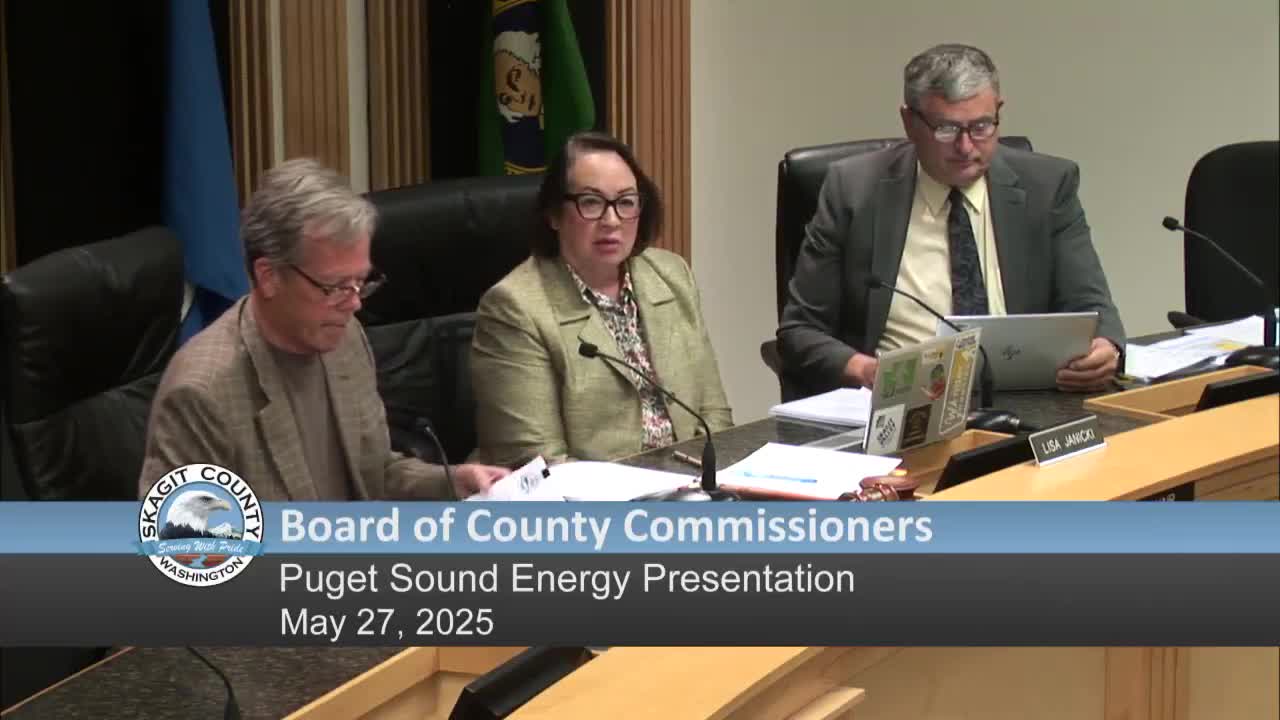
Puget Sound Energy outlines clean‑energy transition, transmission needs and wildfire readiness for Skagit County
Summary
PSE briefed commissioners on state clean‑energy mandates, its planned removal of coal generation, the need for new transmission and battery storage, and wildfire‑risk mitigation measures that include enhanced vegetation management, monitoring and community coordination.
Puget Sound Energy (PSE) staff updated the Skagit County Board of County Commissioners on statewide clean‑energy mandates, the company’s portfolio changes, planned investments in battery storage and emerging technologies, and steps to reduce wildfire risk and improve emergency response coordination.
Robert Knoll of PSE said the utility must comply with Washington’s Clean Energy Transformation Act (CETA) and related laws that require utilities to phase out coal and achieve a carbon‑neutral electricity supply by 2030 and 100 percent non‑emitting electricity by 2045. Knoll said PSE plans to remove its ownership stake in coal‑fired generation this year and is contracting or building renewable projects; since CETA passed the company has contracted about 3,800 megawatts of new renewable capacity.
Knoll said the region will need thousands of megawatts of additional non‑emitting generation and large amounts of transmission and storage to meet demand growth and replace dispatchable coal generation. He described an “all‑of‑the‑above” approach that includes utility‑scale batteries, exploration of long‑duration storage and partnerships on hydrogen and advanced small modular nuclear concepts to provide on‑demand, non‑emitting generation.
On wildfire risk, PSE described steps to improve situational awareness and to reduce ignition risk: expanded vegetation management in high‑risk areas, targeted undergrounding projects for distribution lines, weather stations and cameras, drone inspection capability, and updated operational tools such as enhanced power‑line settings and targeted outages in extreme conditions. Knoll described public safety power shutoff (PSPS) criteria and said PSE will notify customers 48 hours in advance when practical and provide updates at 12‑hour intervals.
Knoll also briefed the Board on local projects and dam safety work at Baker River facilities and said seepage mitigation work at Lower Baker was nearing completion. He said the company is working with county public works and emergency management on coordination and noted that PSE will continue to pursue federal and state grant funding for infrastructure projects.
Commissioners asked about sewer and development questions raised by county planners and about the relationship between distributed generation incentives (net metering) and broader clean‑energy goals. Knoll said PSE is balancing customer programs, system reliability and the pace of state mandates as it implements the transition.