Get Full Government Meeting Transcripts, Videos, & Alerts Forever!
Get email alerts on the Hemp Products topic
No spam. Unsubscribe anytime.
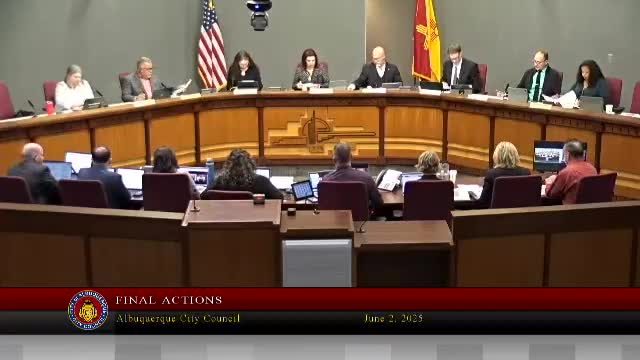
Council advances intoxicating hemp-products ordinance after weeks of debate; 7-2 vote moves it forward
Summary
The City Council voted 7–2 to give a ‘do pass’ recommendation to R-78, an ordinance that would prohibit retail sale of certain intoxicating hemp-derived products in Albuquerque; supporters cited youth exposure, opponents said federal and state changes make local prohibition premature.
The Albuquerque City Council on June 2 voted 7–2 to give a “do pass” recommendation to R-78, legislation sponsored by Councilor Dan Lewis that would create a new Part 3 in Chapter 9, Article 11 of the Revised Ordinances of Albuquerque (1994) to prohibit retail sales of specified intoxicating hemp-derived products in the city.
The sponsor told the council the ordinance targets high-dose, semi-synthetic or synthetic hemp products sold in convenience stores and gas stations and marketed in packaging that can appeal to children. "If your business model is to market that high dose hemp and put it into retail, convenience stores, gas stations and sell it to children ... that's exactly what this bill has to do with," Councilor Lewis said.
Why it mattered: The bill drew extensive public comment from the hemp and cannabis industries, medical and consumer groups, and industry professionals. Supporters and the bill sponsor argued the products create a public-health risk for youth and are unregulated locally; opponents said the ordinance would harm compliant local manufacturers, could push demand to unregulated markets outside the city, and that federal and state legislation (including changes to the 2018 Farm Bill under consideration) may render local prohibitions premature.
Public testimony: More than a dozen speakers addressed the council. Some industry speakers said manufacturers already use third-party ISO testing and that a city ban would shutter local small businesses and drive consumers to out-of-city or illicit sellers. Anani Das and other commenters favored regulation to reduce harm; others urged the council to wait for federal action. Several public commenters and industry representatives asked that the city instead adopt labeling, age restrictions or packaging rules rather than an outright retail ban.
Enforcement and procedure: Council members pressed administration staff on enforcement mechanics, testing and inspection capacity. City staff said Environmental Health would likely require outside laboratory testing to confirm whether a product exceeded regulated thresholds and that the department is assessing standard operating procedures for inspections; they also noted the council could need to provide additional appropriation if new inspection capacity were required.
Vote and roll call: The motion for a “do pass” to R-78 passed 7–2. The roll call was: Baca — Yes; Champagne — Yes; Fiebelcourt — No; Graub — Yes; Lewis — Yes; Vice President Pena — Yes; Rogers — Yes; Sanchez — Yes; President Hassan — No.
Next steps: The council’s vote advances R-78 for further consideration under the council process. Several councilors said they expect state or federal legislative activity later this year and discussed possible future amendments to align local rules with state or federal standards.
Ending: The council majority framed the ordinance as a public-safety and youth-protection measure targeted at retail channels outside the regulated cannabis market; opponents urged delay until federal or state changes are finalized.