Get Full Government Meeting Transcripts, Videos, & Alerts Forever!
Get email alerts on the Language Access topic
No spam. Unsubscribe anytime.
Albuquerque Police Department details expansion of language access program
Summary
APD updated the City Council on a language access program that tracks interpreter needs, added an ASL station at a substation and is collecting data to guide staffing and resources.
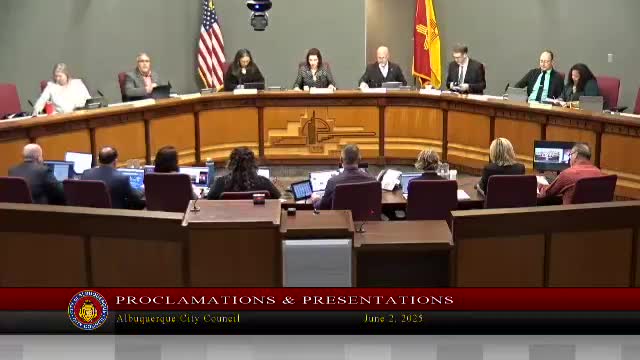
Deputy Chief JJ Griego of the Albuquerque Police Department told the City Council on June 2 that the department has formalized a language access program and hired a dedicated language access coordinator, Jocelyn Segovia, to manage data collection, training and interpretation services.
The presentation described the program as intended to institutionalize language access across APD. "Language access is not a political issue. This is a human rights issue," Griego said, and noted that a single staff coordinator role was required to do the work. Segovia told the council the department has begun labeling police reports and body-worn camera notes to identify interactions involving communication barriers and has added telephonic-interpretation logging in the emergency communications center to quantify need.
Why it matters: Council members and APD said better data is intended to shift the department from an informal practice model to a system that can allocate interpreters and training where needs are greatest. Segovia presented counts collected since the new measures were implemented: APD identified 671 police reports in 2024 that referenced a communication barrier; 89% of those involved spoken-language barriers and about 10% involved deaf or hard-of-hearing interactions. The Emergency Communications Center logged 10,717 calls requiring telephonic interpretation in 2023 and 12,556 in 2024, Segovia said.
APD described operational steps already taken. The department has installed a visual-ASL station on an iPad at the Northeast Substation to serve deaf and hard-of-hearing residents and has worked with the state to print traffic tickets in multiple languages. Griego and council members discussed staffing and training: Councilor Rogers emphasized the need for ongoing training for new cadets and periodic refresher training, and asked APD to preserve institutional knowledge beyond current retirements.
Councilor Champine asked how many calls APD receives annually; Griego said APD receives about 1,100,000 phone calls that result in roughly 500,000 calls for service. Champine also asked about use of artificial intelligence; Griego and Segovia said APD is avoiding machine translation for operational use, relying instead on professional translation and interpretation, although limited machine translation may be used to triage report content before professional review.
The presentation repeatedly returned to data gaps: the 12,556 telephonic-interpretation calls in 2024 likely undercount true need because not all systems or documents are labeled, Segovia said. Councilors asked APD to provide follow-up material on staffing implications and to continue work with community groups to shape the program.
APD did not propose an ordinance or request a specific appropriation during the presentation; councilors requested additional information on staffing needs and metrics for future briefings.
Deputy Chief Griego said the department will continue to refine data labels, expand training examples from body-worn camera footage, and coordinate with community groups to improve access and trust.
Ending: Councilors thanked Griego and Segovia for the presentation and asked for follow-up materials on staffing and data sources to guide potential future resource requests.