Get Full Government Meeting Transcripts, Videos, & Alerts Forever!
Get email alerts on the Medicaid Access topic
No spam. Unsubscribe anytime.
Guam Legislature advances Medicaid Access Enhancement Act to third-reading file
Summary
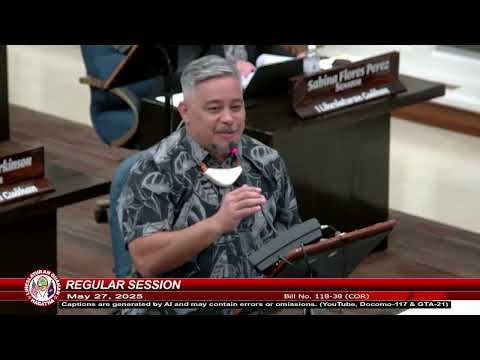
The Guam Legislature on May 27 moved Bill 118-38 COR, the Guam Medicaid Access Enhancement Act, into the third-reading voting file after floor debate on whether tax rebates will expand access to care for Medicaid enrollees.
HAGATNA, Guam — The Guam Legislature on May 27 moved Bill 118-38 COR, the Guam Medicaid Access Enhancement Act, into the third-reading voting file after floor debate on whether tax rebates will expand access to care for Medicaid enrollees.
The bill, introduced on the floor by Senator Salas Matanani, would authorize an unpledged business-privilege-tax (BPT) rebate on Medicaid receipts. Matanani said the substituted bill was developed in collaboration with the governor’s office and accompanied by a May 27, 2025, letter from Acting Governor Joshua F. Tenorio endorsing the substitute with technical recommendations. “There are more than 30,000 people on Guam who rely on Medicaid just to access basic health care,” Matanani said on the floor as she argued the bill would give providers an incentive to accept more Medicaid patients.
Supporters said the measure offers targeted relief to clinics and providers who say Medicaid reimbursements and administrative burdens limit how many Medicaid patients they can treat. The bill ties rebates to actions such as hiring or expanding services and includes audit, fraud-prevention and annual reporting requirements, supporters said.
Opponents and some questioners said Guam already has many clinics and providers listed as accepting Medicaid and warned the measure effectively reduces general fund revenue by an estimated $4.8 million to $6 million. One senator urged caution that rebates could amount to a tax giveaway and pressed for evidence that similar rebates will increase access for patients.
Several senators raised legal and administrative concerns: the substitute places the rebate authority under the Guam Economic Development Authority (GEDA) and references a section of Title 12, Chapter 58 of the Guam Code Annotated. Opponents asked whether placing the program under the chapter for qualifying certificates (QCs) was germane and whether GEDA had been consulted; the presiding officer ruled the substitute germane after consultation with legal counsel. Senators also noted the bill contains no sunset provision and includes a 90-day rulemaking timeline for GEDA; the author and backers said the administration supported the timeline and the use of GEDA for implementation.
Floor speakers also referenced a proposed federal Centers for Medicare & Medicaid Services (CMS) rule, published May 12, 2025, that would limit certain state tax schemes on Medicaid receipts. Supporters said federal action made it timely for Guam to enact a targeted rebate; opponents said federal changes could alter the program’s fiscal or legal footing.
On the floor, Matanani formally moved the substituted bill into the third-reading voting file; the motion carried without objection. The author also moved and had ordered the addition of multiple cosponsors on the floor. Separately, earlier in the session senators placed the nomination of Mark B.C. Mendiola to the Port Authority board into the voting file with a recommendation to confirm.
The bill text and committee substitute assign GEDA, in consultation with the Department of Public Health and Social Services, to promulgate rules and to administer applications; supporters said the agency will define application procedures and guardrails. Backers described the measure as a targeted incentive intended to reduce caps on Medicaid patients at some clinics and to encourage providers to accept more Medicaid cases, while critics said the claimed access problem was not proven at committee hearings and that the measure reduces revenue available for other programs.
With the bill placed on the third-reading file, senators can expect a full recorded vote on final passage at a subsequent session date. The chamber recessed until 9 a.m. the following day.