Get Full Government Meeting Transcripts, Videos, & Alerts Forever!
Get email alerts on the Transit Oriented Development topic
No spam. Unsubscribe anytime.
Planning commission hears update on transit-oriented development ordinance, adaptive reuse and workforce housing incentives
Summary
Consultants updated the Planning Commission on a draft transit-oriented development (TOD) overlay ordinance, explaining proposals for adaptive reuse, parking coordination, workforce housing triggers and map boundaries and asking staff to prepare a mid-summer formal submission to Planning Commission and City Council.
Consultant Peter Simone updated the Reading Planning Commission Tuesday on a draft transit‑oriented development (TOD) overlay ordinance that would layer new development incentives and requirements over existing zoning around the planned rail station.
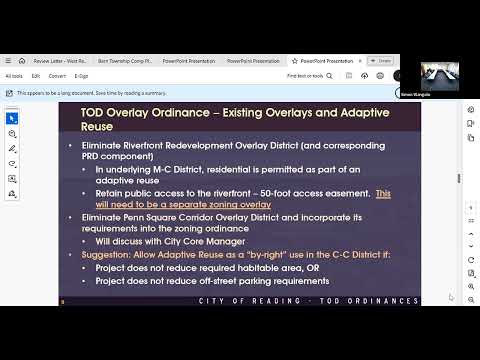
The draft ordinance would allow adaptive reuse in commercial districts, establish incentives such as increased height and reduced lot-size minimums, coordinate parking requirements with proposed SALDO amendments, and include a workforce housing requirement triggered on new construction projects.
Simone told commissioners the ordinance team has met repeatedly with city staff, the chamber (the project client) and other stakeholders and expects staff will be ready to present a formal ordinance to the Planning Commission and City Council in mid to late summer. “We submitted a draft ordinance to the city staff… they’ve reviewed it,” Simone said, and consultants planned revisions after a May 14 meeting with staff.
Why it matters: the TOD overlay is designed to encourage redevelopment near a planned rail station, promote pedestrian‑oriented development and preserve flexibility for adaptive reuse of older buildings while adding tools to increase housing supply, including units affordable to lower‑income workers.
Key provisions and status - Adaptive reuse: The draft makes adaptive reuse a special exception in the CC (central commercial) district; consultants proposed allowing adaptive reuse by right in CC where projects do not reduce required habitable area or create off‑street parking deficits. Simone said staff did not accept all recommendations and the team continues to refine nonconformity provisions. - Expansion threshold: The consultants proposed that an adaptive‑reuse project that expands more than 25% of its footprint would be treated under the TOD provisions rather than only under adaptive‑reuse rules. - Parking coordination: Simone said parking is “probably the biggest area of coordination” between the draft TOD ordinance and SALDO parking amendments staff is developing. The team proposed reducing minimum parking where feasible and exploring redevelopment of surface parking lots in the overlay. - District boundaries: The overlay generally runs from Buckwood Street and Eleventh Street down to the riverfront, with the team recommending removal of the overlay from floodplain areas and proposing a new riverfront overlay to require river access during future land development on certain riverfront parcels. - Workforce housing: The draft would trigger a workforce requirement on new construction projects above a size threshold (consultants suggested 30 dwelling units). The proposal discussed at the meeting would require 10% of units in qualifying projects be offered at 60% of area median income (AMI) (AMI determined annually by HUD). Simone described the requirement as targeted to “school teachers and firefighters and people who are essential to the city,” noting qualification would be income‑based rather than job‑title‑based. - Incentives: Developers complying with TOD standards would be eligible for increased height, smaller minimum lot sizes and increased impervious cover limits (with usual stormwater controls still required), among other incentives.
Commission reactions and clarifications Commissioners asked whether the workforce requirement would apply to adaptive reuse. Simone clarified the workforce requirement is geared toward new construction and would not generally pull adaptive reuse projects into TOD rules unless they expanded more than 25% of their footprint. Commissioners raised concerns that the 30‑unit trigger might deter some redevelopment projects that could choose to proceed as straight adaptive reuse to avoid TOD triggers.
Simone noted prior public engagement and research: “This is the fifth time we've been to the planning commission,” and the project team has presented to professional conferences and a project steering committee. He said staff and the consultant team intend to return a redrafted ordinance for formal review in mid‑summer.
Next steps No formal vote took place on the draft ordinance at Tuesday’s workshop. Consultants plan to supply updated text for staff review and to seek formal Planning Commission review and then a recommendation to City Council after coordination with SALDO amendments and other staff comments.
Ending Commissioners said they expect to see a drafted ordinance for formal consideration in the coming weeks. The Planning Commission’s next regular meeting is scheduled for May 27, 2025, and staff and consultants indicated a goal of presenting to City Council once staff completes its revisions.