Get Full Government Meeting Transcripts, Videos, & Alerts Forever!
Joint Government Operations reviews Education Freedom Scholarship emergency rule as House gives positive recommendation; Senate vote split
Summary
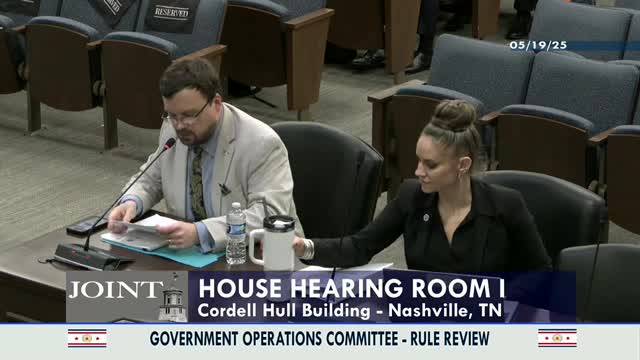
A joint meeting of the Tennessee Joint Government Operations Committee on May 19 reviewed emergency rules to implement the Education Freedom Scholarship program created by Public Chapter 7 of the first extraordinary session of 2025, pressing officials on eligibility, income verification, virtual‑school participation, fraud controls and application processing.
A joint meeting of the Tennessee Joint Government Operations Committee on May 19 reviewed emergency rules to implement the Education Freedom Scholarship (EFS) program created by Public Chapter 7 of the first extraordinary session of 2025. Committee members pressed State Board of Education and Department of Education officials on program eligibility, income verification, virtual-school participation, fraud prevention and the application backlog.
The EFS law authorizes state scholarship funds for students who attend private schools in categories established by the State Board. Nathan James of the State Board of Education told the committee the statute "creates the Education Freedom Scholarship program" and that the board's emergency rules focus on "defining key terms, establishing application and eligibility processes, establishing appeals procedures, and setting forth other logistical matters necessary to effectuate the program." The law requires the program to be available for the 2025–26 school year.
Why it matters: the program initially makes 20,000 scholarships available and specifies growth triggers for additional seats. Committee members repeatedly sought practical details about who will be eligible, how families will prove income and how the state will guard against misuse of funds. Several members framed their questions around whether the program prioritizes low-income students at struggling schools.
Key points from the hearing
• Program scope and timing: Nathan James said the board is implementing the program under the deadline set in the statute and that a permanent rule will be considered at the State Board's May 30, 2025 meeting.
• Slot limits and growth: Committee members were repeatedly told the statute authorizes 20,000 scholarships in the first year and contemplates increases (typically 5,000 additional seats) in subsequent years if statutory growth thresholds and appropriations are met. James said the rules include priority language so that returning scholarship recipients are prioritized when seats are limited.
• Applications and queue: Lawmakers raised concerns about the number of applications already submitted and how the state is processing them. One member said publicly reported application counts ranged into the tens of thousands; department staff said applications are processed in the order received. The department confirmed the program uses a first-come, first-served review process for available seats.
• Income verification: The emergency rule requires income verification; the department said Form 1040 tax returns are primary documentation but the rule authorizes the department to request additional documents (for example, pay stubs) if there are discrepancies. The department said it has authority to request supporting documentation when needed.
• Virtual schools and "brick-and-mortar" requirement: Emily Cornute, director of legislative affairs for the Department of Education, responded to questions about virtual providers accepted for EFS. "They do have to have a physical presence that has either a lease or a deed for property within the state," Cornute said, adding such facilities provide a place where students can receive instruction or assessment if required.
• Payments and expelled students: James said scholarship payments are split into four installments to guard against a situation where funds would remain with a school after a student leaves or is expelled.
• Fraud prevention and payment platform: The department described an electronic platform and vendor that will manage accounts and e-wallets. Department counsel said, in practice, "all funds are handled through a digital platform" and are paid to schools; purchases allowed under the law and rule are processed through that platform and reviewed by the department before funds are released.
• School meal programs: Lawmakers asked whether private schools accepting EFS students will be required to offer federally supported school meals. Department counsel said private schools may opt into the Department of Agriculture's school meal program but are not required to do so by the EFS law or rule.
• Application confirmations and data security: Committee members raised a vendor problem on launch day in which some applicants received incorrect confirmation emails showing other students' names. The department said the issue affected a small subset, was corrected early on launch day,…
Already have an account? Log in
Subscribe to keep reading
Unlock the rest of this article — and every article on Citizen Portal.
- Unlimited articles
- AI-powered breakdowns of topics, speakers, decisions, and budgets
- Instant alerts when your location has a new meeting
- Follow topics and more locations
- 1,000 AI Insights / month, plus AI Chat