Get Full Government Meeting Transcripts, Videos, & Alerts Forever!
Get email alerts on the Education School Choice topic
No spam. Unsubscribe anytime.
Joint Government Operations reviews Education Freedom Scholarship emergency rule as House gives positive recommendation; Senate vote split
Summary
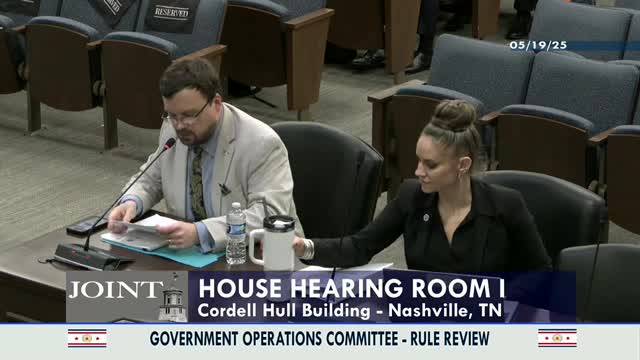
A joint meeting of the Tennessee Joint Government Operations Committee on May 19 reviewed emergency rules to implement the Education Freedom Scholarship program created by Public Chapter 7 of the first extraordinary session of 2025, pressing officials on eligibility, income verification, virtual‑school participation, fraud controls and application processing.
A joint meeting of the Tennessee Joint Government Operations Committee on May 19 reviewed emergency rules to implement the Education Freedom Scholarship (EFS) program created by Public Chapter 7 of the first extraordinary session of 2025. Committee members pressed State Board of Education and Department of Education officials on program eligibility, income verification, virtual-school participation, fraud prevention and the application backlog.
The EFS law authorizes state scholarship funds for students who attend private schools in categories established by the State Board. Nathan James of the State Board of Education told the committee the statute "creates the Education Freedom Scholarship program" and that the board's emergency rules focus on "defining key terms, establishing application and eligibility processes, establishing appeals procedures, and setting forth other logistical matters necessary to effectuate the program." The law requires the program to be available for the 2025–26 school year.
Why it matters: the program initially makes 20,000 scholarships available and specifies growth triggers for additional seats. Committee members repeatedly sought practical details about who will be eligible, how families will prove income and how the state will guard against misuse of funds. Several members framed their questions around whether the program prioritizes low-income students at struggling schools.
Key points from the hearing
• Program scope and timing: Nathan James said the board is implementing the program under the deadline set in the statute and that a permanent rule will be considered at the State Board's May 30, 2025 meeting.
• Slot limits and growth: Committee members were repeatedly told the statute authorizes 20,000 scholarships in the first year and contemplates increases (typically 5,000 additional seats) in subsequent years if statutory growth thresholds and appropriations are met. James said the rules include priority language so that returning scholarship recipients are prioritized when seats are limited.
• Applications and queue: Lawmakers raised concerns about the number of applications already submitted and how the state is processing them. One member said publicly reported application counts ranged into the tens of thousands; department staff said applications are processed in the order received. The department confirmed the program uses a first-come, first-served review process for available seats.
• Income verification: The emergency rule requires income verification; the department said Form 1040 tax returns are primary documentation but the rule authorizes the department to request additional documents (for example, pay stubs) if there are discrepancies. The department said it has authority to request supporting documentation when needed.
• Virtual schools and "brick-and-mortar" requirement: Emily Cornute, director of legislative affairs for the Department of Education, responded to questions about virtual providers accepted for EFS. "They do have to have a physical presence that has either a lease or a deed for property within the state," Cornute said, adding such facilities provide a place where students can receive instruction or assessment if required.
• Payments and expelled students: James said scholarship payments are split into four installments to guard against a situation where funds would remain with a school after a student leaves or is expelled.
• Fraud prevention and payment platform: The department described an electronic platform and vendor that will manage accounts and e-wallets. Department counsel said, in practice, "all funds are handled through a digital platform" and are paid to schools; purchases allowed under the law and rule are processed through that platform and reviewed by the department before funds are released.
• School meal programs: Lawmakers asked whether private schools accepting EFS students will be required to offer federally supported school meals. Department counsel said private schools may opt into the Department of Agriculture's school meal program but are not required to do so by the EFS law or rule.
• Application confirmations and data security: Committee members raised a vendor problem on launch day in which some applicants received incorrect confirmation emails showing other students' names. The department said the issue affected a small subset, was corrected early on launch day, and the office followed up with corrected confirmations; department staff said they would follow up with committee members on communications given to families about data protection.
Committee reaction and votes
The Committee's consideration of the EFS emergency rule involved multiple procedural votes in both chambers and some procedural confusion recorded in the transcript. The House gave a positive recommendation on the rule by roll call (7–5). In the Senate, members voted on objections and motions in separate series; at one recorded roll call a Senate tally was recorded as 3 yes and 4 no and was described on the record as failing in the Senate. Legal counsel reminded the panel of the chamber practice regarding how a house-level defeat is reflected in drafting and next steps. Committee members and staff said additional clarifications and permanent-rule review will continue at the State Board's May 30 meeting.
What remains unresolved
Lawmakers pressed staff on several items that cannot be changed by rule and instead require statutory change, including the law's income-tier designations and set-aside allocations. Officials repeatedly told members that some elements — for example, how the reserved set‑asides operate — are fixed by statute and would require action by the General Assembly to alter.
Next steps
The board indicated it will consider the permanent version of the rule at its May 30 meeting; implementation also depends on the annual appropriations process for future expansion of seats. Department staff said they will follow up with committee members about the application email incident and about details on how families will be notified if the department requests additional income verification.
Votes at a glance (items on the May 19 rule-review agenda)
This committee considered 10 rule items during the joint hearing. Where roll-call tallies were recorded in the transcript they are noted below.
1) State Board of Education — Education Freedom Scholarship (emergency rule; Public Chapter 7, 2025) House: positive recommendation (roll call recorded on the record as 7–5 in favor) Senate: recorded split and procedural votes; at one roll call the tally was recorded as 3 yes, 4 no and described in the transcript as failing in the Senate; committee counsel provided follow-up guidance about drafting practice.
2) State Board of Education — Educator preparation rule (amendments recognizing national accreditors; clinical mentor observation tool) Senate: positive (recorded as 4 ayes, 1 no, 1 present not voting) House: positive (voice vote)
3) State Board of Education — Educator licensure rule (license validity periods; temporary permits) Senate: positive (recorded as 4 ayes, 1 no, 1 present not voting) House: positive (voice vote)
4) State Board of Education — Academic and instructional requirements (promotion and retention changes, conference pathway) Senate: positive (recorded as 6 ayes, 0 nays) House: positive (voice vote)
5) Board of Medical Examiners — Advisory Committee for Acupuncture (fee reductions) Senate: positive (recorded as 6 ayes, 0 nays) House: positive (voice vote)
6) Department of Commerce & Insurance — Detection Services Licensing Program (security guard training and fee adjustments) Senate: positive (recorded as 6 ayes, 0 nays) House: positive (voice vote)
7) University of Tennessee — Student residency classification (in-state tuition for certain groups per federal and state law) Senate: positive (recorded as 6 ayes, 0 nays) House: positive (voice vote)
8) TennCare — Supplemental payment program for RHCs and FQHCs (permanent rules to codify federal requirements and automate reporting) Senate: positive (recorded as 6 ayes, 0 nays) House: positive (voice vote)
9) Department of Finance & Administration — Repeal: publication specifications for annual reports (retrospective rule review) Senate: positive (recorded as 6 ayes, 0 nays) House: positive (voice vote)
10) TennCare — Remote fetal monitoring coverage (implementation of Public Chapter 674 / coverage of remote fetal ultrasound and nonstress testing) Senate: positive (recorded as 6 ayes) House: positive (voice vote)
Speakers (those who spoke on EFS or provided primary responses during the item)
- Nathan James — State Board of Education (presented the EFS emergency rule; first referenced at transcript timecode 1158.835) - Rachel Cuppay — General Counsel, State Board of Education (legal counsel for rule; first referenced at 1162.2749) - Emily Cornute — Director of Legislative Affairs, Tennessee Department of Education (explained brick-and-mortar requirements for virtual providers; first referenced at 1168.0901) - Representative McKenzie — Member, Tennessee House of Representatives (asked about application counts and income tiers; first referenced at 1376.5599) - Representative Fritz — Member, Tennessee House of Representatives (asked about set-asides and whether schools may require employees to take scholarships for tuition discounts; first referenced at 1608.055) - Representative Renaud — Member, Tennessee House of Representatives (asked about free/reduced lunch and private school participation; first referenced at 1744.56) - Representative Glenn — Member, Tennessee House of Representatives (asked about application confirmation emails and tracking; first referenced at 2381.0698) - Senator Bolling — Member, Tennessee Senate (asked about application counts and enrollment projections; first referenced at 1874.475)
Authorities referenced in the hearing
- statute: "Tennessee Education Freedom Scholarship Act (Public Chapter 7, 2025, First Extraordinary Session)" — referenced repeatedly during the EFS presentation and rule construction. - federal/state program references: Department of Agriculture school meal program (discussed by staff and members regarding private school participation).
Clarifying details extracted from the hearing
- Program start: Statute requires the EFS program be available for the 2025–26 school year. - Initial seats: 20,000 scholarships authorized in the first year; statutory triggers and appropriations determine subsequent growth (described in rule as additional 5,000 seats under specified growth metrics). - Application processing: Department uses a digital vendor and processes applications in the order received (first-come, first-served for available seats). - Income verification: Primary documentation is the federal Form 1040; the rule allows the department to request additional documents (for example, pay stubs) when clarifying discrepancies. - Payments: Scholarship disbursements are made in four installments to limit payments remaining with schools after student departure or expulsion. - Virtual school criterion: Virtual providers must maintain a physical presence in Tennessee (lease or deed) to qualify under category definitions, per the Department of Education. - Fraud controls: The department uses an e-wallet vendor and requires transactions outside tuition to be made via the platform; reports of alleged fraud will be investigated or referred to the appropriate agency. - Application/email incident: Some families received incorrect confirmation emails at launch; the department reported the vendor corrected the issue early on launch day and affected families were re-notified.
Community relevance
- Geographies: Tennessee statewide (program affects students across the state) - Funding sources: state scholarships (subject to appropriation); potential interaction with federal programs such as school meals - Impact groups: K–12 students, parents/guardians seeking private-school options, private schools participating in EFS, low- and moderate-income households
Meeting context
- Engagement level: the EFS item produced the longest discussion on a 10-item agenda; approximately a dozen members and staff engaged in substantive Q&A; item consumed the committee's opening hour-plus. - Implementation risk: medium — the rule implements a new statewide scholarship program required to begin in 2025–26 and requires vendor operations, interagency coordination and appropriations to fully scale. - History: the rule implements Public Chapter 7 (1st Ex. Sess. 2025); the State Board planned to consider a permanent rule at its May 30, 2025 meeting.
Searchable tags
["education","school choice","Education Freedom Scholarship","TDOE","rulemaking","Tennessee","scholarship"]
Provenance (transcript evidence)
{"transcript_segments":[{"block_id":"1158.835","local_start":0,"local_end":292,"evidence_excerpt":"Okay. So we're going to start with our education freedom scholarship emergency rules. This is page 1 of the rule packet. On the 02/12/2025, governor Lee signed into law the Tennessee Education Freedom Scholarship Act. This is chapter 7 of the public acts of '25, in the first extraordinary session.","tc_start":"1158.835","tc_end":"144","reason_code":"topicintro"},{"block_id":"3816.305","local_start":0,"local_end":242,"evidence_excerpt":"...Representative Crawford also voted yes. So that, moves out with a positive recommendation in the House.","tc_start":"3816.305","tc_end":"3816.305","reason_code":"topicfinish"}]}
Salience assessment
{"overall":0.85,"overall_justification":"The item implements a new statewide scholarship program that reallocates state funds for K–12 private-school scholarships and affects tens of thousands of applicants and private schools; the committee's extensive questioning and procedural votes increase newsworthiness.","impact_scope":"state","impact_scope_justification":"Applies across Tennessee public policy for K–12 education and state budgeting.","attention_level":"high","attention_level_justification":"The program was enacted this year and must be implemented for 2025–26; the topic generated lengthy committee debate and public interest.","novelty":0.9,"novelty_justification":"EFS is newly created by 2025 legislation and its emergency rules address early implementation decisions.","timeliness_urgency":0.9,"timeliness_urgency_justification":"Statute requires the program to begin in the 2025–26 school year; rules must be finalized and operational quickly.","legal_significance":0.7,"legal_significance_justification":"Rules interpret statutory eligibility and procedural requirements; some matters are statutory-only and were emphasized by lawmakers.","budgetary_significance":0.7,"budgetary_significance_justification":"The program consumes state scholarship dollars and includes a statutory seat cap and growth triggers that affect future appropriations.","public_safety_risk":0.0,"environmental_impact":0.0,"affected_population_estimate":20000,"affected_population_estimate_justification":"Statute authorizes 20,000 scholarships in year one; additional seats are possible under growth triggers and appropriations.","affected_population_confidence":0.8,"affected_population_confidence_justification":"The 20,000 seat figure is statutory; growth estimates depend on appropriation and reapplications.","budget_total_usd":null,"budget_total_usd_justification":"The transcript and rules discussed seat counts and statutory allocation but did not specify a total dollar appropriation.","decision_deadline":"2025-06-30","decision_deadline_justification":"Rules must be finalized for the 2025–26 school year and the State Board's May 30 permanent-rule review was cited.","policy_stage":"implementation","policy_stage_justification":"Statute is enacted; emergency rules are in effect and the board is preparing a permanent rule."}
engagement_forecast
{"newsworthiness":{"national":0.15,"regional":0.25,"local":0.9,"justification":"School-choice policy has national resonance but this is a state-specific program with immediate local impact in Tennessee.","justification":"Local news audiences and education stakeholders are most affected."},"notify_recommendation":{"audience":"state","reason":"High local/state impact; immediate implementation timelines; significant public interest and fiscal consequence."},"notify_thresholds":{"local_min":0.25,"regional_min":0.45,"national_min":0.75},"predicted_interest":{"national":0.2,"regional":0.35,"local":0.95,"justification":"Local and statewide education stakeholders and parents likely to read; regional trade press may cover policy implications."},"predicted_click_through":0.45,"predicted_click_through_justification":"Article contains procedural results and implementation details likely to attract clicks from affected families and schools.","predicted_read_time_minutes":3.5,"predicted_read_time_minutes_justification":"Readers will spend time on detailed Q&A and vote outcomes."}
graph_signals
{"jurisdictions":["US-TN"],"jurisdictions_justification":"State statute and state rule review committee.","ontology_topics":["education","school choice","state budgeting"],"ontology_topics_justification":"Article addresses education policy, scholarship funding and state rulemaking.","entities":[{"id":"org:tn_state_board_of_education","name":"Tennessee State Board of Education","type":"agency"},{"id":"org:tn_department_of_education","name":"Tennessee Department of Education","type":"agency"},{"id":"vendor:student_first_technologies","name":"Student First Technologies","type":"business"}],"entities_justification":"These organizations were named in committee discussion and matter to implementation."}