Get Full Government Meeting Transcripts, Videos, & Alerts Forever!
Get email alerts on the Comprehensive Plan Update topic
No spam. Unsubscribe anytime.
Skagit County holds public hearing on 2025 comprehensive plan update; tribe and conservation groups urge more time and stronger environmental protections
Summary
At a June 16 public hearing on the 2025 periodic comprehensive plan update and development regulations, the Swinomish Indian Tribal Community and local conservation groups asked the county to slow the process, align the plan with the Shoreline Master Program and strengthen protections for salmon habitat, wetlands and rural character.
Skagit County held a public hearing on Monday, June 16, to take testimony on the 2025 periodic comprehensive plan update and accompanying development regulations. County staff said the update implements state changes related to affordable housing and requires a new climate change element; the Growth Management Act requires a full periodic update every 10 years.
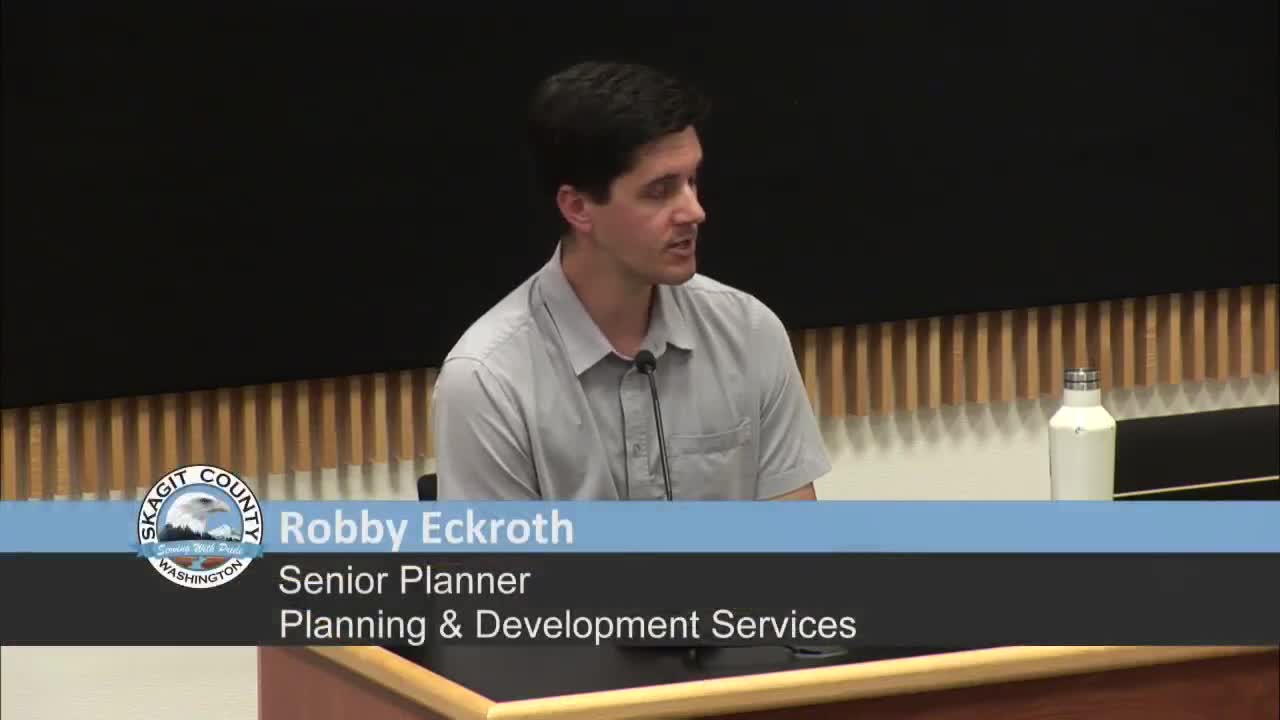
Robbie Eckroth of Planning and Development Services summarized the process to date and said the planning commission recommended the plan in April. Eckroth told the board the planning commission’s recommendation and associated materials were posted for public review and that the board could take possible action on June 23 at 11 a.m. He also said the county is still awaiting a planning commission recommendation on the critical areas ordinance and that critical areas will be considered separately.
Multiple speakers urged the board to allow more time for review and to strengthen environmental policies. Heather Spore, environmental policy manager for the Swinomish Indian Tribal Community, said the tribe is ‘‘very concerned about the direction of the draft comprehensive plan’’ and noted the county had not adequately addressed the tribe’s comments on salmon recovery and climate change. She asked the county to slow the process and ‘‘allow a minimum of an additional 30 days for the public to review the voluminous documents’’ and said the tribe remains uncertain how the comprehensive plan will align with the county’s revised Shoreline Master Program while that program is still under review by the Washington State Department of Ecology.
Mollie Doran, executive director of Skagit Land Trust, supported stronger language to reflect that nonprofit conservation partners can conserve and keep working lands in production. Doran urged policymakers to direct growth to urban areas, supported lowering a countywide rural growth allocation proposal from 20% to 10%, and endorsed policies that encourage voluntary conservation easements paired with transfer of development rights to reduce rural development pressure.
Other public commenters raised a range of environmental and process concerns: Ann Winkus proposed forming a county environmental advisory board to guide climate and environmental policy; Jan Edelstein and Ellen Bynum urged inclusion of specific Big Lake protections and basin‑level stormwater review; Kyle Loring of Evergreen Islands recommended preserving stronger wetlands language and limiting accessory dwelling units (ADUs) in rural areas to avoid increasing rural density; and Betty Carteret urged a specific implementation planning process for the new climate element.
Speakers repeatedly stressed the need for consistency between the comprehensive plan and other regulatory documents, including the shoreline master program, and asked the board to maintain the county’s higher‑standard language on wetlands and geologic hazards rather than shifting to weaker phrasing such as ‘‘no net loss.’’ Several commenters also asked that settlement language and special‑rule protections for areas such as Big Lake be carried forward into the updated plan and code.
Board members responded with procedural clarifications. Commissioners said the comprehensive plan is aspirational and policy‑setting, while code and development‑regulation changes provide enforcement mechanisms. County staff said comments received during the hearing would be posted and sent to the commissioners and that the record will remain open until 4:30 p.m. that day. The Planning Commission’s recommendation on the critical areas ordinance is expected after June 17; the board will hold a separate hearing on critical areas later this summer.
Robbie Eckroth and staff told the board they will post comments and materials on the project website and that the board may take possible action on the plan and development regulations on June 23. The county invited written comments by mail or email (pdscomments@co.skagit.wa.us) and emphasized that the public comment period for this hearing closed at 4:30 p.m. on June 16.