Get Full Government Meeting Transcripts, Videos, & Alerts Forever!
Get email alerts on the Election Transparency topic
No spam. Unsubscribe anytime.
Speakers at Davis County Conservatives meeting press for election-record transparency, cite withheld voter rolls and contested petition reviews
Summary
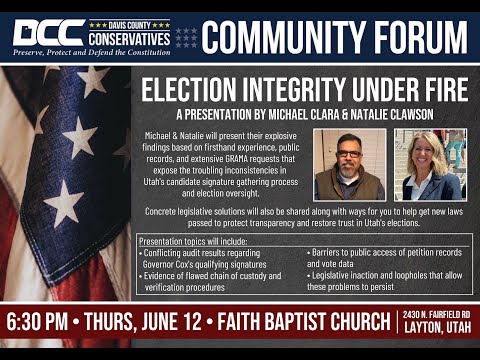
At a recent meeting of the Davis County Conservatives at Faith Baptist Church in Kaysville, candidates and investigators renewed calls for greater election transparency in Utah, describing what they said were problems with withheld voter records, the handling of nominating petitions and a write-in inducement that they say interfered with the GOP nominating process.
At a recent meeting of the Davis County Conservatives at Faith Baptist Church in Kaysville, candidates and investigators renewed calls for greater election transparency in Utah, describing what they said were problems with withheld voter records, the handling of nominating petitions and a write-in inducement that they say interfered with the GOP nominating process.
Natalie Clausen, the running mate of Phil Lyman and an attorney, told the group she and others are pursuing more transparency around voter rolls and petition packets. "We should be able to verify our elections," Clausen said, adding that the governor's contest last year "highlighted the problems with our elections" and that the group had asked the Public Interest Legal Foundation (PILF) to pursue a federal case over access to voter registration lists.
Clausen and former law-enforcement investigator Michael Clara said Utah's voter rolls include a large "withheld" category that limits public visibility and, they said, hampers verification. Clausen said the withheld category was expanded when previously public "private" registrations were moved into a withheld status in 2021 and that the withheld group now accounts for roughly 40% of the rolls; she described those entries as "ghost voters" in some precincts. Clausen cited the National Voter Registration Act (NVRA) as a federal standard she says supports more open voter-roll access.
Clara detailed document requests and audits he and others pursued. He described a patchwork of responses from the lieutenant governor’s office and county clerks when the campaigns sought to inspect nominating-petition packets. Clara said Davis County had become the central repository for statewide petition packets; he and others raised questions about whether the county and the lieutenant governor had signed formal contracts before handling and verifying packets and whether temporary employees who reviewed packets were trained and certified.
Both presenters described apparent discrepancies in signature-verification audits. They cited a state audit by the auditor's office that found a shortfall in validated signatures for one candidate and later legislative audit figures that reported differing counts for "spare" or extra signatures. Clausen and Clara said the inconsistent accounting makes independently verifying whether candidates met statutory thresholds difficult.
The meeting also focused on an alleged inducement involving a write-in candidate, Richard ("Rich") Lyman. Clausen and Clara described messages and witness accounts they said show a person filed as a write-in after being recruited and provided money and other incentives; they said the write-in was later removed from the ballot by stipulation after a court challenge but argued the incident sowed confusion among voters. Clara described a text he reviewed in which someone who became a write-in said "it's all been cleared" and that a campaign-backed account would ensure his paperwork was filed.
Clausen said attempts to get records from the lieutenant governor’s office were repeatedly delayed or denied, often on the ground that records were part of a law-enforcement inquiry handled by the attorney general’s office. She and Clara said that, in some instances, records later appeared to contradict that claim. Clara said he pursued records requests, state-records appeals and court filings to obtain material; he said the state’s records process is changing after legislation replaced the State Records Committee with an administrative law judge process.
Presenters pointed to specific local examples they said demonstrate the problem: Clausen cited a Salt Lake County analysis that, in their description, showed more votes cast in certain withheld categories than there were registered voters in those categories in some precincts. They said some precincts reported turnout percentages in the withheld group that exceeded 100 percent. Clara said that, based on his review of cover sheets and packets he obtained, thousands of signatures were collected and that differences in how clerks treated packet validation affected the counts available to auditors.
Both speakers urged delegates and attendees to press for legislative and administrative reforms. Clausen said organizers had recruited PILF to file a federal case over NVRA compliance to force public access to voter-roll data. Clara encouraged attendees to contact state senators who would confirm a records official and to follow hearings of the legislative oversight committee examining election and records practices.
Not all details presented at the meeting are reflected in publicly available final determinations: Clausen and Clara said several audits and investigations are ongoing or have produced differing numbers; some court actions they described ended with dismissals or stipulations. The presenters said they have not lost on the underlying merits in court filings when the merits were reached, but they described legal roadblocks and shifting explanations from officials that, they said, prevented timely public review before key deadlines.
The presenters named specific officials and agencies in their remarks: Deidre Henderson, Utah's lieutenant governor and chief elections officer; Spencer Cox, Utah’s governor and the incumbent in the 2024 governor’s race; Brian McKenzie, Davis County clerk; Christian Adams of the Public Interest Legal Foundation; and state auditors and legislators who have reviewed petitions and signature verification. The presenters blamed a combination of centralized petition handling, classification of voter registrations as "withheld," and inconsistent disclosure practices for limiting third-party verification.
Organizers told the meeting they will continue to press for records access, legislative changes and legal remedies. Clausen said the next step in the outreach was ongoing litigation overseen by PILF and additional appeals to legislative oversight panels. "We have to be able to trust our elections," she said.
Readers should note that the assertions summarized above reflect the presenters' accounts at the Davis County Conservatives meeting; several claims described incomplete audits, ongoing appeals and active investigations. Where presenters cited audits, court filings or criminal charges, those matters remain subject to official procedures and determinations by auditors, courts and prosecutors.
Ending: The Davis County Conservatives meeting concluded with organizers asking members to spread the group's materials and attend upcoming events; presenters urged continued public attention to records access and petition-handling practices while legal and administrative reviews continue.