
Audit committee presses for component-unit audits, plans meeting with state auditor after new TRT testing request
Get AI-powered insights, summaries, and transcripts
Subscribe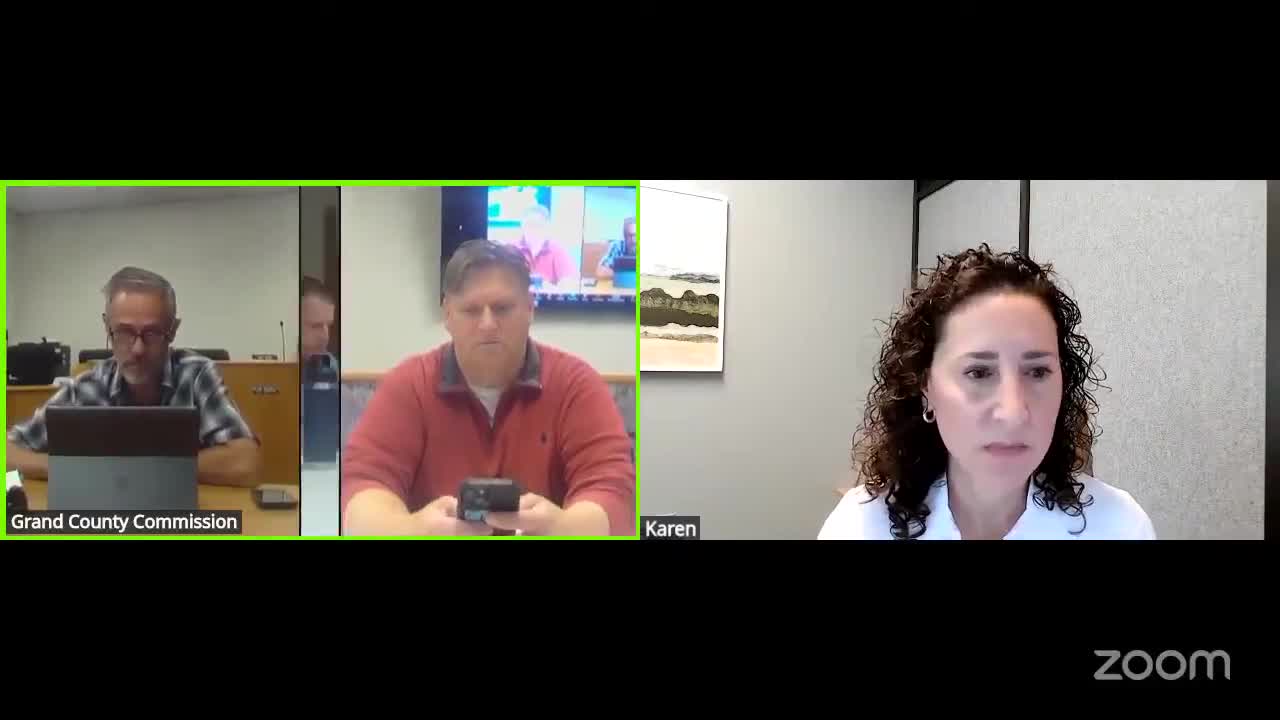
Summary
Grand CountyAudit Committee members discussed delayed component-unit audits, a new request from the state auditor to test Transient Room Tax (TRT) promotional spending, and next steps to avoid a qualified audit opinion. The committee approved minutes from June 4 and directed staff to convene component-unit leaders and the state auditor.
The Grand County Audit Committee met June 13 and focused on delayed audits for several county component units and a new state-auditor request to test how the county classifies and spends Transient Room Tax (TRT) revenues.
The committee, chaired by Grand County Commissioner Bill Winfield, opened the meeting by approving minutes from the June 4 meeting. Winfield then turned the discussion to outstanding component-unit financial statements and a request from the state auditor that auditors test TRT promotional expenditures for 2024.
Why it matters: county staff and the external auditor said missing component-unit audits could force Grand County to accept a qualified opinion on the county's 2024 financial statements if the missing pieces are material. A qualified opinion could complicate federal and state filings and affect external perceptions of the county's financial controls.
What the committee heard and discussed
- Missing component-unit statements: External auditor John Heirely and county staff reported the county still lacks audit or financial submissions from several component units. Committee members said the county has seven component units in total and that four were still outstanding during the meeting; the units named in discussion included Grand County Solid Waste Special Service District, the county EMS entity (Grand Canyon EMS), the county recreation district, and a Thompson-related special service entity. Moab Valley Fire was discussed as a non-component entity whose statements the county also needs for consolidation.
- Timeline and risks: Heirely told the committee that if the county receives all component-unit information on time, the county's financial statements can be issued with an unmodified (clean) opinion. If the county is missing information from one or more of the larger component units (the auditor cited EMS and solid waste as examples), the county may have to issue a qualified (modified) opinion. Heirely warned that reissuing corrected reports later is possible but cumbersome for federal submissions.
- Cost and procurement options: Committee members discussed options to improve timeliness, including incorporating component-unit audits into a single county-issued procurement (an RFQ/RFP) so one firm audits the county and its component units. Members suggested the county could pay part of component-unit audit fees to create an incentive for timely work. Heirely and committee members noted some component-unit audit contracts are small (estimates mentioned roughly $5,000 for some, $6,000'$10,000 for solid waste, and about $15,000'$20,000 for larger entities), and that such low fees may not attract sufficient audit staffing to finish on time.
- State auditor TRT testing request: The committee's external auditor said the state auditor (referred to in the meeting as "Seth") recently asked that auditors test TRT expenditures to ensure promotional spending is classified correctly. Heirely described the request as arriving late in the audit cycle and said the county should expect the audit to include a supplemental TRT report that ties back to the financial statements. Heirely said his office will test by sampling expenditures to determine whether those charged to promotion are allowable under the state's treatment of TRT, and that if the state auditor deems items unallowable the state auditor would issue any resulting finding. Heirely told the committee, "You're putting me in the middle," describing the difficulty of reconciling county practice and the state auditor's expectations.
- Response from a component-unit director: Andy Smith, director of Grand Canyon EMS, told the committee that his organization has "never been late" on state filing deadlines and that the current state-law audit deadline is June 30. Smith said his auditor had promised a June 1 completion but had outstanding grant documentation; he said EMS would provide its materials to county staff as soon as possible and offered to participate in any regional procurement but said he would not ask the county to pay EMS's audit fees.
Committee direction and next steps
- Convene a meeting with the state auditor: Committee members agreed to schedule an in-person meeting that includes county leadership and the state auditor to obtain clearer, statute-based guidance on TRT promotional vs. mitigation classifications. The attendees the committee listed for that meeting include Commissioner Bill Winfield, county staff (including Gabe and Mark Tanner), external auditor Heirely, and state auditor "Seth." Committee members emphasized they want a statutory standard rather than recurring interpretive disagreement.
- Collect outstanding component-unit financials: County staff were directed to continue pressing the remaining component units for their financial statements or, if audits are not complete, to provide trial-balance or financial-survey information sufficient for the county to determine materiality and finalize the county's statements.
- Consider procurement approach: Committee members discussed issuing a single RFQ/RFP for the county and component units (or an RFQ focused on qualifications rather than lowest cost), and the committee asked staff to draft language and convene district leaders to discuss whether the county should contract and subsidize part of component-unit audits to improve timeliness.
- Corrective accounting before issuance: Heirely recommended that, where it is appropriate and agreed, the county make corrective transfers (for example, paying back promotional accounts) before the financial statements are issued, which could reduce the likelihood of a finding being reported in the audit.
Other items
- Draft audit report schedule: The external auditor said a draft of the 2024 financial statements and management letter should be ready for internal review by Monday following the meeting. The audit committee requested time to read the draft internally before it is released publicly.
- Formal action taken: The committee approved minutes of the June 4 meeting by voice vote; the motion passed unanimously.
What was not decided
- The committee did not accept the 2024 audit report at this meeting and deferred formal acceptance until outstanding component-unit materials and the TRT testing outcome are resolved.
Next meeting and follow-up
Committee members asked county administration to set up: (1) a meeting with the named component-unit managers to discuss the missing financials and deadlines, and (2) the in-person meeting with the state auditor to seek statute-based clarity on TRT treatment. The committee asked staff to provide an updated status on all component-unit submissions within two weeks and to circulate the draft audit documents for internal committee review once available.