Get Full Government Meeting Transcripts, Videos, & Alerts Forever!
Get email alerts on the Carbon Capture Pipelines topic
No spam. Unsubscribe anytime.
Committee advances bill to let state set CO2-pipeline safety rules as federal process stalls
Summary
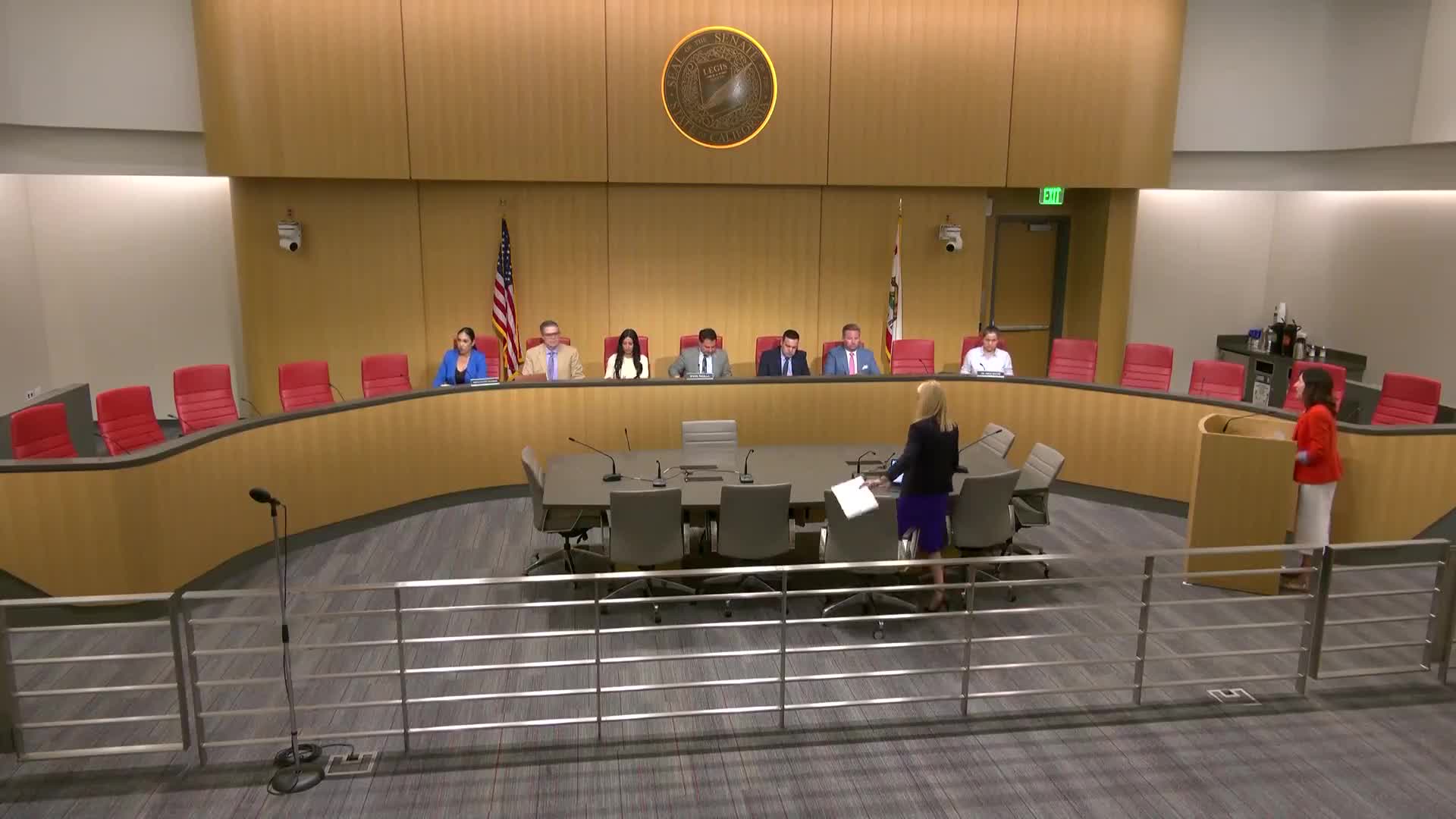
Assemblymember Petrie Norris, author of AB 881, told the Senate Committee on Governmental Organization that the bill would allow California to set its own safety standards for pipelines carrying captured carbon and lift a moratorium the state placed in 2022.
Assemblymember Petrie Norris, author of AB 881, told the Senate Committee on Governmental Organization that the bill would allow California to set its own safety standards for pipelines carrying captured carbon and lift a moratorium the state placed in 2022. “Carbon capture technologies are a necessary and important part of California’s strategy to achieve our climate goals,” Petrie Norris said.
AB 881 would direct the State Fire Marshal to use the Biden administration’s recently released draft federal safety guidelines as a starting point and to develop state regulations that would permit construction of CO2 pipelines subject to state safety requirements. Supporters say the move is necessary because the federal rulemaking was paused after the 2025 administration transition and that California risks losing federal funding windows if the moratorium remains in place.
The bill’s supporters included Laura Lewis, chief legal and government affairs officer for SMUD, who said carbon capture is needed to maintain reliable, affordable power while the state reaches high levels of zero-carbon generation. “To reach the remaining 10%, while still remaining reliable and affordable, we need emerging technologies such as carbon capture and storage,” Lewis said. She described a planned retrofit of a 550-megawatt Sutter natural gas plant near Yuba City, in which SMUD would be the offtaker; Lewis said the project would cut over 95% of the facility’s carbon emissions and help keep rates stable while the utility transitions.
Labor and industry witnesses also supported the bill. Scott Wych, speaking for the California State Pipe Trades Council, said the 2022 law (SB 905) created a permitting framework but included a moratorium on pipeline construction until the Pipeline and Hazardous Materials Safety Administration (PHMSA) finalized federal pipeline safety standards. “This window for carbon capture projects is…narrowing,” Wych said, noting a 10-year sunset in prior statutory language and a similar sunset on certain federal funding.
Opponents said the bill does not yet contain sufficient siting and safety protections for communities near pipelines. Maureen Lou of the Central California Environmental Justice Network warned that CO2 pipelines present different hazards than natural gas pipelines and called for additional safeguards for pipelines sited near population centers. “Leaks are more likely to lead to zipper‑like fractures which release substantial amounts of CO2…posing a cloud of CO2 that can travel through communities,” Lou said, adding that high concentrations of CO2 can create asphyxiation risks and can interfere with emergency response vehicles.
Committee members asked whether the State Fire Marshal’s work would be limited to adopting the federal draft as written. Petrie Norris said the bill intends the federal draft to be a starting point and that the State Fire Marshal would “build on those and ensure that we have regulations and safety standards that aren’t just the strongest in the nation, but are the strongest in the world.” She also said sponsors were continuing to work with community advocates on additional protections.
The committee moved AB 881 to the Senate Environmental Quality Committee. The roll call recorded in the hearing resulted in a committee tally of 14 yes, 0 no; the item was placed out of committee for further consideration in the legislative process.
AB 881 references California’s 2022 framework for carbon capture (SB 905) and relies on federal pipeline safety rulemaking (PHMSA). The bill’s sponsors and witnesses said the change is intended to preserve eligibility for forthcoming federal funds for carbon capture projects and to help California meet stated carbon removal goals of 20 million metric tons by 2030 and 100 million metric tons by 2045.
Next steps: AB 881 will proceed to the Senate Environmental Quality Committee for further hearings and possible amendments.