Get Full Government Meeting Transcripts, Videos, & Alerts Forever!
Get email alerts on the Mass Graves Investigation topic
No spam. Unsubscribe anytime.
Residents and descendants urge Tulsa City Council to fund mass-graves investigation; $1 million request part of FY2026 budget public hearing
Summary
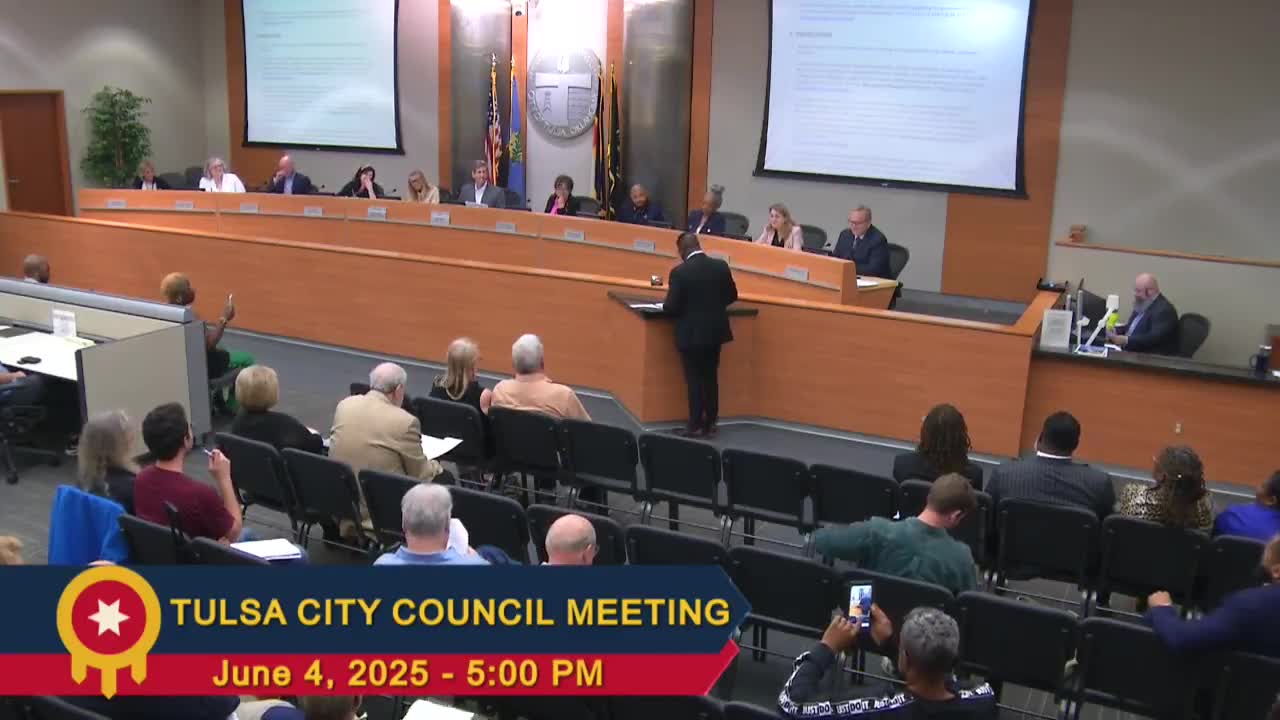
Dozens of Tulsa residents and community leaders told the City Council during a June 3 public hearing that the city should provide $1,000,000 requested by Mayor Monroe Nichols to continue an investigation into mass graves tied to the 1921 Tulsa Race Massacre.
Dozens of Tulsa residents and community leaders told the City Council during a June 3 public hearing that the city should provide $1,000,000 requested by Mayor Monroe Nichols to continue an investigation into mass graves tied to the 1921 Tulsa Race Massacre.
The public hearing on the proposed City of Tulsa fiscal year 2026 budget drew 13 speakers on the topic. Donald Rose Jr., director of operations for the Black Wall Street Chamber of Commerce and a commissioner on the Greater Tulsa African American Affairs Commission, told the council: "the chamber's full and unwavering support for the for mayor Nichols' proposal to allocate $1,000,000 to continue the mass graves inspect investigation." He noted that one identified remain was a World War I veteran, C.L. Daniel.
Why it matters: speakers said the investigation is about identification, dignity and closure for descendants and survivors’ families. Many framed the work as a moral obligation, saying the city has a responsibility to identify victims, notify families and provide proper burials.
Kuma Roberts, president of the Black Wall Street Chamber, described the Greenwood Trust reparations proposal and said the funding request was part of a broader effort to restore economic and historic justice. "The Greenwood Trust is the final opportunity for our community to liberate itself from generations of theft and disinvestment," she said. Roberts advocated funding the mayor's proposal and related reparations planning.
Historians and local guides also spoke. Cody Ransom, a Greenwood historian and tour guide, told the council people travel to Tulsa to learn the full history and that failing to finish the investigation would leave an incomplete record. "We can't just benefit from the story and not actually finish the story," he said.
Several speakers detailed institutional and procedural concerns about past investigations. Christy Williams, chair of the Beyond Apology Commission and a former member of the mass-graves oversight committee, said the original oversight committee lost power and became the "out of sight" committee. She urged the council to treat identification work as "sacred work" and said the search "is gonna go on until it's done."
Dr. Alicia Odewale, an archaeologist and descendant who said she served on multiple oversight teams, asked the council both to approve the funding and to reinstate the oversight committee's original authority, and to create transparent liaisons across teams performing physical investigations. She said her research and that of colleagues had identified more than two sites of interest; "there are at least 36 that we have accounted for," she said, describing the scale of remaining work.
Clergy and community leaders framed the request as a moral imperative. Reverend Keith Mays Sr., pastor of Vernon AME Church and a member of the Beyond Apology Commission, praised Mayor Nichols for releasing previously secret documents and for reviving oversight structures. "This is a Tulsa truth issue, a moral mandate, a human obligation," Mays said.
Supporters also cited ancillary benefits. Nate Morris noted the city obtained an Emmett Till genealogy grant connected to the mass-graves work and said that genealogy tools have helped cold-case work and family reconnection. Several speakers described the emotional impact of identifications already made, including the naming of C.L. Daniel.
What the council has before it: the testimony occurred during the budget public hearing; the transcript records the public comments and the mayor's request but does not show a final council vote on the $1,000,000 allocation during the televised meeting. Several speakers urged continued funding year-to-year "until the work is done," but no formal appropriation or amendment of the FY2026 budget is recorded in the meeting minutes available in the transcript.
Context and history: speakers repeatedly referenced the 1921 Tulsa Race Massacre, the city's previous centennial and investigative efforts, and the release of city documents in recent years. Critics and supporters alike described earlier oversight changes, reinterment controversies and the unresolved nature of many sites. Speakers said some remains were reinterred without notification to the public oversight committee and reported children were among remains previously handled by investigators.
What supporters asked next: speakers asked the council to fund the $1,000,000 request, restore or strengthen oversight and transparency for physical investigations, and ensure families are notified and involved. Several speakers said the work should continue until all victims are identified and properly interred.
The mayor was not present to give a report during the televised portion of the meeting. The council received the public testimony and continued with other agenda business that evening.