Get Full Government Meeting Transcripts, Videos, & Alerts Forever!
Get email alerts on the Children Youth Families topic
No spam. Unsubscribe anytime.
Mayor’s Office outlines Office of Children, Youth and Families; councilors press for budget clarity
Summary
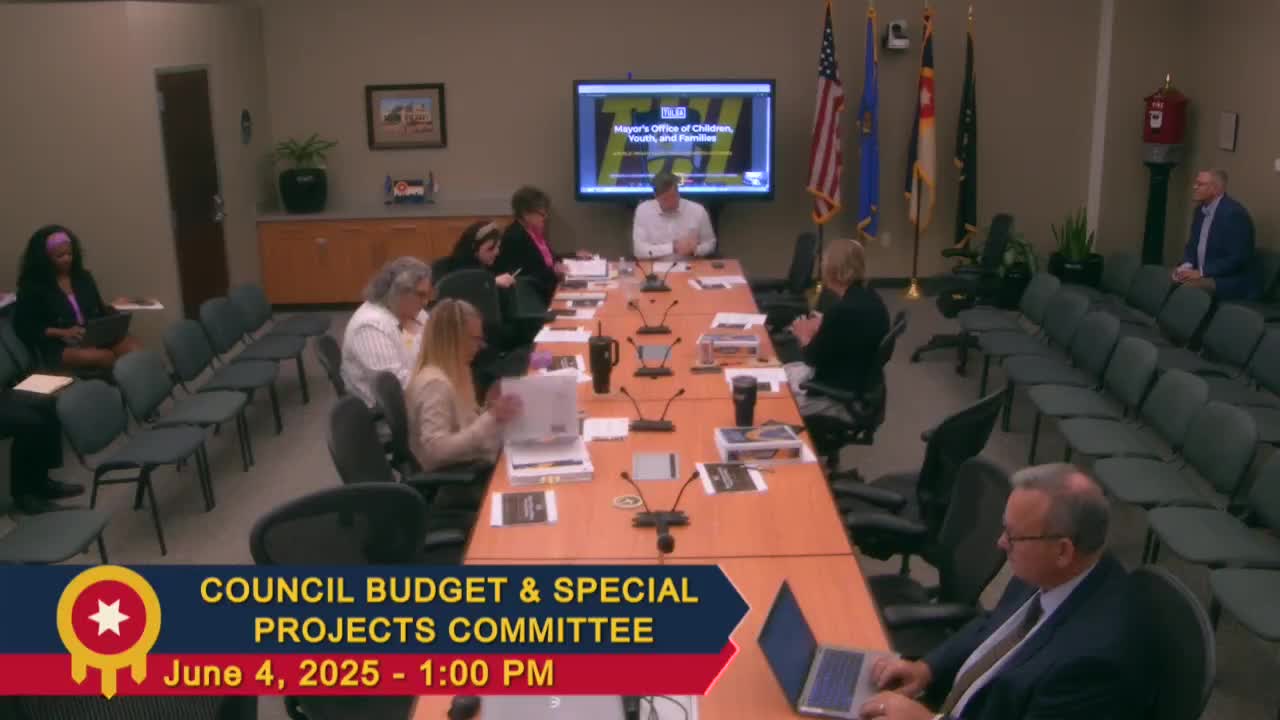
Deputy Mayor Crystal Reyes and Ashley Wilton, executive director of Impact Tulsa, presented the proposed Office of Children, Youth and Families to the Tulsa City Council, describing a cradle-to-career strategy that the city and nonprofit partners say will coordinate early learning, literacy, stability services and summer safety work.
Deputy Mayor Crystal Reyes and Ashley Wilton, executive director of Impact Tulsa, presented the proposed Office of Children, Youth and Families to the Tulsa City Council, describing a cradle-to-career strategy that the city and nonprofit partners say will coordinate early learning, literacy, stability services and summer safety work.
The presentation said the office will operate as a partnership with Impact Tulsa supplying operational staff and national technical assistance. Reyes said the office will convene a children’s cabinet of city departments, tribal nations, philanthropy and service providers to build a fiscal map showing where public and private dollars for youth services are spent.
The city’s stated goals include increasing pre-K enrollment in high-need ZIP codes, improving third-grade reading and middle-grade math outcomes, reducing chronic absenteeism linked to eviction, and creating more streamlined citywide internship and postsecondary pathways. The presentation referenced a target that Mayor Nichols has discussed — “15,000 additional young people on a path to economic mobility” — and said cabinet work will produce policy recommendations and a logic model for council review.
Councilors pressed staff on the budget ask and how the office will be paid. One councilor asked whether the mayor’s general fund request to establish the office was $250,000; Reyes and Impact Tulsa staff responded that a full-year cost figure was “2.75” as stated in the meeting and that they expect to pursue outside grants and philanthropy to supplement city funds. Councilors repeatedly asked for a clearer breakdown of what the city would pay, what Impact Tulsa already provides, and what external dollars and in-kind assistance are committed.
Wilton said Impact Tulsa brings data capacity and national partnerships to the work and highlighted several initiatives under way or planned in early months of the office’s launch: an eviction-alert pilot tied to school attendance data (expansion to additional districts was described as costing “roughly about $7,000 per district” in the presentation), an early-warning literacy tool, a Read Around the 918 literacy campaign with Tulsa City-County Library, and efforts to connect students to paid internships across city departments. She also named national technical partners and supports the office has attracted, including a FUSE fellow for postsecondary pathways, StriveTogether technical assistance and a $75,000 StriveTogether convening grant, Bloomberg interest in 0–3 supports, and enrollment in a Harvard Ed Redesign Success Planning Institute.
Councilors raised several recurring concerns: whether the city should fund a new office at this time while other core services face tight budgets; how much of the startup and ongoing cost can be offset by philanthropy or federal grants; and whether the office’s convening role will translate quickly into concrete, council-ready policy changes. Several councilors asked for a one-sheet or flowchart showing (a) what Impact Tulsa is already accomplishing, (b) what the office would add, and (c) the dollar value of committed external support versus the proposed city contribution.
Reyes and Wilton said the office will produce a fiscal map and a cabinet-driven policy agenda over the summer; they offered to provide a more detailed logic model and to circulate the cabinet’s policy-development timeline to council staff by the end of the week.
Councilors did not vote on the item during the session; questions and follow-ups were left for upcoming small-budget committee meetings and for subsequent council budget consideration.