Get Full Government Meeting Transcripts, Videos, & Alerts Forever!
Get email alerts on the State Audit Oversight topic
No spam. Unsubscribe anytime.
Committee advances plan request to study moving public funds audit functions to legislature after heated testimony
Summary
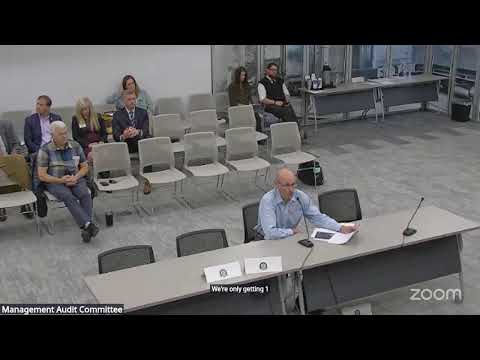
The Management Audit Committee approved a bill draft directing a reorganization plan to transfer the Department of Audit’s public funds division to the legislature for further consideration. Department of Audit officials warned of workload and independence concerns; public and municipal representatives split on the proposal.
The Management Audit Committee voted to advance a bill draft asking for a reorganization plan to transfer the Department of Audit’s public funds division (including the state’s local-government census and other administrative audit functions) to the legislative branch or to create a separate legislative audit office.
LSO attorney Josh Anderson and staff presented the working draft (26 LSO-0165) and described it as a statutory mechanism that would direct the Department of Audit and the Legislative Service Office directors to jointly prepare a type-2 reorganization plan for submission to the governor, management council and this committee by July 1, 2026, with implementation targeted by July 1, 2027.
Department of Audit Director Justin Chavis testified at length about what the public funds division does and the operational implications of a transfer. He described core administrative functions handled by the division — receiving and reviewing preliminary and final budgets for special districts, collecting census financial reports from roughly 900 local government entities, producing the statutorily required cost-to-government report, approving and tracking public-officer training and managing the statewide financial-statement audits and federally required single audits. Chavis said those administrative duties combined with required audits consume substantial staff time: he estimated the census effort alone requires roughly 4,500–5,000 hours annually and said the public-funds unit has roughly 17 FTEs; the department in total currently has about 103 positions.
Chavis also raised an independence concern: the Department of Audit audits data that feed the state school-funding model and he argued that auditing that model from inside the executive branch currently offers more independence than moving the same responsibility to the legislature, which controls the model’s content.
Committee members pressed department staff for operational details (FTE counts, audit selection process, training administration and how audits are prioritized). Director Chavis and public funds staff described a risk-based selection framework, a legal review process involving LSO and management council, and the limits the department faces in following up on audits because of staffing constraints. Chavis and his staff said many local entities (towns and special districts) are not required to have annual audits, which leaves the state audit office as one of the only independent reviewers for many smaller entities.
Public comment included representatives of Wyoming Association of Municipalities, the Wyoming Association of Rural Water Systems and individual citizens. Ashley Harpreet of the Wyoming Association of Municipalities described a municipal finance division the association is standing up to assist small towns that lack financial expertise. Mark Pepper (Wyoming Association of Rural Water Systems) and Ross Shrickman (citizen and former field auditor) urged stronger, regular audits of local entities and suggested alternatives such as consolidating accounting functions or requiring more independent third-party reviews. Kevin Lewis (Laramie County) recommended the legislature take a stronger audit role and noted the legislature has constitutional authority tied to audit oversight.
Committee debate reflected split views. Representative Sherwood said the proposal is too large and that the committee’s interim topic (evaluation of executive-branch programs) should continue before a reorganization; she opposed advancing a far-reaching reorganization at this stage. Several other committee members, including Vice Chairman Larson and Representative Lean, argued the legislature has an obligation to increase audit capacity and oversight, and moved the draft forward.
The committee adopted a motion to forward bill draft 26 LSO-0165. The roll-call vote recorded: Senator Dockstader — Aye; Senator I. — Aye; Senator McEwen — Excused; Senator Olson — (vote recorded as present earlier); Senator Rothfuss — Excused; Representative Lean — Aye; Representative Block — Aye; Representative Rodriguez Williams — Aye; Representative Sherwood — No; Vice Chairman Larson — Aye; Chairman Knapp — Aye. The clerk recorded eight ayes, one no and two excused.
The draft requires a plan that would (1) maintain operations of the Department of Audit’s other divisions, (2) recommend structure and statute changes for a legislative audit office or similar entity and (3) provide for transfer of personnel, supplies, records and equipment to a newly created office if the plan is approved by the legislature. LSO staff noted personnel classification issues (some public-funds employees are classified by state personnel rules), potential separation-of-powers legal questions and the need for a public fiscal impact analysis as part of any reorganization plan.
Ending note: the committee voted to request and consider the reorganization plan; next steps include receiving the joint plan by the July 1, 2026 deadline and management council review in the interim period.