Get Full Government Meeting Transcripts, Videos, & Alerts Forever!
Get email alerts on the Administrative Rulemaking topic
No spam. Unsubscribe anytime.
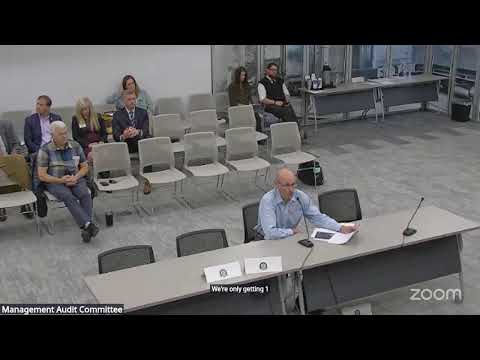
Management Audit Committee advances LSO draft to implement Senate File 127 with changes to major-rule review
Summary
The Management Audit Committee advanced an LSO bill draft to implement Senate File 127’s major-rule review process, endorsing a definition that excludes emergency rules and sets a $200,000 annual economic threshold; the committee debated whether rules required to comply with federal law should be exempt and defeated amendments to change that text.
The Management Audit Committee voted to advance a Legislative Service Office (LSO) bill draft implementing Senate File 127 and the new major-rule regulatory-impact review process.
LSO administrator Matt Petri told the committee that Senate File 127 "gives the legislature more oversight over administrative rulemaking by executive branch agencies" and that the draft under consideration largely reflects the July version with one staff comment for the committee to consider: excluding rules required to comply with federal law from the definition of a major rule.
The draft the committee advanced (Veil draft, 26 LSO-01106) removes emergency rules from the definition of a major rule and sets a clarified economic threshold of $200,000 per year (the committee previously discussed $1,000,000 over five years). LSO attorney Josh Anderson explained the mechanics: the bill would require agencies to identify, at notice of adoption, rules that meet the major-rule definition and supply the information needed for LSO’s regulatory impact analysis; it would also direct the Secretary of State to revise rule-submission forms so agencies provide the new information.
Committee debate focused on two recurring points: (1) whether rules that are adopted only to comply with federal law should be exempt from the additional economic analysis, and (2) whether the dollar threshold for a "major" rule is set at an appropriate level. Representative Lee and public commenter Joey Curenti asked whether excluding federal-law-driven rule changes could let the federal government effect state policy changes that have local consequences; Anderson and Petri replied that LSO’s legal review and management-council process would remain in place and that the staff comment would remove only LSO’s additional economic analysis for those rules, not legal review or the governor’s approval.
Representative Sherwood proposed an amendment to raise the threshold from $200,000 per year to $500,000; that amendment passed a motion and was seconded for consideration but failed on a roll-call vote. A separate motion to adopt the staff comment to exclude federal-law-required rules received no second and died.
The committee then approved forwarding the Veil draft (26 LSO-01106) by roll-call vote. The tally recorded on the transcript was: Senator Dockstader — Aye; Senator I. — Aye; Senator McEwen — Excused; Senator Olson — Aye; Senator Rothfuss — Excused; Representative Veil — Aye; Representative Locke — Aye; Representative Rodriguez Williams — Aye; Representative Sherwood — No; Vice Chairman Larson — Aye; Chairman Knapp — Aye. Committee staff said the bill will take effect in time to inform implementation activity ahead of the statute’s effective date.
Public comment at the hearing included testimony from Joey Curenti of Wyoming Matters, who objected to wording that would categorically exempt rules required by federal law and urged caution about the state ceding oversight in practice.
The approved draft keeps in place the existing legal review and management-council checks described by LSO staff while adding the regulatory impact analysis requirement for rules that meet the major-rule definition. Committee members and staff discussed practical timing issues — for example, how rulemaking tied to session-passed legislation (often effective July 1) typically relies on emergency rules with later permanent rulemaking, and how adding regulatory impact analysis can affect that timeline. LSO staff said they will include draft agency intake forms and guidance in their December report to management council and that agencies would be given forms to identify whether proposed rules are major rules when they begin the promulgation process.
What the committee decided: the draft implementing the new review process will move forward with the definition changes the committee considered, and LSO will prepare forms and a brief report for management council describing implementation steps and the new agency submission requirements.
Ending note: committee members repeatedly emphasized that the bill does not remove the governor’s final rule-approval authority or LSO’s legal review; it layers an economic-impact review onto a subset of rulemaking that the draft defines as "major."